Categories
Uncategorized

Grace’s Summer Getaway in Michigan: The Mystery of Grass Lake

From: Grace, To: Unclear. Date: 1920-1940

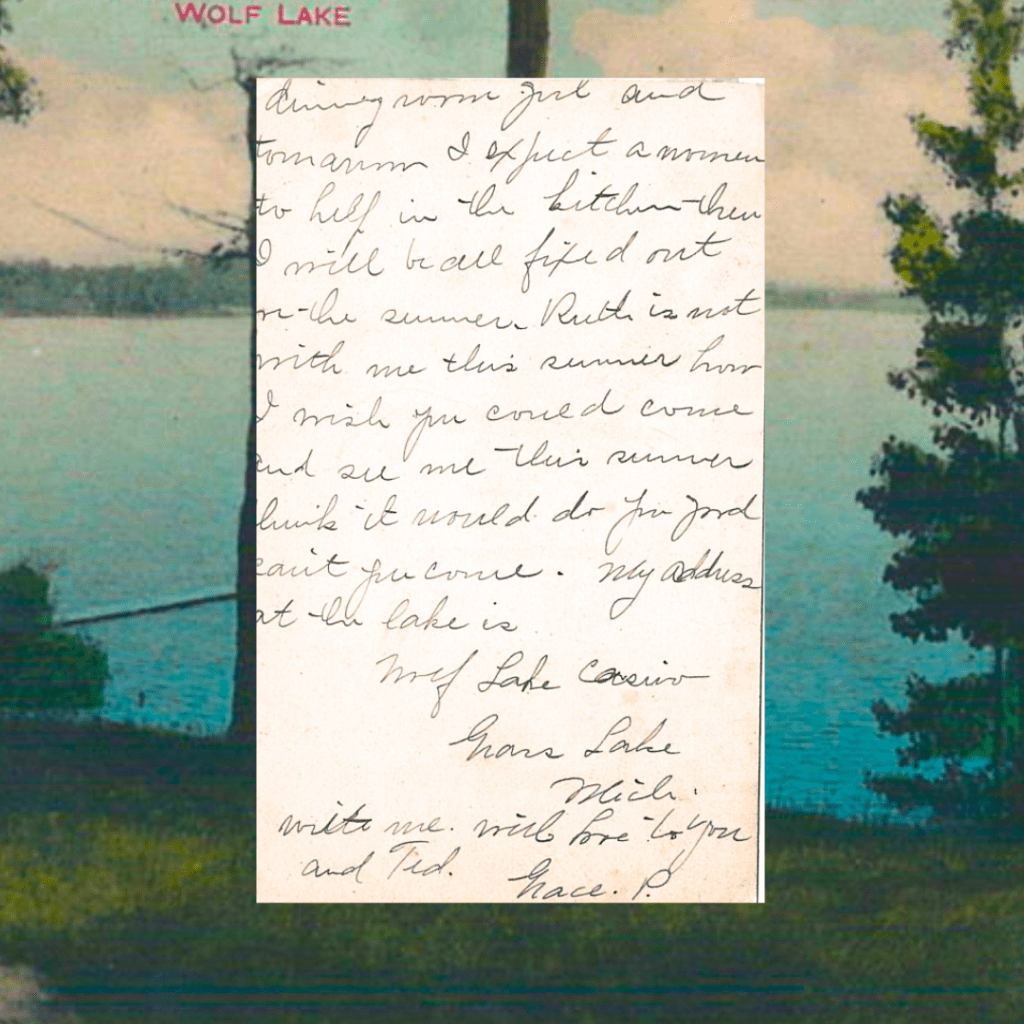
…dining room girl and tomorrow I expect a woman to help in the kitchen, then I will have fixed out for the summer. Ruth is not with me this summer. How. wish you could come and see me this summer. I think it would do you good. Can’t you come? My address at the lake is:

My Lake Cousin

Grass Lake

Michigan

Write me. With love to you and Ted.

Grace P

The village of Grass Lake is a small community nestled in the mid-west corner of Michigan. As of 2020, just over 1000 people lived in the village. In the early 1900’s, the main industries would have centered around the railroad, as well as the lake. Possibly tourism as well.

Unfortunately, I can only guess as to the origins of this postcard. It’s got no divided back, which would date it prior to 1907. However, it also doesn’t have a “Post Card” or “Private Mailing Card” stamped anywhere. While the cursive on the card is beautiful, it’s not the sweeping loops we’d see on a postcard from 1900-1905.

There are a few other clues as well. The somewhat laid back and conversational tone (“it would do you good”, “can’t you come”) of the card indicates to me that it wasn’t written during he first decade of the 20th century. Grace also mentions that she’s “fixed out for the summer”, which tells me it’s an extended vacation. My gut tells me this was written somewhere in the decade of the 1920’s, although I suppose it could have been anywhere between 1920-1940.

Who was Grace? Without a postmark, date, or even last name, I couldn’t research her, or her cousins. But, I have a few guesses.

My primary guess is that this is a young(ish) wife who’s family is at the cabin for the summer. Grass Lake is close enough to larger cities that it’s feasible Grace stayed at the cottage while her husband traveled back and forth for work. With her husband gone, she’d want another adult as company — hence the card sent to her cousin.

My other thought is a teenager. However, it seems unlikely that a teen would say “I expect a woman to help in the kitchen”. She’d probably say “Mama expects a woman to…”. So, while I guess it’s possible, I don’t think that this card was from a teen.

Poor Grace. I hope she found company in her loneliness. I sure wish I had the other part of her letter.

Painted image of Wolf Lake, Michigan
Categories
Education family History Photographs Postcards Teaching Vintage writing

Lloyd Hublers 1911 Postcard: A Valentines Day Prank?

From: Unknown To: Lloyd Hubbler, 1911

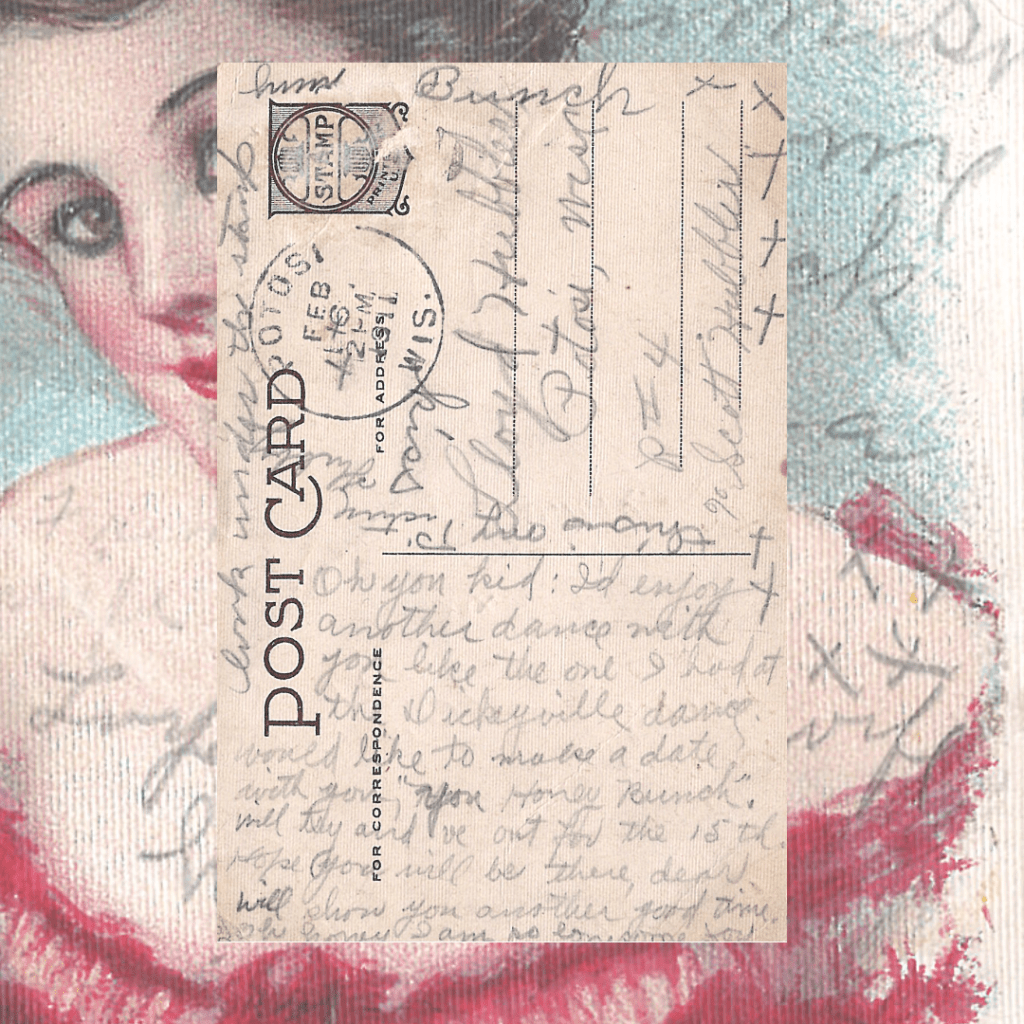
Oh you kid: I’d enjoy another dance with you like the one I had at the Dickeyville dance. Would like to make a date with you, “You Honey Bunch”. Will try and be out for the 15th. Hope you will be there, dear. Will show you another good time. Oh honey I am so lonesome. From – you know who.

(flipped) Look under the stamp honey bunch. xxxxxxx

This is my picture honey.

(On front) I am ready xxx. From your sweet little wife. S.W.A.K

God am so home sick for a x x

Lloyds sweet wife ha ha

I can’t express to you how much I am obsessed with this card. Every inch of it is filled with writing. X’s dot the landscape of both the front and the back and someone added additional rouging and eyeliner to the image on the front. This postcard SCREAMS of some sort of joke, and I am absolutely here for it. So, let’s drop the card into history.

1911 sees the disaster of the Triangle Shirtwaist Factory in New York, the invention of Crisco, and the founding of the first movie studio. However, I have to wonder if the news of these events hit the small village of Potosi. Situated in the southwest corner of Wisconsin, modern day Potosi boasts a population of just over 600 people. Like many small towns, it was originally founded as a mining and farming village. Now, it hosts an annual catfish festival and fish fry the second weekend of August.

In 1911, Lloyd Hubler was a few months shy of his 20th birthday, and at least according to Family Search, still unmarried. He had one brother, who was 8 years his senior. Although the card puts Lloyd’s last name as “Hubbler”, I’m pretty sure it was “Hubler”. The Lloyd I found has a father named “William Scott”, but he’s listed as Scott W. in the census records. Seeing as the card was sent “c/o Scott Hubbler”, and the Hubler’s lived in Harrison County (where Potosi is located), I’m fairly certain I have the right man.

But birth days, death days, draft registrations, and the marriage index provide only the barest amount of context for a life. Who sent this card to Lloyd? Why? There are a few clues that we can use to point us in the right direction. Or at least to make some fun and semi-guesses.

First, the card was sent on February 16, two days after Valentines Day. My mind immediately goes to two scenarios. First, maybe there was a Valentines Dance for the surrounding area. Here, Lloyd met a girl and made the gravest mistake: he told his friends about her. Looking to pull a prank, they put together this card and sent it to him, care of his FATHER for added embarrassment.

Second, Lloyd’s older brother was 28 at the time. It’s possible he sent the card as a practical joke, but why would he misspell the name? While I think it’s possible he had something to do with the card, I doubt it was entirely done by the brother.

So, poor Lloyd had to deal with the embarrassment of being sent this provocative card. Because it was a postcard, everything could be seen by everyone. Not only could his father see and read it…but so could the postman, the postal workers…you get the idea. What did poor Lloyd do to deserve this humiliation? We will never know.

Lloyd did end up finding his “sweet” wife. In 1918, he married Leora Hinman. They went on to have three children. She outlived her husband by a decade, but I hope that their life together was S.W.A.K.

Categories
Education History Photographs Postcards Teaching Vintage Writing Prompt

A Timeless Bond: Uncovering Sylvia and Ethel’s Correspondence

From: Sylvia To: Miss Ethel Maurey. (1906-1910)

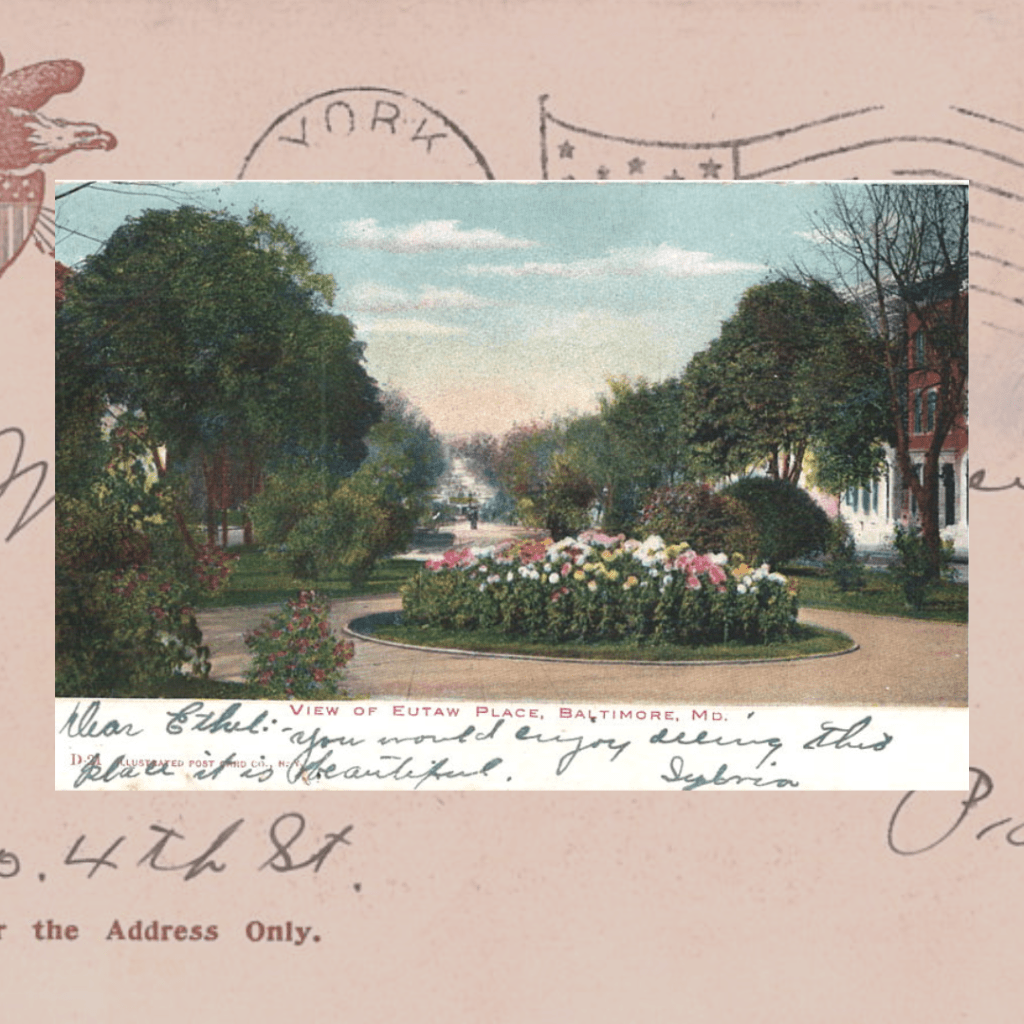
Dear Ethel,

You would enjoy seeing this place it is beautiful.

Sylvia

For the very few of you who are avid followers of my blog, you’ll notice something right off the bat about this postcard. If you’ve recently started following me, fret not sweet friend because you’re about to learn something that *may* help you win a random trivia night.

For those of you who don’t already know, the unique thing about this postcard is that the text is written on the front. Therefore we know that this is part of the “Post Card Period”. Simply put, the period between 1901 and 1907 where it was prohibited to write anything other than an address on the back of the postcard.

Although the postmark date is unreadable, my estimate is that the postcard was written somewhere between 1905-1910. Yes, I’m dating it after the divided back period began, because as we’ve seen before, just because you could write on the back of postcards beginning in 1907, didn’t mean everyone did.

Despite the short message, it truly is a lovely postcard. That’s likely one of the reasons Ethel kept it, and why it’s survived for over a hundred years. The soft glow of the sunset (or sunrise) in the background mingles with the bright cheeriness of the flower arrangements. I love the thought of the postcard itself exchanging hands time and time again, all of us agreeing with the sentiment of the sender.

But who was Ethel Maurey? And who was Sylvia? Well, it turns out I found both of them!

Ethel was born in Sunbury, PA in May of 1892 to Henry and Emma Fritz Sanders Maurey. That would put her anywhere between 9 and 15 during 1901-1907. Based on her obituary, Ethel led a life of great service, raised two sons (though one predeceased her) and was married for 56 years to Jesse Lloyd. Obituaries are difficult, because there’s so much left unsaid. We can’t know the day to day of her life. But we do know she lived through two major wars, could cast her first vote at the age of 28 (!!) and witnessed the assassination of JFK, the Civil Rights Movement, and the first man walk on the moon. Interesting indeed.

And what of Sylvia? Well, if my gut is right, Sylvia is actually Sylvania Maurey, Ethel’s sister. Sylvania was born in 1880, which made her 12 when Ethel was born. Why was Sylvia in Maryland visiting Eutaw Park? I’m not sure. The area still exists as an architectural district that housed many important residents at the turn of the 20th century. Was Sylvia visiting a friend? A college? Was she simply on a trip? Unfortunately the postcard doesn’t tell us.

However, it stands as a testament to the bond of the two sisters. Despite their age gap, Sylvia took time out of her trip to send a quick, and stunning, postcard to Ethel. Because of her bond with Sylvia, Ethel kept the card likely until the day she died. It took another 50+ years to make it into my hands. Which, frankly I find miraculous and serendipitous. It’s as though Ethel and Sylvia wanted me to share their bond with you, my dear readers. So, as you go about your day, think of Ethel and Sylvia, and reach out to your sibling, or best friend, or parents. I think they’d be glad you did.

Back of Postcard with Ethel’s address

Categories
Education History Photographs Postcards Vintage writing

Teenage Flirtation in 1908, A Call to War, and The Mystery Sender A.N.

Mr. Earl Poush, 1908

Hello Earl,

I received your card and was glad to hear from you. I went to the party Saturday night and had a nice time. Vera and I went over to Dallas Sunday afternoon and staid till church at night. Maybe you think we didn’t have time. Well I didn’t have to ask Bertha who the card was from. Did you go to town Saturday. I will have to close for this time.

Answer Soon

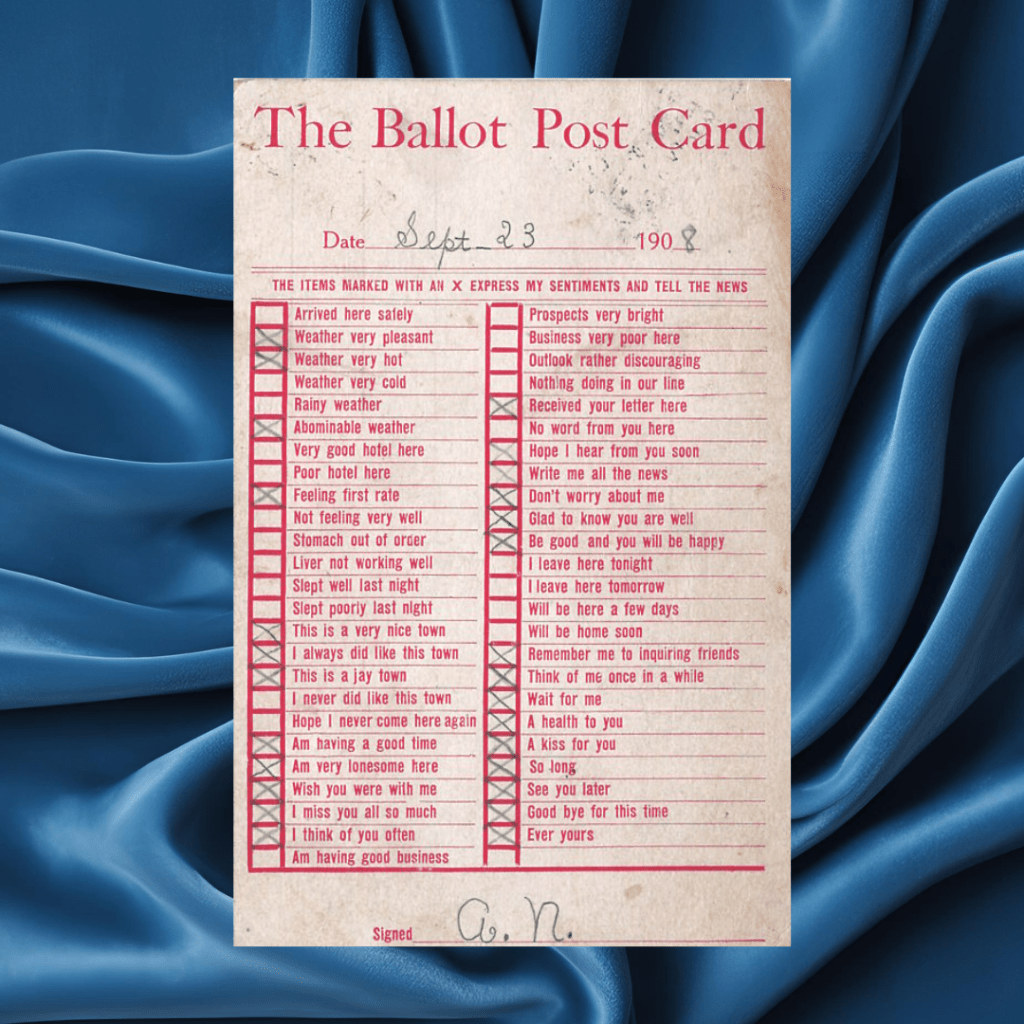
The front of this postcard is just as informative as the back, so rather than post it at the end, I wanted to post it here. Take a gander, then read on:

The Ballot Post Card: September 23, 1908

1908 was a leap year, and saw a variety of notable events that live on within the American zeitgeist. Wilbur Wright completed a 2 1/2 hour flight, Henry Ford debuted his Model T, and the Chicago Cubs won the world series.

But all of that, perhaps, pales in comparison to the light flirtation of teenagers. Again, we have a bit of a mystery sender. There’s no way for me to ascertain who “A.N.” was, or what (I assume her) relationship was to Earl, but I think it’s rather clear that the two of them may have been sweet on each other. Especially since Miss “A.N” checked off “I think of you often”, “Wait for me”, “A kiss for you”, and “Ever yours.”

Additionally, I’m guessing that when “A.N.” says “I didn’t have to ask Bertha who the card was from”, she means she knew the card she received was from Earl before even seeing it. I love that A.N seems to be surrounded by some girl friends, and I wonder if Vera, Bertha, and A.N. were on a little girls trip together.

Although I couldn’t find the identity of A.N., I do believe I found a little bit about Mr. Earl Poush. If I’m correct, it appears that he was born in 1892, which would put him at the tender age of 17 in September of 1908 — the perfect time for an early flirtation. It seems that he fought as a Corporal in World War I, and was injured in 1918. In 1919, he married Hope Lita Hicks (Poush) — not our elusive A.N. The world both teens grew up in must have been very different from the one they sent innocent cards in during the waning summer of 1908.

Categories
Education History Photographs Postcards Vintage

Pauline Howard’s 1936 Postcard to Miss Lois Wright: A Snapshot of Life Amid the Great Depression

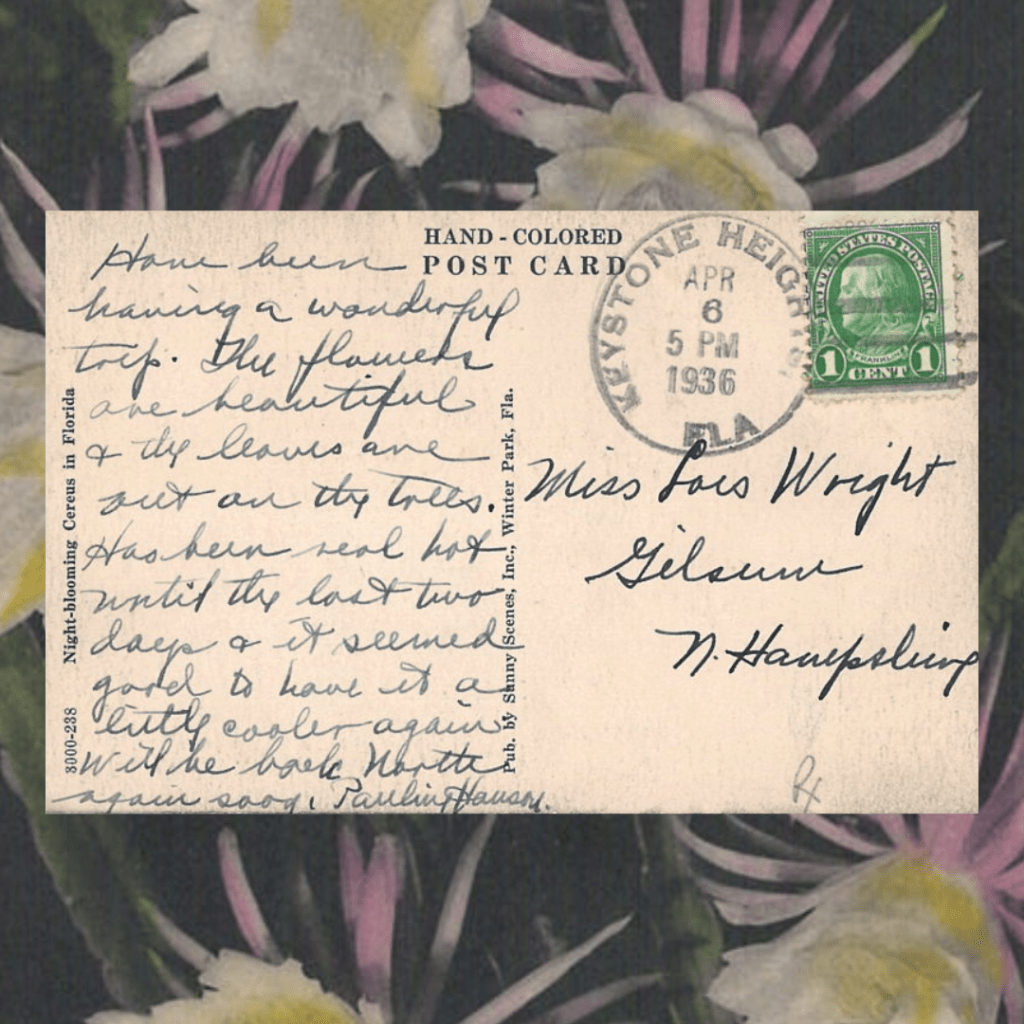
Postcard to Miss Lois Wright, 1936

Have been having a wonderful trip. The flowers are beautiufl and the leaves are out on the trees. Has been real hot until the last two days and it seemed good to have it a little cooler again. Will be back North again soon.

— Pauline Howard

First, the context. In 1936 the country was deep into the Great Depression, though the worst hard times were getting slightly better. Black Sunday, the worst storm from the American Dust Bowl, had happened a year prior, on April 14, 1935. By 1936 FDR was elected for a second term, created the Works Progress Administration (WPA) and brought unemployment to 16.9%, down from 20% of the year before. Dorothea Lange also shot her iconic image of “Migrant Mother” in March. So, even if you don’t know a lot about the 30’s, these things probably sound familiar as they exist in the American zeitgeist.

Because the Great Depression exists in our mind as a sort of dark age of American society, it’s difficult to imagine people living their lives outside of hardship. Our minds immediately go to migrants, joblessness, and perhaps even the Grapes of Wrath or Of Mice and Men.

Yes, people were desperate, and yes, these were difficult times. However, the postcard from Pauline to Lois shows that, once again, people were resilient and living the best they knew how. Now, I don’t know how old Pauline and Lois were (though from the moniker “miss” for Lois, I can assume early 20’s), but what’s clear is that despite the country’s turmoil, there was some fun to be had.

Keystone Heights seems as though it was a semi-popular wintering spot which also received assistance from FDR’s alphabet program the Civilian Conservation Corps. April was, perhaps, a tenuous time to visit, as Florida heat in April can get oppressive (indicated in the message of the postcard). But, the country was in for a worse heat wave beginning in June, so hopefully Pauline managed to make her way North before then.

I wonder what the connection between the two women were. Perhaps school friends or room mates? Women are difficult to research since I’m behind a variety of paywalls, and unfortunately I’m not confident I was able to find the correct people. However, there was a Lois Wright who lived in New Hampshire and, despite marriage, did not change her last name (it seems). She lived to be 104, and fits the timeline. Though, of course I can’t guarantee this is our Lois, I’d like to believe it could be.

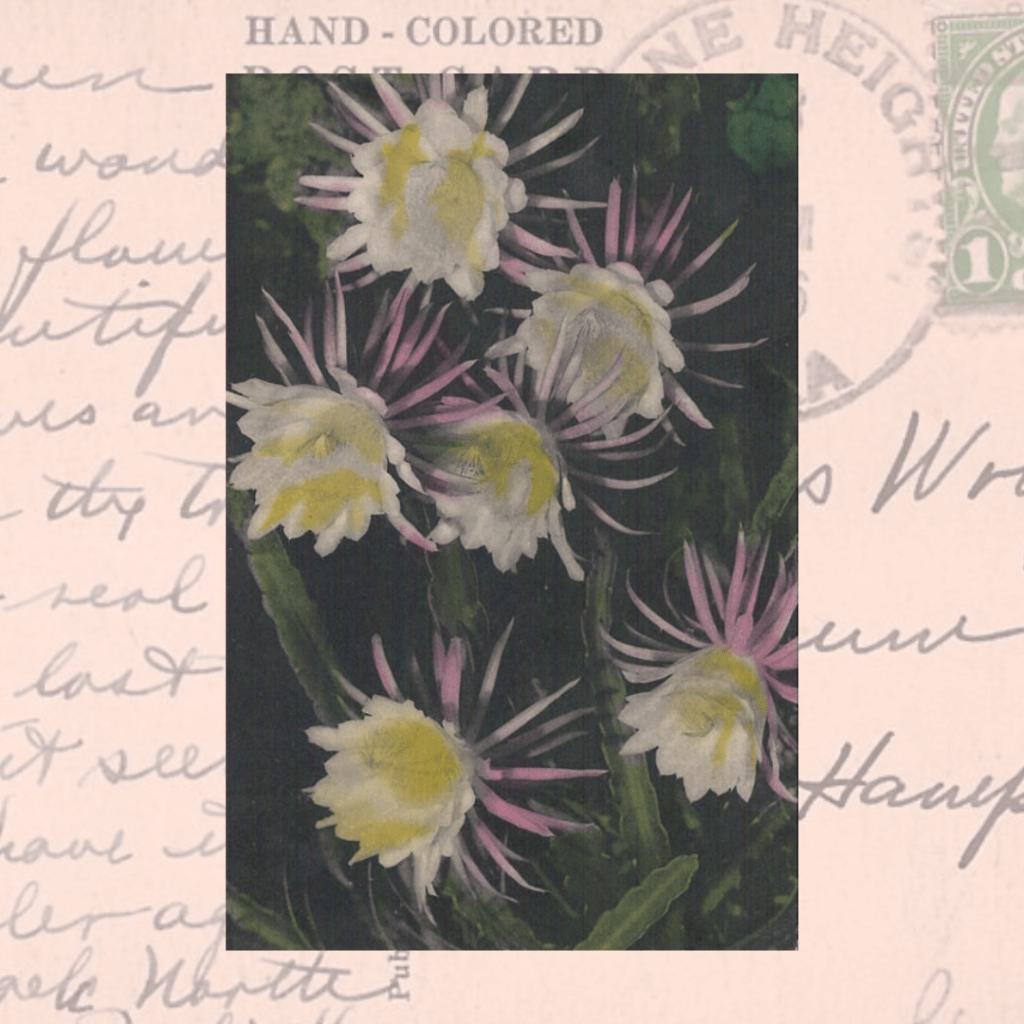
The postcard is also beautifully hand colored, and is stunning in person.

Night Blooming Cereus: Front of Postcard