Categories
History Photographs Postcards Vintage Writing Prompt

Unveiling the Enigma of Mrs. N. in 1913 Los Angeles Through a Vintage Postcard

Miss Louise M. Simmons(?)

Box 13-87 Los. Angeles CA

Dear Friend Louise,

I am writing you a long letter but am to sleepy to finish up tonight so send this card instead. With Love. From your old friend,

Mrs. N.

What a stunning card from an exciting time in the history of the west. By 1913, Los Angeles was the 17th largest city in the nation, with upwards of 319,198 people. 1913 was also a momentous year for the city. The Los Angeles Aqueduct was completed, which because the city could not sell it’s water to other areas, meant that LA grew significantly over the course of the next decades as smaller areas annexed themselves into LA.

Cecil B. de Mille shot the first “Hollywood” movie, the Natural History Museum of Los Angeles County opened, and Georgia, “Tiny” Broadwick became the first woman to parachute out of a plane, landing safely in Griffith Park.

Mrs. N, being in Los Angeles in January, perhaps didn’t know much of what was in store for the city that year. But, this postcard does give us a tantalizing peek into the history of that bright city. Unfortunately, the longer letter is lost to time, or perhaps someones attic, so we can’t know for certain why Mrs. N. was in Los Angeles. Was her family there to work on the aqueduct? Was she part of the burgeoning movie industry? Had the family moved South after the 1906 San Francisco earthquake? Were they citrus farmers? I’d love to hear what you think.

With very little information on the postcard — including the full name of the elusive Mrs. N, it’s difficult to ascertain how and why she had made it to Los Angeles. However, it’s an exercise in imagination to think of what she must have seen in that important year of 1913.
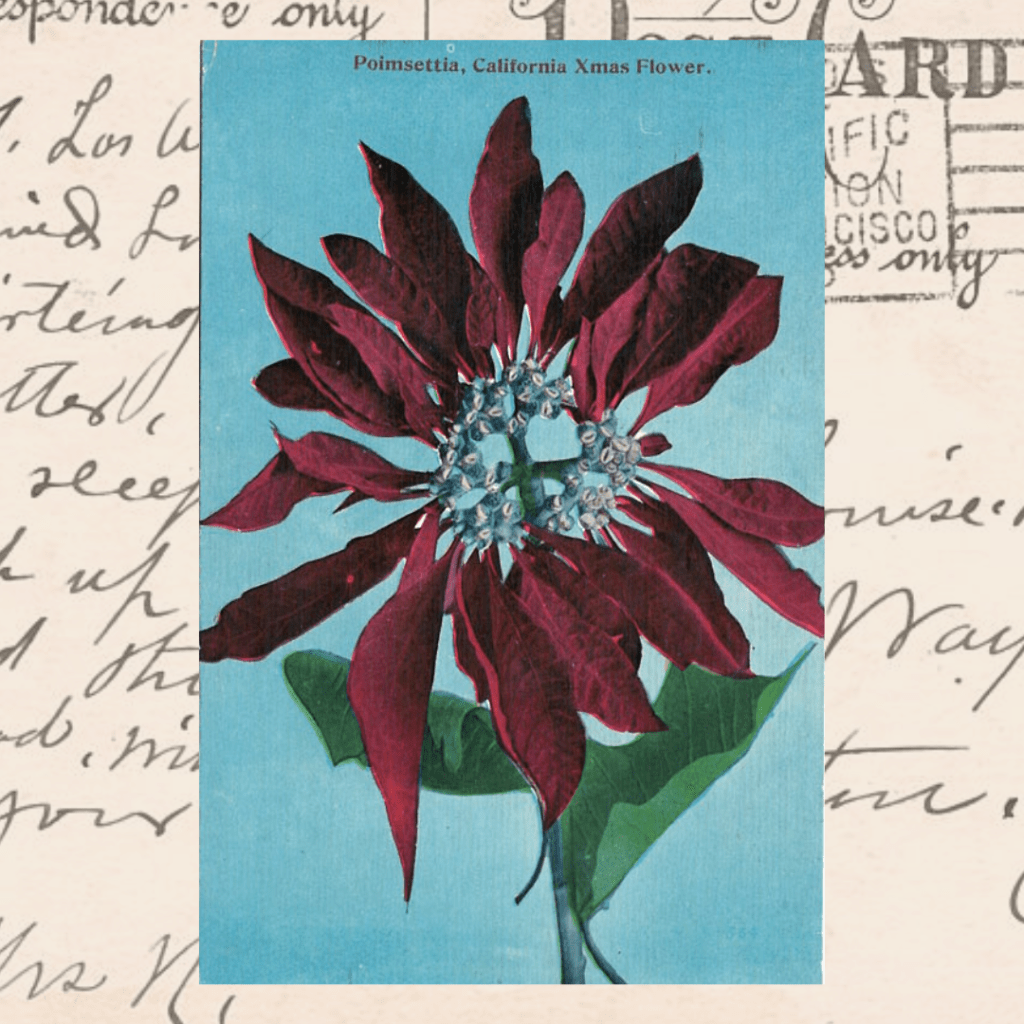
Front of Postcard: “Poimsettia, California Xmas Flower.”
Categories
Education History Photographs Postcards Vintage

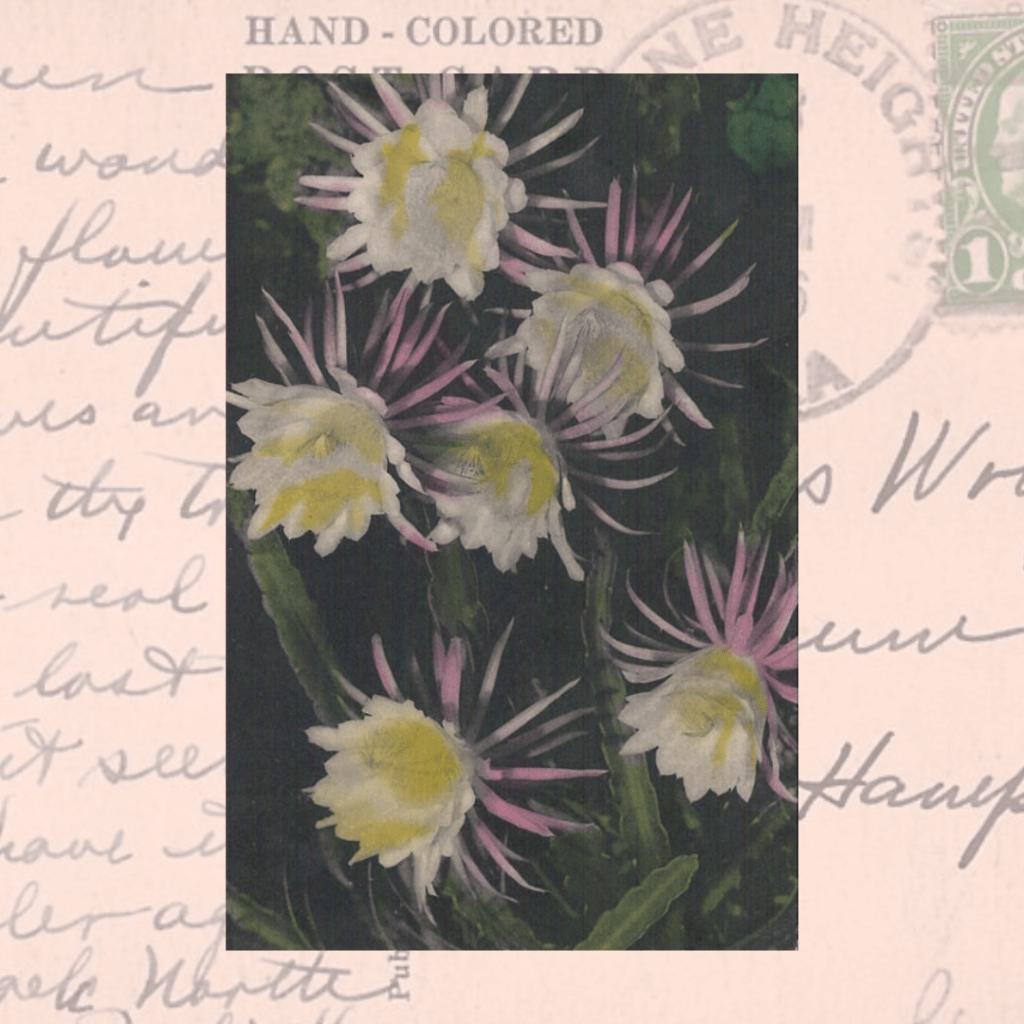
Pauline Howard’s 1936 Postcard to Miss Lois Wright: A Snapshot of Life Amid the Great Depression

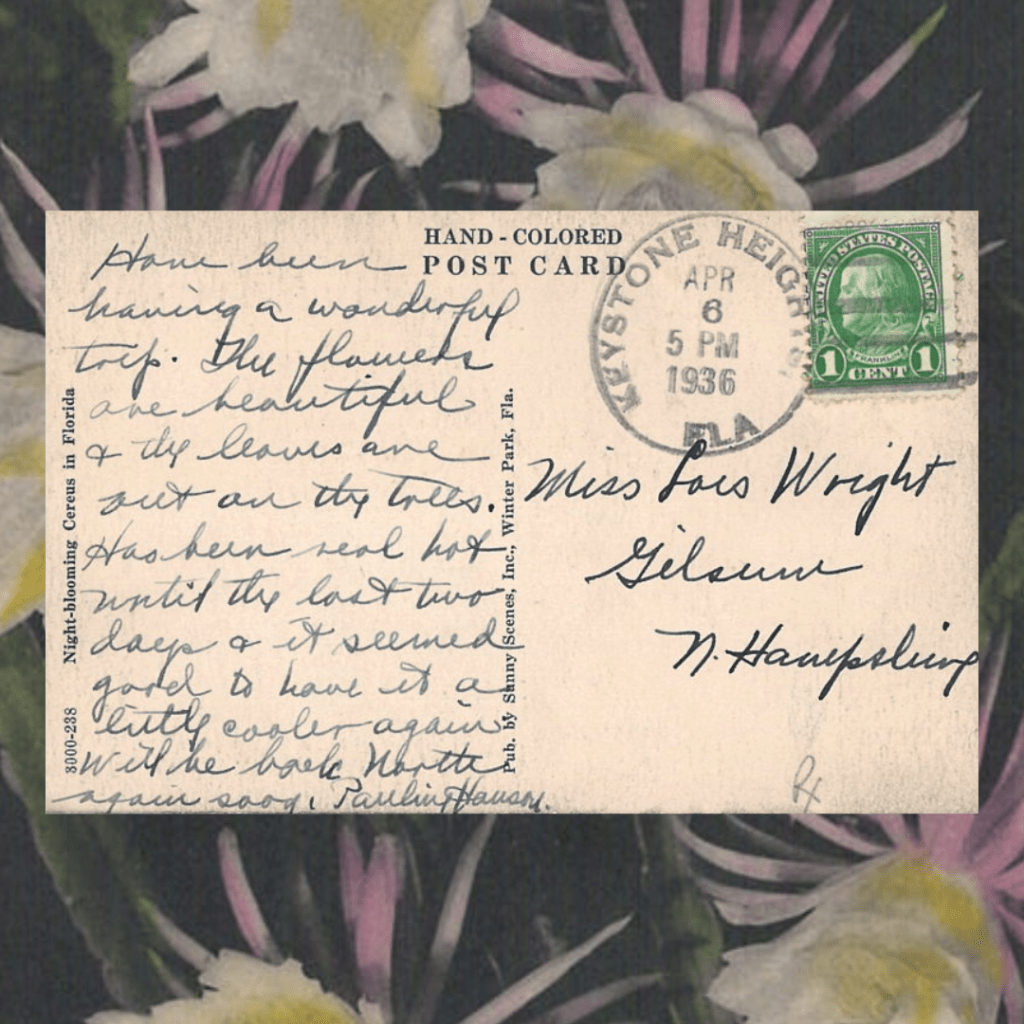
Postcard to Miss Lois Wright, 1936

Have been having a wonderful trip. The flowers are beautiufl and the leaves are out on the trees. Has been real hot until the last two days and it seemed good to have it a little cooler again. Will be back North again soon.

— Pauline Howard

First, the context. In 1936 the country was deep into the Great Depression, though the worst hard times were getting slightly better. Black Sunday, the worst storm from the American Dust Bowl, had happened a year prior, on April 14, 1935. By 1936 FDR was elected for a second term, created the Works Progress Administration (WPA) and brought unemployment to 16.9%, down from 20% of the year before. Dorothea Lange also shot her iconic image of “Migrant Mother” in March. So, even if you don’t know a lot about the 30’s, these things probably sound familiar as they exist in the American zeitgeist.

Because the Great Depression exists in our mind as a sort of dark age of American society, it’s difficult to imagine people living their lives outside of hardship. Our minds immediately go to migrants, joblessness, and perhaps even the Grapes of Wrath or Of Mice and Men.

Yes, people were desperate, and yes, these were difficult times. However, the postcard from Pauline to Lois shows that, once again, people were resilient and living the best they knew how. Now, I don’t know how old Pauline and Lois were (though from the moniker “miss” for Lois, I can assume early 20’s), but what’s clear is that despite the country’s turmoil, there was some fun to be had.

Keystone Heights seems as though it was a semi-popular wintering spot which also received assistance from FDR’s alphabet program the Civilian Conservation Corps. April was, perhaps, a tenuous time to visit, as Florida heat in April can get oppressive (indicated in the message of the postcard). But, the country was in for a worse heat wave beginning in June, so hopefully Pauline managed to make her way North before then.

I wonder what the connection between the two women were. Perhaps school friends or room mates? Women are difficult to research since I’m behind a variety of paywalls, and unfortunately I’m not confident I was able to find the correct people. However, there was a Lois Wright who lived in New Hampshire and, despite marriage, did not change her last name (it seems). She lived to be 104, and fits the timeline. Though, of course I can’t guarantee this is our Lois, I’d like to believe it could be.

The postcard is also beautifully hand colored, and is stunning in person.

Night Blooming Cereus: Front of Postcard

Categories
History Photographs Postcards Vintage writing

Manie’s Postcard to Mr. Howard Burr: A Snapshot of 1917

Postcard to Mr. Howard Burr, 1917

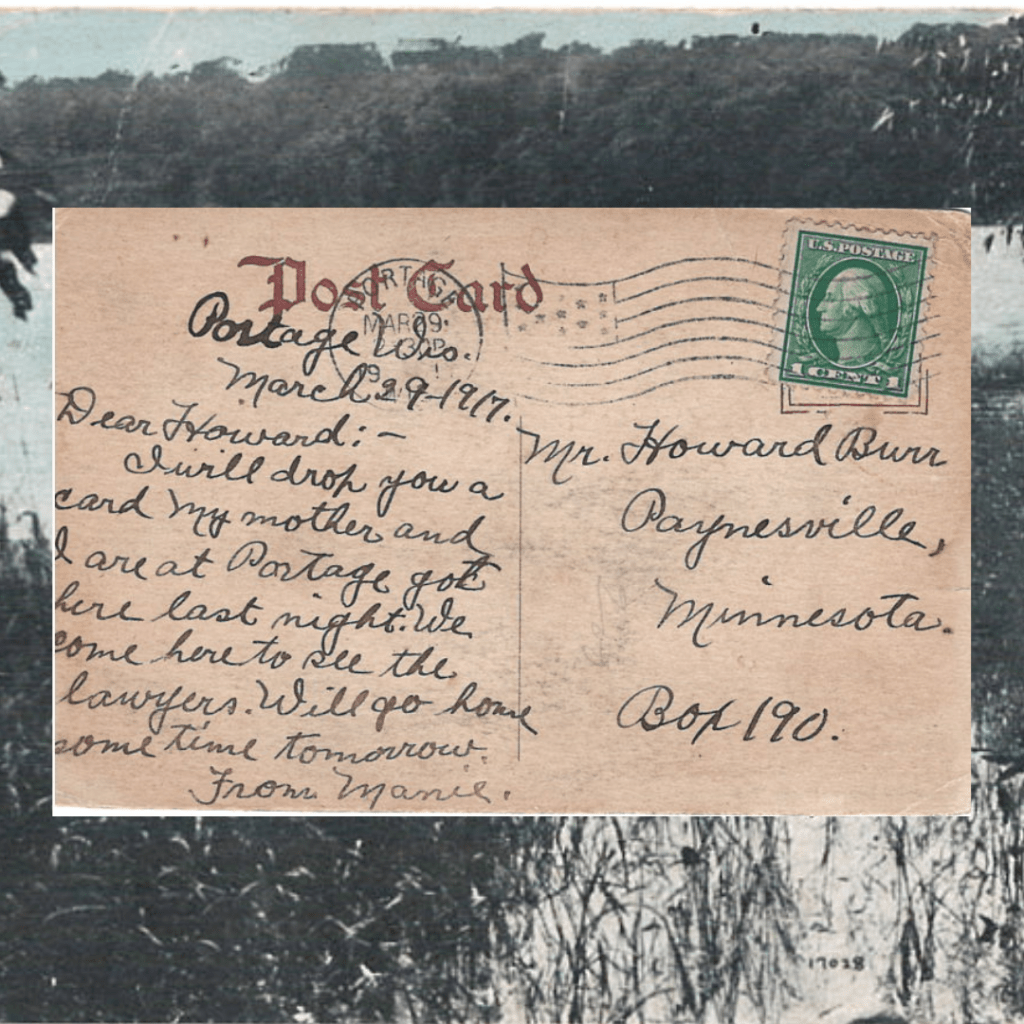
Portage Wis. March 29, 1917

Dear Howard: –

I will drop you a card. My mother and I are at Portage. Got here last night to see the lawyers. Will go home some time tomorrow.

From,

Manie

Before I get into this tantalizing postcard, let me first drop 1917 into history, as it’s a fairly pivotal year, and March an important month. Europe was at war, but in February of 1917, the Russian Revolution began. This would eventually prompt the US to enter World War 1, but war was not declared until April 4, 1917. The US would institute a draft in May, and the Spanish flu was still a year away. So, when Manie wrote this postcard on March 29, 1917, the United States was six days away from war.

I always love mementos like this, cards on the precipice of something big. I have to wonder, how anxious were they? Did they know the world was about the change, or were they fairly isolated in their midwestern towns? I suspect a little bit of both.

Without a last name, I wasn’t able to easily research Manie, the sender. Though I would love to know why he and his mother were meeting with lawyers. Did it have to do with the impending war? A family estate? A marriage? A death? A divorce? Legal troubles? Your guess is as good as mine, though my guesses tend to run the gambit of wild and unusual.

Portage, Wisconsin was somewhat easier to research — as towns tend to be. In 1917 it seemed it was a larger commercial district, which explains why Manie and his mother were there to see a lawyer. We can imagine that they perhaps did some shopping, or stayed in a quaint hotel in the city center.

I was able to find a Mr. Howard Burr who was born in Paynesville, MN in 1896 and died in Wisconsin in 1972. I wasn’t able to locate a (free) obituary, however I’m fairly confident this is to whom the card is addressed. If I’m right, Howard would have been just under 21 years old — the right age for the draft instituted in May of 1917. I’d guess Manie was around the same age. It leaves me wondering if they both fought in the war.

I also hope that whatever legal business Manie was involved with was easily resolved.

Front of Postcard. Silver Lake, Portage Wis.

Categories
History Postcards Writing Prompt

Historical Postcard: Family Sickness in Akron, Oh – August 20, 1909

Miss Anna L Thomas: 1909

Akron, Oh. Aug – 20 -09

Dear Sister,

Came back to Aunt “L” yesterday 4 P.M. Will stay till Sat or Sun then mother is coming in. Aunt L is awful tired. Uncle L is no better. bad off. Had an awful bad night last night. Minnie is some better. Nettie is well hasn’t worked since Tues.

Love to all, your sis

— Elizabeth

Unlike some of my more recent posts, this card also does little more than reveal a (perhaps forgotten) family illness. Nevertheless, I always find these the most poignant, as they reveal that the everyday mundanities of life haven’t changed much in our human history.

Here, we have (seemingly) an entire family that’s been ill with some sort of sickness. Perhaps the flu, a cold, or something more serious — it’s impossible to know exactly. However, the card does provide some clues. We know the family has been tired, we know that the children (?) are recovering, and we also know that they haven’t been able to work for a few days.

The illness of Aunt and Uncle “L” prompted family to rally around them in an effort to nurse them back to health. Elizabeth stayed with them 3-4 days (August 20, 1909 was a Friday) and then presumably, her mother took over the care.

I have to wonder why Elizabeth refers to the family as Aunt “L” and Uncle “L”. I’m sure it’s a last name, but the parenthesis made me pause.

Dropping this into history a bit, I want to note that Pertussis vaccinations weren’t given until 1914, Diphtheria until 1926, and the flu until 1945. I can’t surmise if the “L” family had any of these diseases, but I can tell you that they all would have been contagious.

Additionally, the melancholy tone of this postcard is incongruous to the picture of the park, a place where we can imagine people walked and mingled and took air when they were healthy. Perhaps a silent wish for better times?

Entrance Grace Park, Akron, Ohio

Categories
History Postcards Writing Prompt

1907 Postcard: Silverton, Colorado – A Typical Rocky Mountain Town

Miss Elizabeth Jordan, 1907

This is a typical Rocky Mountain town

— Joe

In 1890 the West was officially “closed”. The United States had succeeded in its colonial aspirations of Manifest Destiny and settled from the Atlantic to the Pacific. The west may no longer have been “wild”, but that doesn’t mean it wasn’t wily. Mining towns dotted the western landscape, as men toiled for all that glittered. In September of 1907, there were 45 states, Butch Cassidy and the Sundance Kid were still alive (though in South America) and it would be another nine years before the last stage coach robbery occurred.

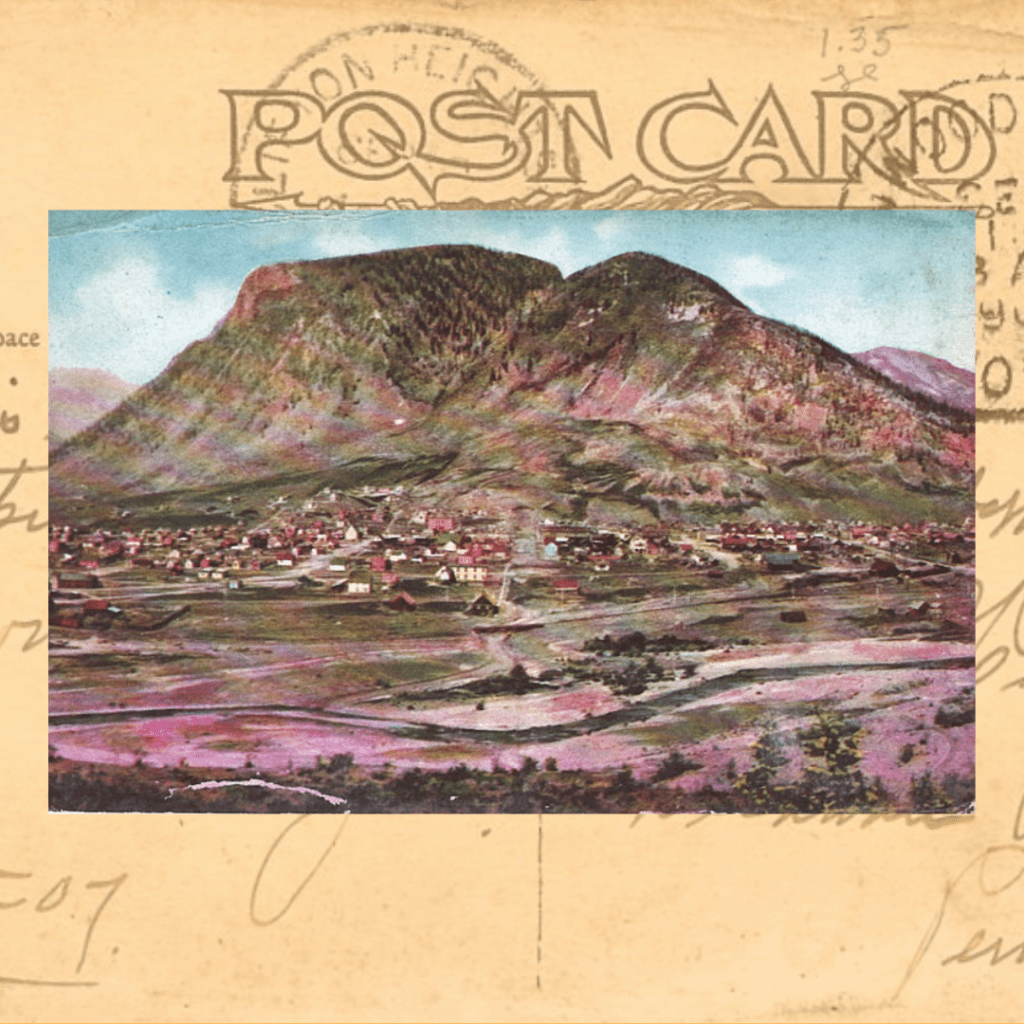
Silverton, Colorado was no exception. Home to both silver and gold mines, it’s feasible that Joe had gone west to take part in the vast industry and opportunity that the west offered. The Knickerbocker Crisis had yet to occur, and being out west probably allowed Joe to make some money in an effort to buy land. Was Joe a brother? A cousin? A lover? It’s impossible to know. Well, if not impossible, then at least difficult. What is clear, is that Silverton has not changed much from the front of the postcard.

Front of postcard, depicting Silverton, Colorado.

Silverton, Colorado in 2010, taken by By Daniel Schwen.

So, when Joe told Elizabeth that Silverton was a “typical Rocky Mountain town”, he couldn’t have known that it would become a historical landmark that preserved aspects a typical Rocky Mountain at the turn of the 20th century.

Categories
History Postcards Writing Prompt

Red Cross War Fund and Soldier’s Postcard: Private Charles P. Kerchner 1943

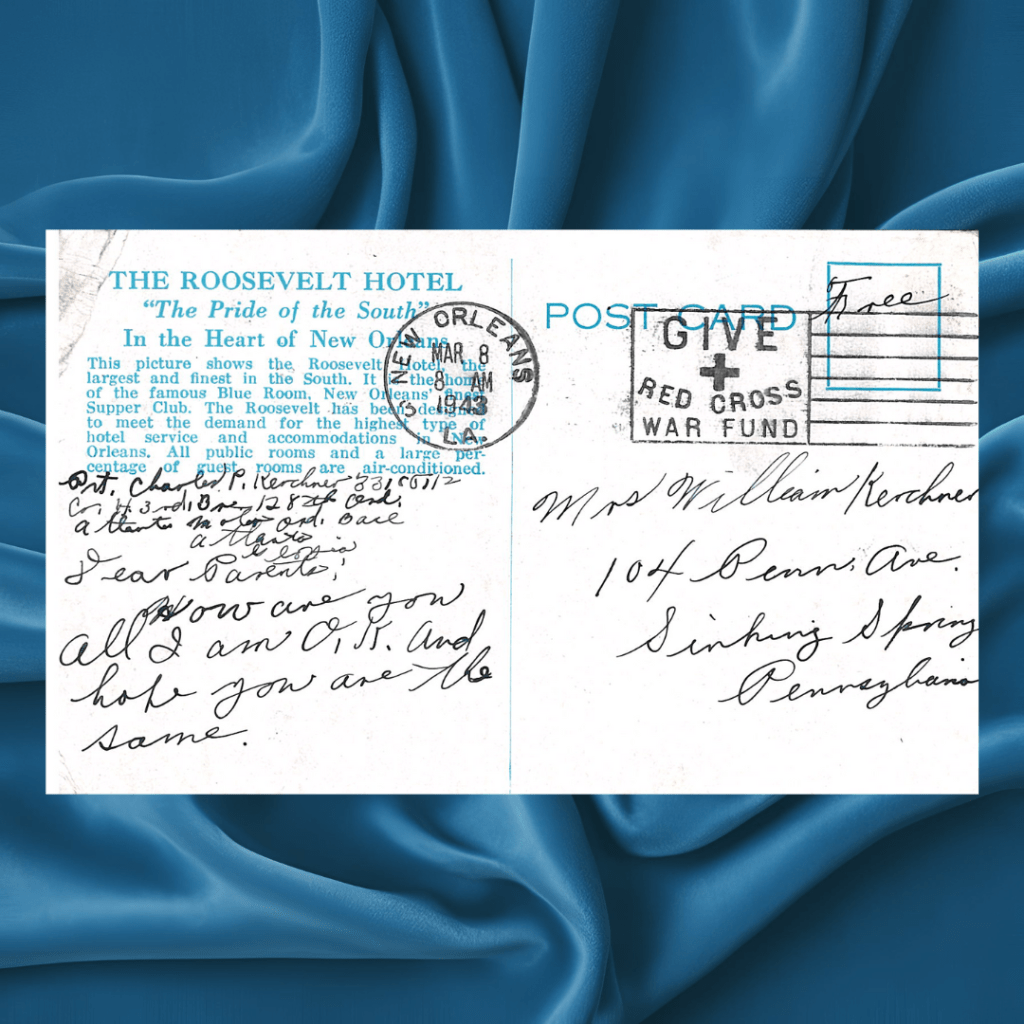
Mrs. William Kerchner: 1943

Pvt. Charles P. Kerchner

Dear Parents:

How are you all. I am O.K. and hope you are the same.

A simple message scrawled quickly in pen on the back of a beautiful postcard opens a door for us to understand a little more about postcard history, as well as World War II history.

When I began this project I knew nothing about the history of postcards in the United States or abroad. I’m still lacking in my historical knowledge, but I’m also learning with each post I create. One simple piece of information I’ve recently stumbled upon are the different “eras” of postcards.

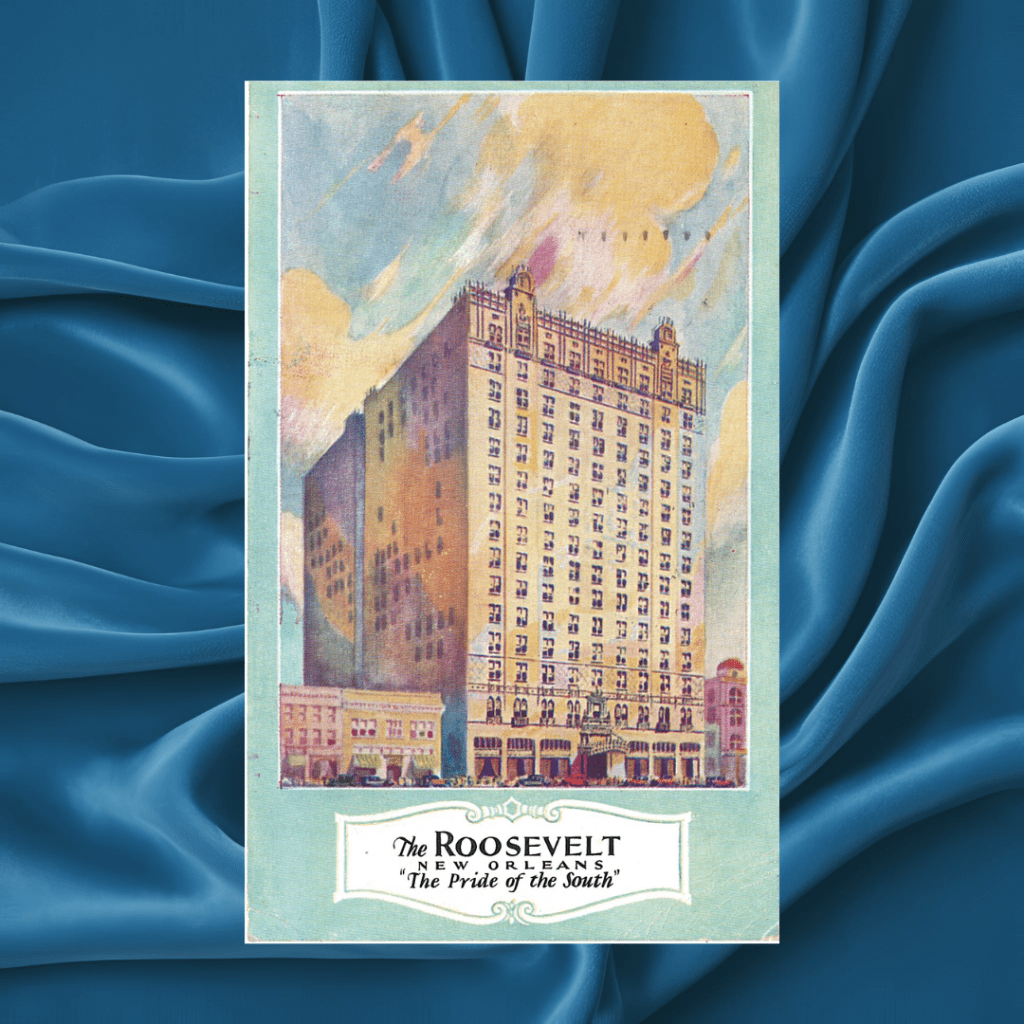
By roughly 1930, “linen” type postcards had begun to circulate. These postcards have a different look and texture than the early 1900’s postcards. In fact, it may suprise you to find out that they look like they are printed on linen (shocking I know). The colors on these postcards also tend to be more vibrant and saturated. This postcard is no different. While the back is somewhat nondescript and not quite as pretty as some of the earlier postcards in my collection, the front is so beautiful it could be framed as a watercolor painting.

I assumed the “free” written in the stamp section had something to do with the fact that this is a soldier sending a postcard home to his family. A brief google search revealed that by World War II, if the soldier wrote his outfit and camp (along with the word “free” in the stamp box), then the postage was comped for him.

Another notable aspect of this postcard is the stamped “GIVE: Red Cross War Fund.” I have a few of these from postcards sent during WWII, but I find them fascinating reminders of a different time.

This is also the first postcard where I feel confident I’ve found some information on the original sender. Private Charles P. Kerchner survived the war, married, raised a family, and died in 2008 at the age of 87.

A lovely piece of history from a bygone era.

Front of postcard. Note the blues and yellows and pinks that serve as the masquerade of a sunset.

Categories
History Postcards Writing Prompt

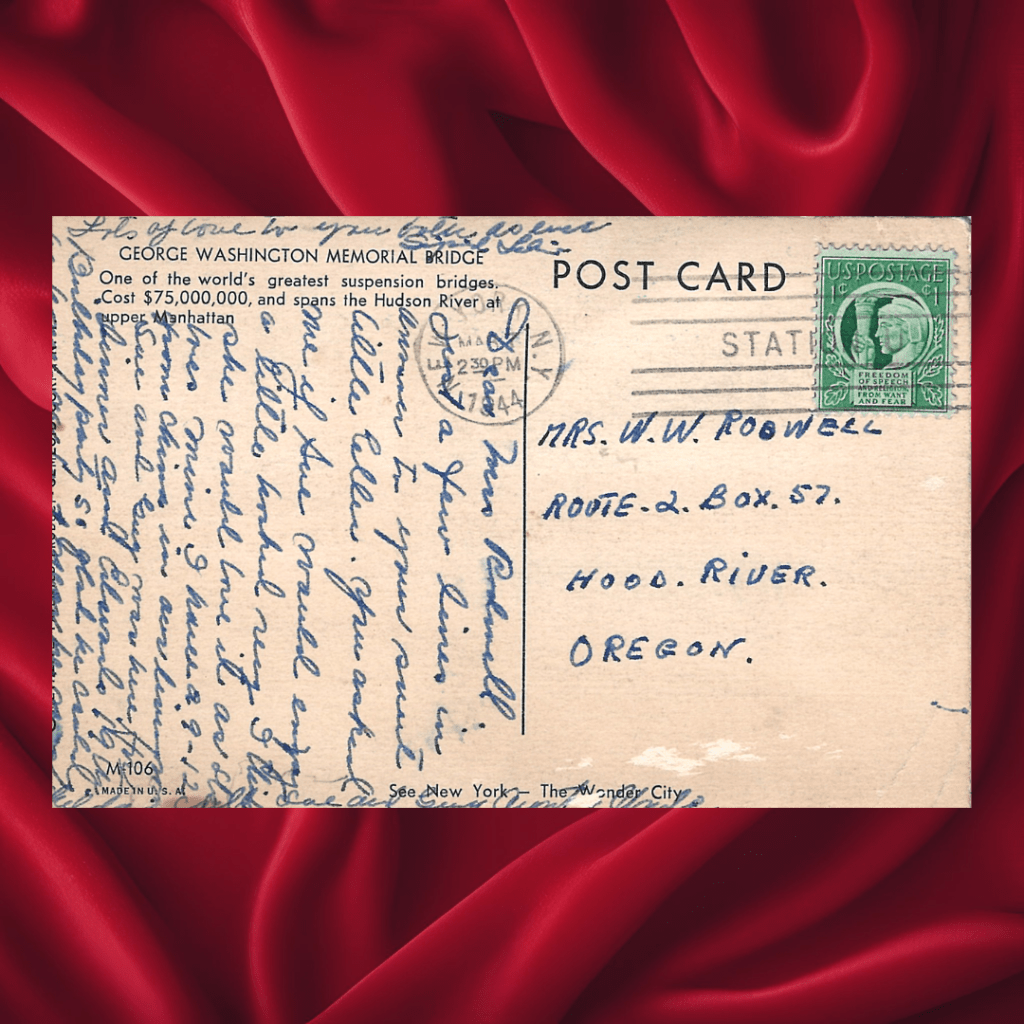
Postcard from 1944: Connecting Lives Across Geographic and Cultural Differences

Mrs. W.W. Roswell, 1944

Dear Mrs. Roswell,

Just a few lines in answer to your recent little letter. You asked me if Sue would enjoy a little (??). I think she would love it as she loves mine. I have a 9-12 from China in my living room. Sue and (?) were here for dinner and Edwards 19th birthday party. So glad he could be home (rest of text unclear).

Lots of love to you forever

This postcard is slightly frustrating to me, because I can’t make large parts of it out. The handwriting is long and spread out, then scrunches together at the bottom and top as the writer tries to make up for her previous luxurious writing. Since this is 1944, and Edward is turning 19, I wonder if he went to war, or had been back from war. I can’t research it either, because I can’t quite make out the senders name or last name.

What I do love about this postcard is imagining the differences between the sender and the receiver. New York has always been a bustling center of activity, and in 1944 it was no different, especially with a war on. Hood River, Oregon, in contrast, is still fairly rural. The 2020 census indicated only 8,000 some odd people, up by 3,000 from the year 2000. That tells me that in 1944, it would have been a largely agricultural community, connected to the rest of the world by railway. Mrs. Roswell and her friend must have lived markedly different lives, but managed to connect through family ties and friendship.

Categories
History Local Government Postcards Writing Prompt

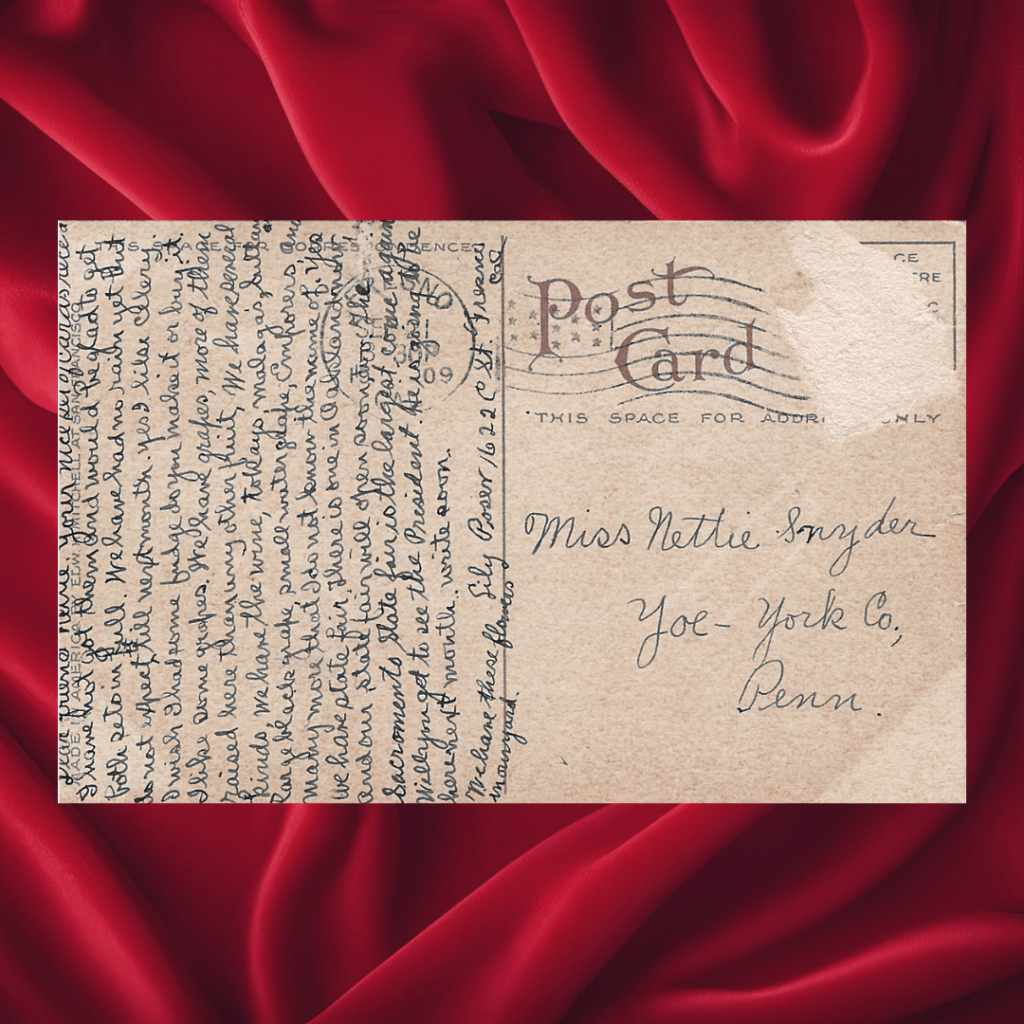
President Taft’s Visit and Grape Farming: Insights from a 1909 Fresno Postcard

Miss Nettie Snyder, 1909

Dear Friend Nettie,

Your nice set of cards reced. I have not got them and would be glad to get both sets in full. We have had no rain yet, but do not expect till next month. Yes I like celery. I wish I had some fudge. Do you make it or buy it. I like some grapes. We have grapes, more of them raised here than any other fruit. We have several kinds, we have the wine, tokays, malaga, sultana, large black grape, small water grape, Emperors, and many more that I do not know the name of. We have state fair. We have one in (unreadable), and our state fair will open soon. The Sacramento state fair is the largest. Come again. Will you get to see the president. He will be here next month. Write soon.

We have these flowers in our yard.

Lily Proser. 622 C Street, Fresno Cal

There is so much going on in this postcard and I love every bit of it. However, I first want to point out that Nettie and Lily are separated by over 2000 miles. Not only is the friendship important enough to be maintained, but Nettie had somehow managed to visit Lily in California (as indicated by the “come again”). The bonds between these two must have been strong and I have to wonder how old they were in 1909. At times, personal histories can be frustrating, especially since women change names at marriage. So, when given nothing but a maiden name, it’s difficult to trace in the (free) records.

The listing off of grape types is also an indication of how rural Fresno would have been in 1909. Founded in 1872 by the Central Pacific Railroad Company, Fresno was mainly a farming town known for…you guessed it! Grapes. It’s touted as the “raisin capital of the world.” So, while two lines devoted to grapes might seem a tad mundane for two girls to be writing about, it’s actually Lily telling Nettie about her families livelihood.

Furthermore, based on Lily’s postcard, we know that President Taft visited Fresno. She perhaps included it as bait to get Nettie back out to California. Since Lily sent her postcard in September of 1909, we can assume that she was speaking about the Presidents visit to city hall park in October of 1909. You can read a transcript of his speech here.

So, while on the outset the postcard doesn’t seemingly reveal more than idle chit-chat, overall, this one little postcard provides a slew of information about the everyday life of someone living in Fresno, California in 1909. What a great piece of history.

I hope Lily got some fudge.

Front of Postcard. Cactus Dahlia

Categories
History Postcards writing Writing Prompt

So Don’t Get Married

Mr. Frank Van Gordon, 1912

Dear Old Friend:

How are you. I am fine and dandy. Marie said she was raising (or saving?) her daughter for you so don’t get married. “Ha Ha”. I never got your letter until the other day and will just send you a card. Haven’t seen tasel(?) for a long time. Well so long my son.

Yours,

Chuck

542 N Elder Ave Indpls

My favorite thing about this postcard is actually not necessarily what’s written on the card, but the intricate “Post Card” script with the picture of the C. Other than that, I love the moniker “old friend.” I love the “fine and dandy”, I love the joking about getting married. These are clearly two people who’s bonds went deep.

Front of Postcard

Categories
History Postcards Writing Prompt

Is Your Cold Much Better?

Miss Lena Friedman, Date Unclear (I’d guess 1908 or 1909)

Dear Lena,

I am awful sorry I didn’t see you before I came home. Is your cold much better? And how is your sister? I hope she is getting better. I started back to school last Monday and it seems funny to be going to school after our vacation.

L (or I?)

This is such a sweet postcard because it’s somewhat clear it’s a young girl writing to her friend or relation (maybe a cousin?). What I love so much about history is that, despite the span of time that separates us from this postcard, human nature doesn’t seem to change much. This girl went on vacation, didn’t get the chance to see her friend, and wrote her a postcard. She was also back at school. I hope Lena and the sender remained friends as they grew up.

There’s a post script on the front.

This postal is not appropriate for now because it is quite cold down here now.

Front of postcard. “Summer On the Farm”