Categories
Education History Photographs Postcards Vintage Writing Prompt

1936: TB Patients in Arizona and Mrs. Kenneth Brentlinger’s Story

Mrs. Kenneth Brentlinger, 1936

Fri Eve:

We are at Hotel Kimball for nite, cheaper than tourist cottage. Everything here at Phoenix is filled up. The roads are full of tourists. Then, this is where the T.B. patients come. We are going to Grand Canyon and Boulder Dam Sat. then on to Helena Sun. but don’t know what time. Getting along just fine. Mrs. B came through the operation just fine. Had a good nights rest last night.

— Mother

I was able to find Mrs. Kenneth Brentlinger’s name: Helen, and her grave (see the link above), but I wasn’t able to easily find the name of her mother. A lack of information means that I can’t pick apart the intricate lives of these two women, but we can at least drop them into the historical context of wider world events.

In 1936, FDR was re-elected President, Labor Unions protested, and Germany hosted the Summer Olympics, where Jesse Owens won four gold medals. Hitler’s Nuremberg Laws had been enacted in 1935, the United States was in the midst of the Great Depression, and we were still five years away from joining World War II.

Additionally, in 1936, Mrs. Kenneth (Helen) Brentlinger’s mother visited the Grand Canyon and Boulder Dam. A reminder that amidst the grand events of the world stage, our individual lives march on as best we know how. There are so many questions I have about this postcard, the first of which being who is Mrs. B, and what operation did she have?

But what struck me most was a fact that I had never heard before: that TB patients flocked to Arizona for treatment believing that the dry, hot air of the desert would serve as a place where they could rest, recuperate, and unfortunately pass away, from Tuberculosis.

For the patients with money, there were a variety of posh hospitals with beautiful views and state of the art luxuries. These sanatoriums held upward of 100-150 patients, and did their best to treat the disease.

However, there were many more who suffered in poverty. That did not dissuade them from seeking treatment. Called “lungers” as a pejorative, tent cities of patients popped up in Pheonix and Tucson, and though funding and services had improved by 1936, based on this postcard we can see that the influx of patients hadn’t ceased due to the depression. In fact it only increased in the 20s and 30s.

Treatment for TB included the dry air and rest, as well as invasive surgery that included collapsing a lung through the removal of a rib. Is it possible this is the surgery Mrs. B went through? I rather hope not, though perhaps a visit to a sick friend created a sort of impromptu vacation for Helen Brentlinger’s mother.

There’s an inscription around the edge of the front: Seen hundreds of these today. Sure pretty. The sun was sure wonderful and make my toes burn up in places.

There’s something about this that is so human. I love it.

Categories
Education History Photographs Postcards Vintage writing

Teenage Flirtation in 1908, A Call to War, and The Mystery Sender A.N.

Mr. Earl Poush, 1908

Hello Earl,

I received your card and was glad to hear from you. I went to the party Saturday night and had a nice time. Vera and I went over to Dallas Sunday afternoon and staid till church at night. Maybe you think we didn’t have time. Well I didn’t have to ask Bertha who the card was from. Did you go to town Saturday. I will have to close for this time.

Answer Soon

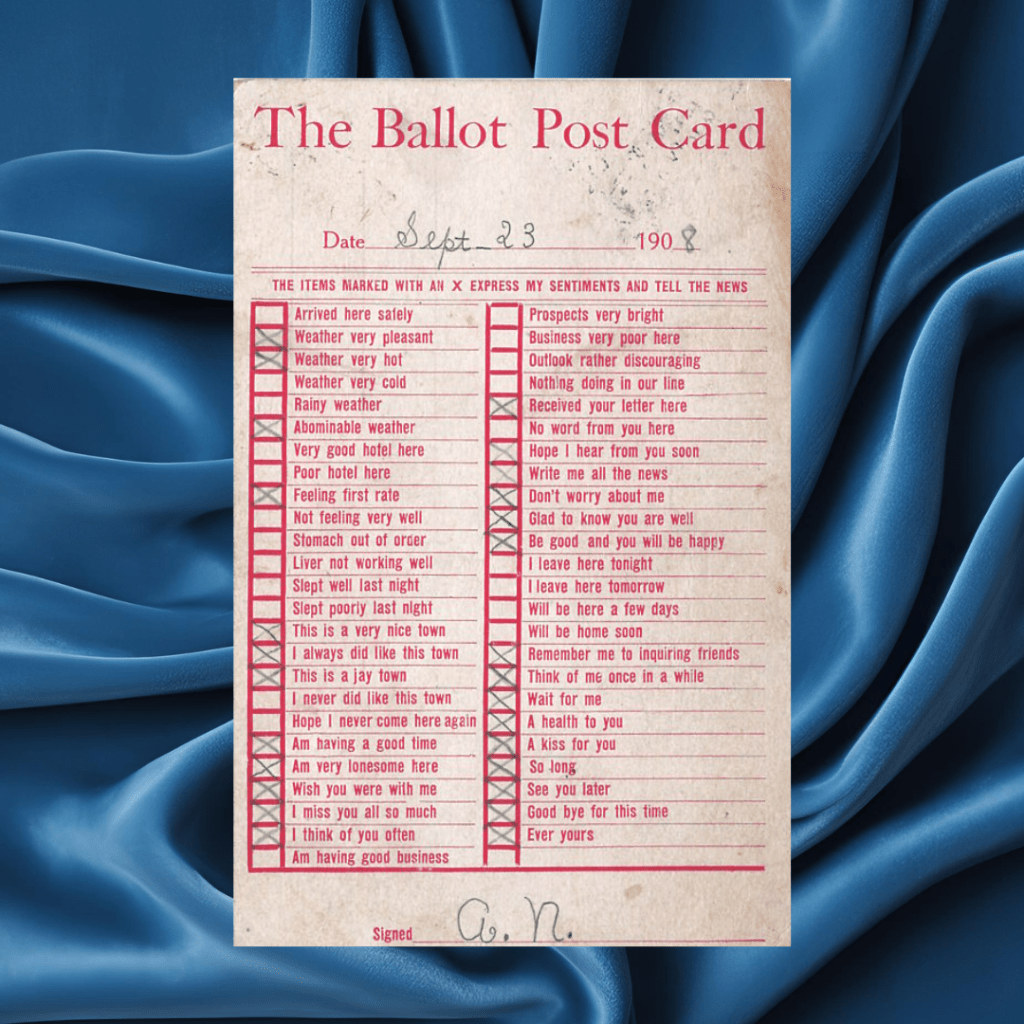
The front of this postcard is just as informative as the back, so rather than post it at the end, I wanted to post it here. Take a gander, then read on:

The Ballot Post Card: September 23, 1908

1908 was a leap year, and saw a variety of notable events that live on within the American zeitgeist. Wilbur Wright completed a 2 1/2 hour flight, Henry Ford debuted his Model T, and the Chicago Cubs won the world series.

But all of that, perhaps, pales in comparison to the light flirtation of teenagers. Again, we have a bit of a mystery sender. There’s no way for me to ascertain who “A.N.” was, or what (I assume her) relationship was to Earl, but I think it’s rather clear that the two of them may have been sweet on each other. Especially since Miss “A.N” checked off “I think of you often”, “Wait for me”, “A kiss for you”, and “Ever yours.”

Additionally, I’m guessing that when “A.N.” says “I didn’t have to ask Bertha who the card was from”, she means she knew the card she received was from Earl before even seeing it. I love that A.N seems to be surrounded by some girl friends, and I wonder if Vera, Bertha, and A.N. were on a little girls trip together.

Although I couldn’t find the identity of A.N., I do believe I found a little bit about Mr. Earl Poush. If I’m correct, it appears that he was born in 1892, which would put him at the tender age of 17 in September of 1908 — the perfect time for an early flirtation. It seems that he fought as a Corporal in World War I, and was injured in 1918. In 1919, he married Hope Lita Hicks (Poush) — not our elusive A.N. The world both teens grew up in must have been very different from the one they sent innocent cards in during the waning summer of 1908.

Categories
History Photographs Postcards Vintage Writing Prompt

Unveiling the Enigma of Mrs. N. in 1913 Los Angeles Through a Vintage Postcard

Miss Louise M. Simmons(?)

Box 13-87 Los. Angeles CA

Dear Friend Louise,

I am writing you a long letter but am to sleepy to finish up tonight so send this card instead. With Love. From your old friend,

Mrs. N.

What a stunning card from an exciting time in the history of the west. By 1913, Los Angeles was the 17th largest city in the nation, with upwards of 319,198 people. 1913 was also a momentous year for the city. The Los Angeles Aqueduct was completed, which because the city could not sell it’s water to other areas, meant that LA grew significantly over the course of the next decades as smaller areas annexed themselves into LA.

Cecil B. de Mille shot the first “Hollywood” movie, the Natural History Museum of Los Angeles County opened, and Georgia, “Tiny” Broadwick became the first woman to parachute out of a plane, landing safely in Griffith Park.

Mrs. N, being in Los Angeles in January, perhaps didn’t know much of what was in store for the city that year. But, this postcard does give us a tantalizing peek into the history of that bright city. Unfortunately, the longer letter is lost to time, or perhaps someones attic, so we can’t know for certain why Mrs. N. was in Los Angeles. Was her family there to work on the aqueduct? Was she part of the burgeoning movie industry? Had the family moved South after the 1906 San Francisco earthquake? Were they citrus farmers? I’d love to hear what you think.

With very little information on the postcard — including the full name of the elusive Mrs. N, it’s difficult to ascertain how and why she had made it to Los Angeles. However, it’s an exercise in imagination to think of what she must have seen in that important year of 1913.

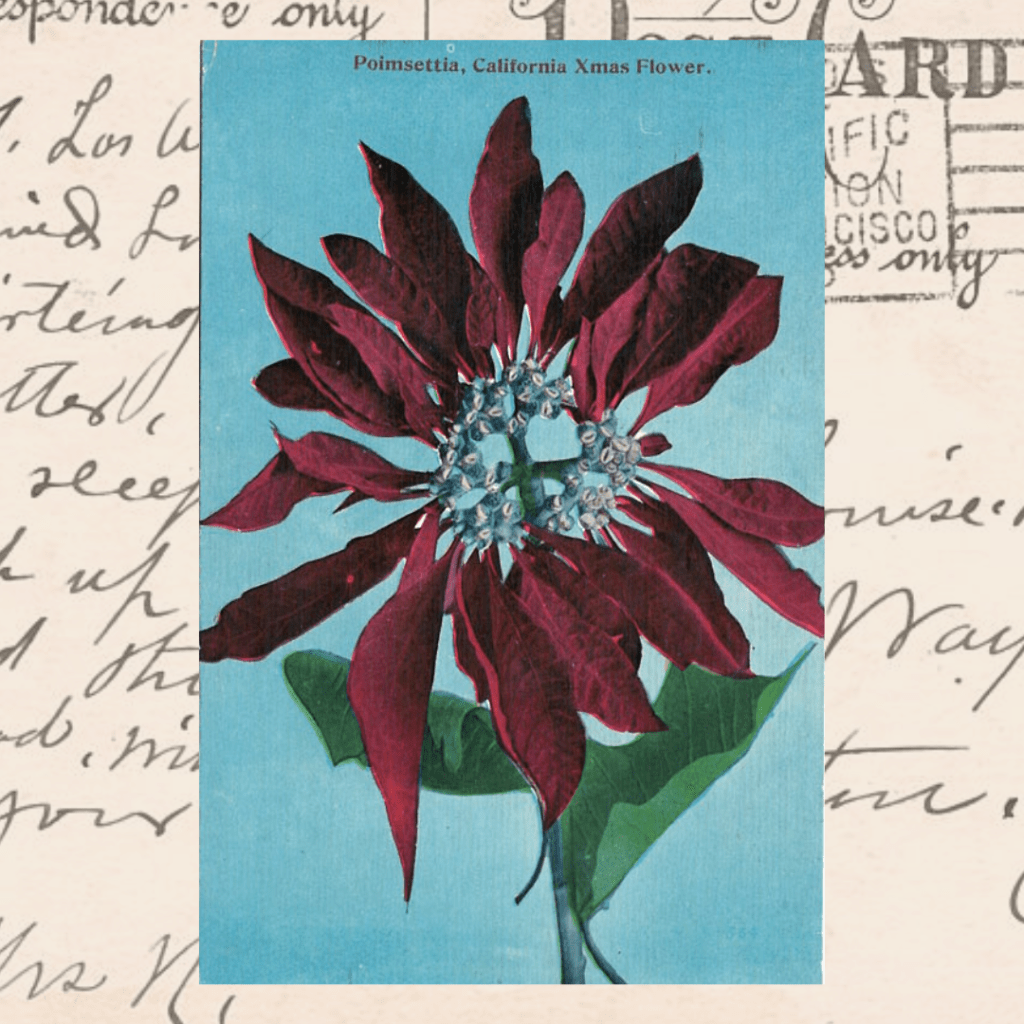
Front of Postcard: “Poimsettia, California Xmas Flower.”

Categories
Education History Photographs Postcards Vintage

Pauline Howard’s 1936 Postcard to Miss Lois Wright: A Snapshot of Life Amid the Great Depression

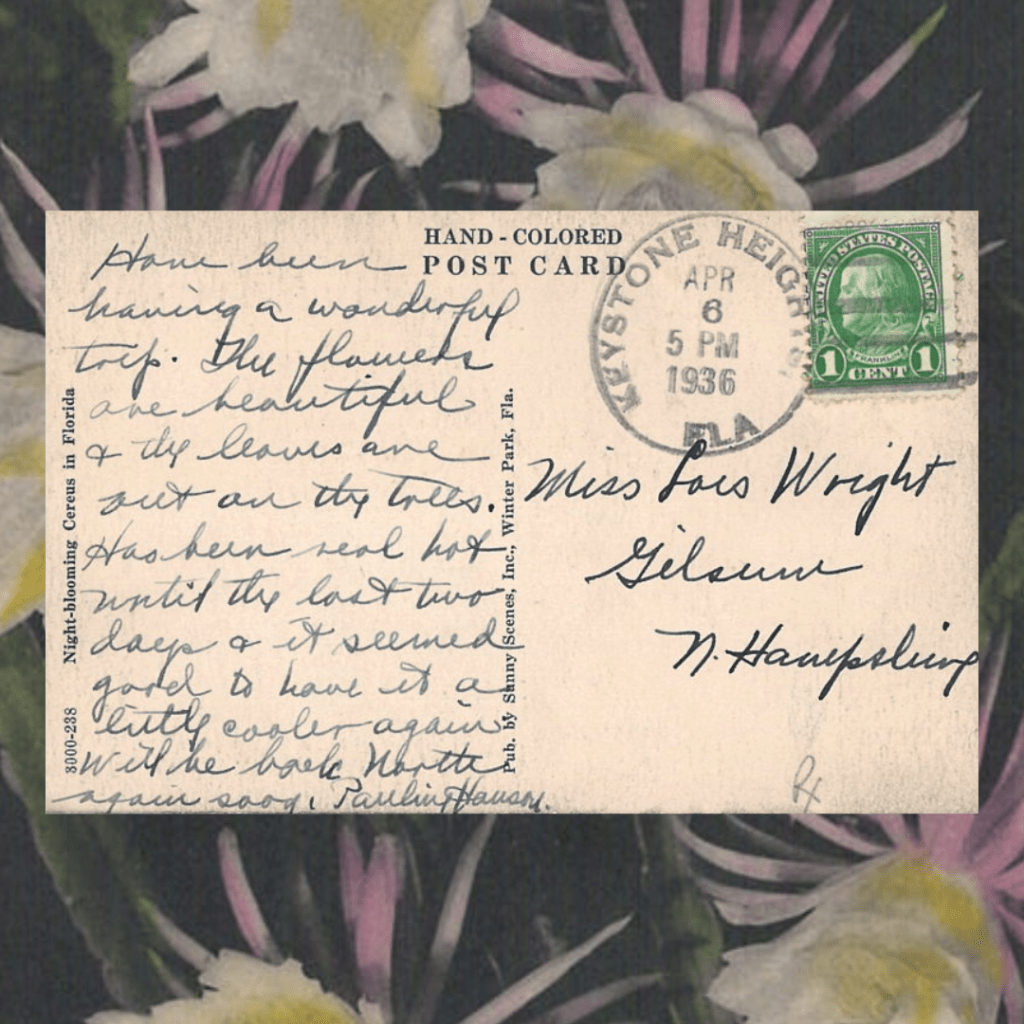
Postcard to Miss Lois Wright, 1936

Have been having a wonderful trip. The flowers are beautiufl and the leaves are out on the trees. Has been real hot until the last two days and it seemed good to have it a little cooler again. Will be back North again soon.

— Pauline Howard

First, the context. In 1936 the country was deep into the Great Depression, though the worst hard times were getting slightly better. Black Sunday, the worst storm from the American Dust Bowl, had happened a year prior, on April 14, 1935. By 1936 FDR was elected for a second term, created the Works Progress Administration (WPA) and brought unemployment to 16.9%, down from 20% of the year before. Dorothea Lange also shot her iconic image of “Migrant Mother” in March. So, even if you don’t know a lot about the 30’s, these things probably sound familiar as they exist in the American zeitgeist.

Because the Great Depression exists in our mind as a sort of dark age of American society, it’s difficult to imagine people living their lives outside of hardship. Our minds immediately go to migrants, joblessness, and perhaps even the Grapes of Wrath or Of Mice and Men.

Yes, people were desperate, and yes, these were difficult times. However, the postcard from Pauline to Lois shows that, once again, people were resilient and living the best they knew how. Now, I don’t know how old Pauline and Lois were (though from the moniker “miss” for Lois, I can assume early 20’s), but what’s clear is that despite the country’s turmoil, there was some fun to be had.

Keystone Heights seems as though it was a semi-popular wintering spot which also received assistance from FDR’s alphabet program the Civilian Conservation Corps. April was, perhaps, a tenuous time to visit, as Florida heat in April can get oppressive (indicated in the message of the postcard). But, the country was in for a worse heat wave beginning in June, so hopefully Pauline managed to make her way North before then.

I wonder what the connection between the two women were. Perhaps school friends or room mates? Women are difficult to research since I’m behind a variety of paywalls, and unfortunately I’m not confident I was able to find the correct people. However, there was a Lois Wright who lived in New Hampshire and, despite marriage, did not change her last name (it seems). She lived to be 104, and fits the timeline. Though, of course I can’t guarantee this is our Lois, I’d like to believe it could be.

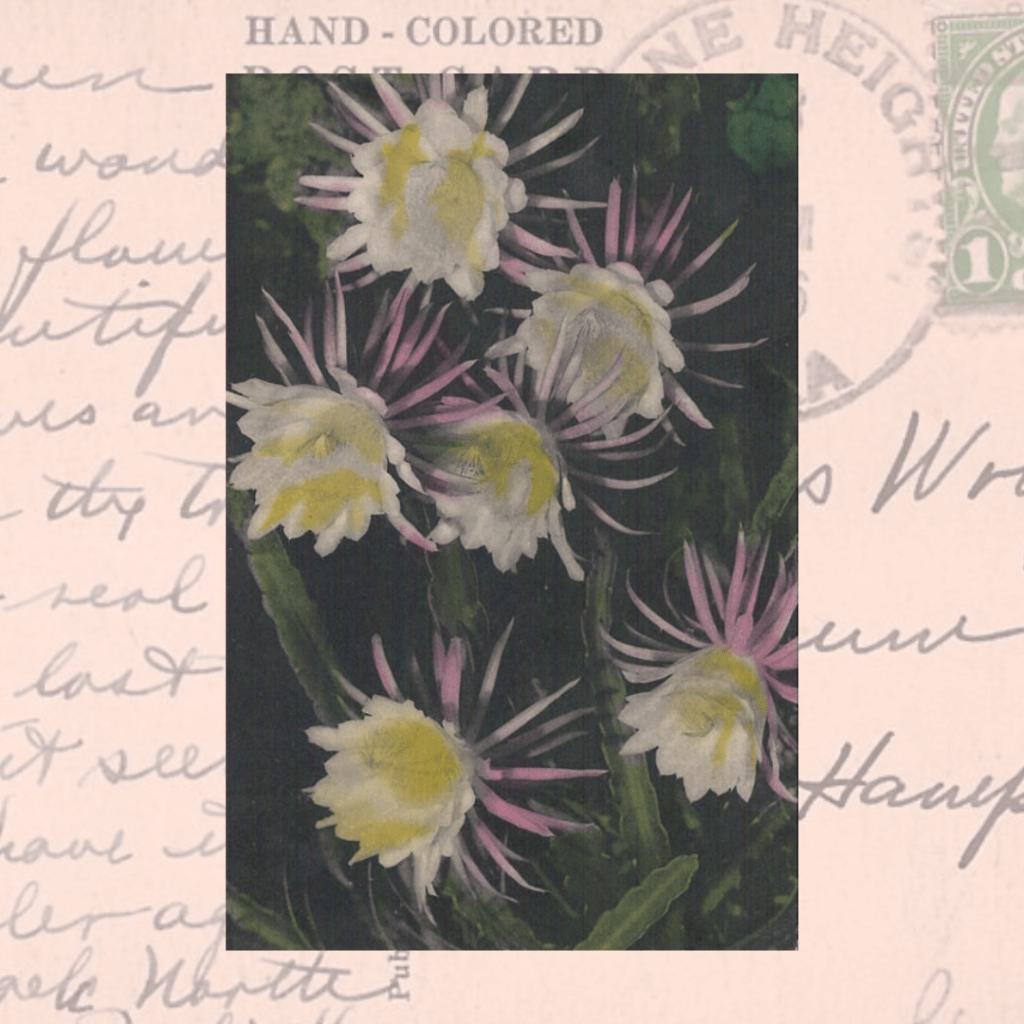
The postcard is also beautifully hand colored, and is stunning in person.

Night Blooming Cereus: Front of Postcard

Categories
History Photographs Postcards Vintage writing

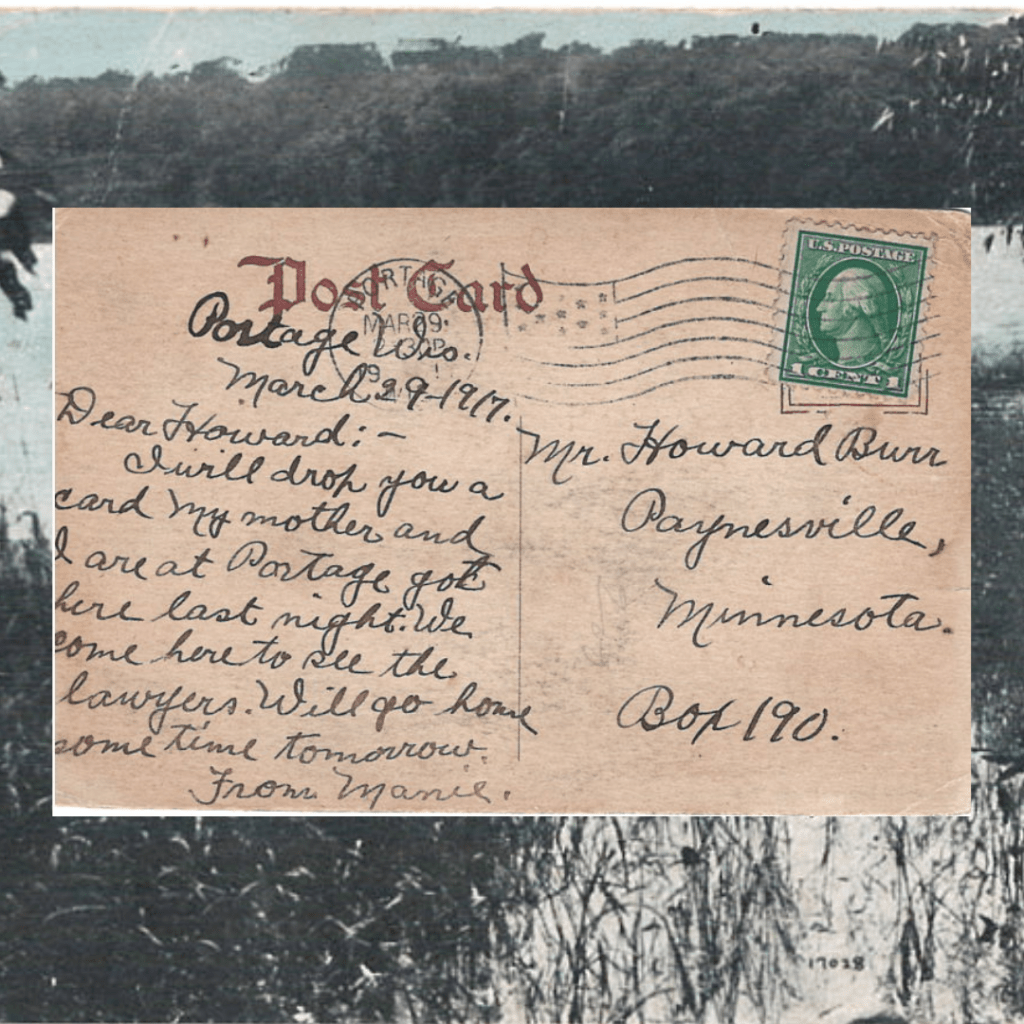
Manie’s Postcard to Mr. Howard Burr: A Snapshot of 1917

Postcard to Mr. Howard Burr, 1917

Portage Wis. March 29, 1917

Dear Howard: –

I will drop you a card. My mother and I are at Portage. Got here last night to see the lawyers. Will go home some time tomorrow.

From,

Manie

Before I get into this tantalizing postcard, let me first drop 1917 into history, as it’s a fairly pivotal year, and March an important month. Europe was at war, but in February of 1917, the Russian Revolution began. This would eventually prompt the US to enter World War 1, but war was not declared until April 4, 1917. The US would institute a draft in May, and the Spanish flu was still a year away. So, when Manie wrote this postcard on March 29, 1917, the United States was six days away from war.

I always love mementos like this, cards on the precipice of something big. I have to wonder, how anxious were they? Did they know the world was about the change, or were they fairly isolated in their midwestern towns? I suspect a little bit of both.

Without a last name, I wasn’t able to easily research Manie, the sender. Though I would love to know why he and his mother were meeting with lawyers. Did it have to do with the impending war? A family estate? A marriage? A death? A divorce? Legal troubles? Your guess is as good as mine, though my guesses tend to run the gambit of wild and unusual.

Portage, Wisconsin was somewhat easier to research — as towns tend to be. In 1917 it seemed it was a larger commercial district, which explains why Manie and his mother were there to see a lawyer. We can imagine that they perhaps did some shopping, or stayed in a quaint hotel in the city center.

I was able to find a Mr. Howard Burr who was born in Paynesville, MN in 1896 and died in Wisconsin in 1972. I wasn’t able to locate a (free) obituary, however I’m fairly confident this is to whom the card is addressed. If I’m right, Howard would have been just under 21 years old — the right age for the draft instituted in May of 1917. I’d guess Manie was around the same age. It leaves me wondering if they both fought in the war.

I also hope that whatever legal business Manie was involved with was easily resolved.

Front of Postcard. Silver Lake, Portage Wis.

Categories
History Postcards Writing Prompt

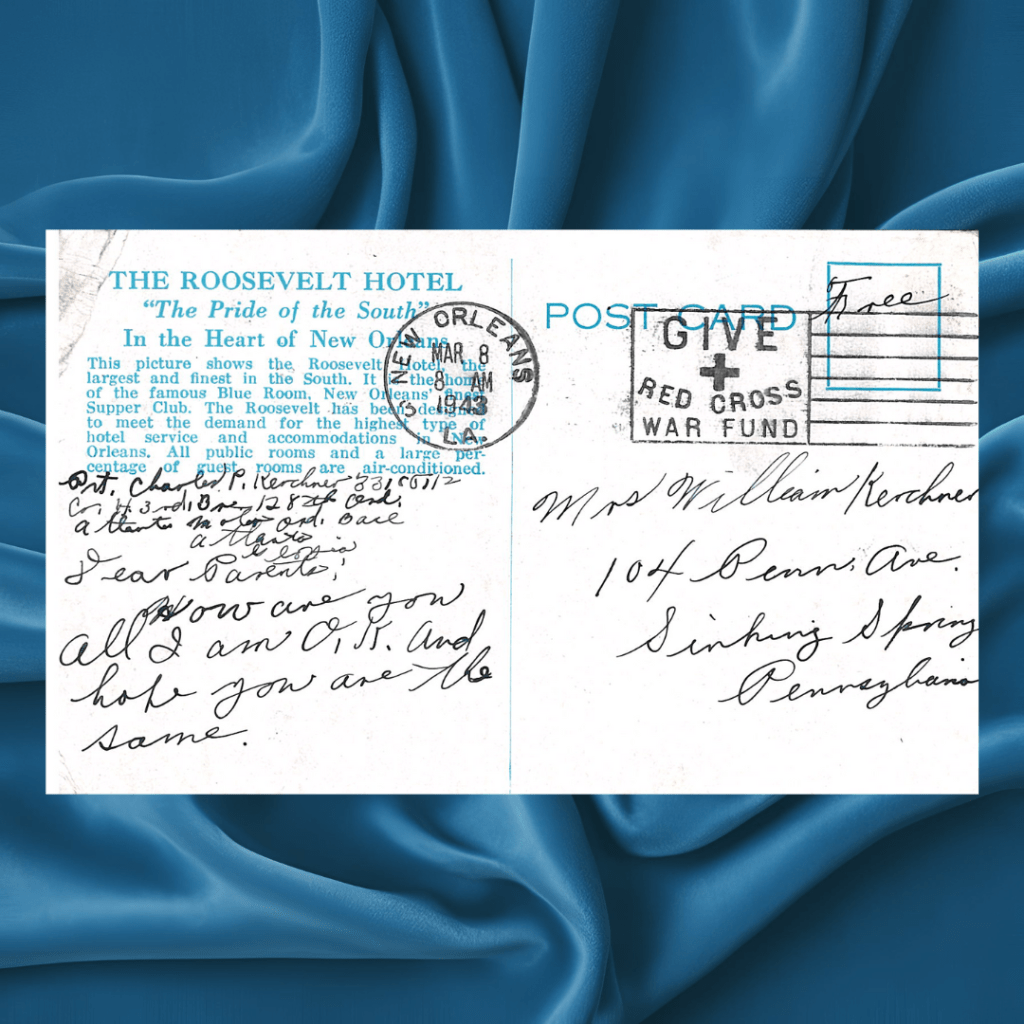
Red Cross War Fund and Soldier’s Postcard: Private Charles P. Kerchner 1943

Mrs. William Kerchner: 1943

Pvt. Charles P. Kerchner

Dear Parents:

How are you all. I am O.K. and hope you are the same.

A simple message scrawled quickly in pen on the back of a beautiful postcard opens a door for us to understand a little more about postcard history, as well as World War II history.

When I began this project I knew nothing about the history of postcards in the United States or abroad. I’m still lacking in my historical knowledge, but I’m also learning with each post I create. One simple piece of information I’ve recently stumbled upon are the different “eras” of postcards.

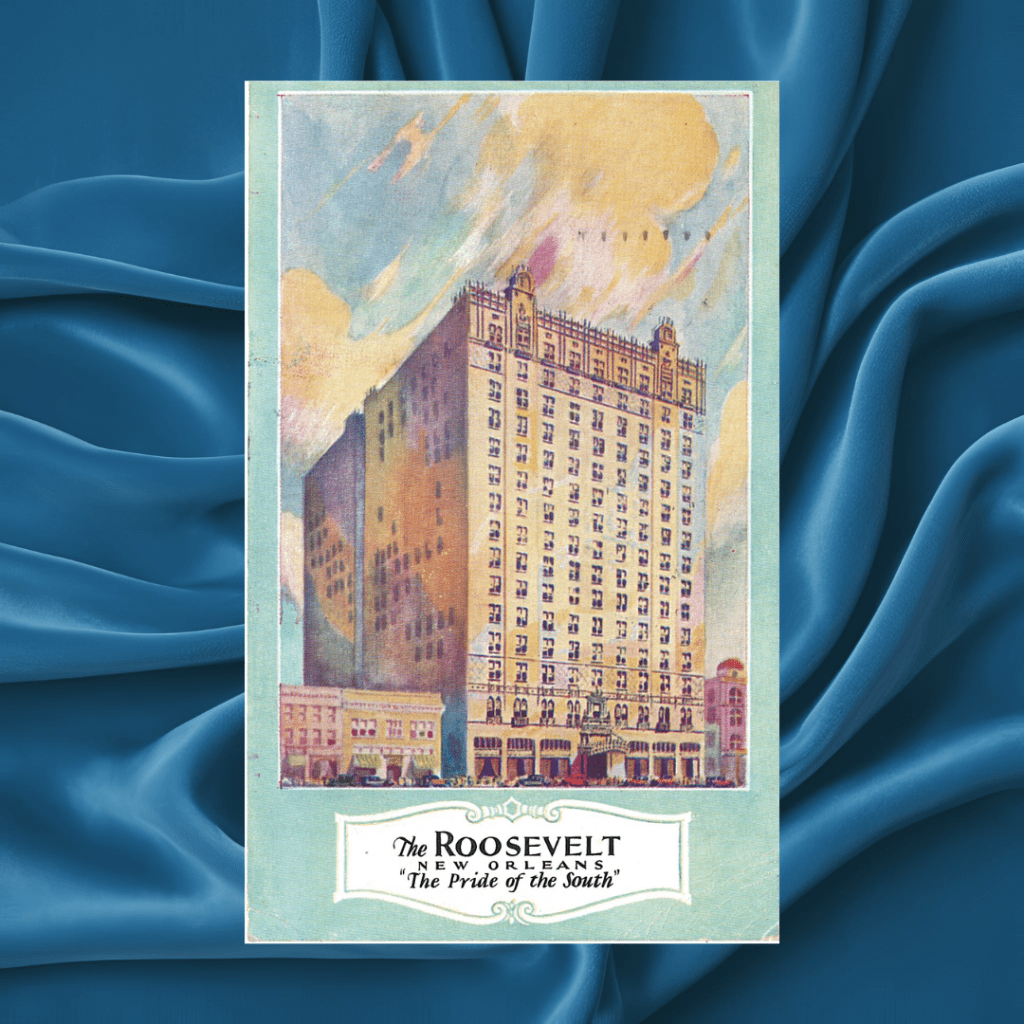
By roughly 1930, “linen” type postcards had begun to circulate. These postcards have a different look and texture than the early 1900’s postcards. In fact, it may suprise you to find out that they look like they are printed on linen (shocking I know). The colors on these postcards also tend to be more vibrant and saturated. This postcard is no different. While the back is somewhat nondescript and not quite as pretty as some of the earlier postcards in my collection, the front is so beautiful it could be framed as a watercolor painting.

I assumed the “free” written in the stamp section had something to do with the fact that this is a soldier sending a postcard home to his family. A brief google search revealed that by World War II, if the soldier wrote his outfit and camp (along with the word “free” in the stamp box), then the postage was comped for him.

Another notable aspect of this postcard is the stamped “GIVE: Red Cross War Fund.” I have a few of these from postcards sent during WWII, but I find them fascinating reminders of a different time.

This is also the first postcard where I feel confident I’ve found some information on the original sender. Private Charles P. Kerchner survived the war, married, raised a family, and died in 2008 at the age of 87.

A lovely piece of history from a bygone era.

Front of postcard. Note the blues and yellows and pinks that serve as the masquerade of a sunset.

Categories
History Postcards writing Writing Prompt

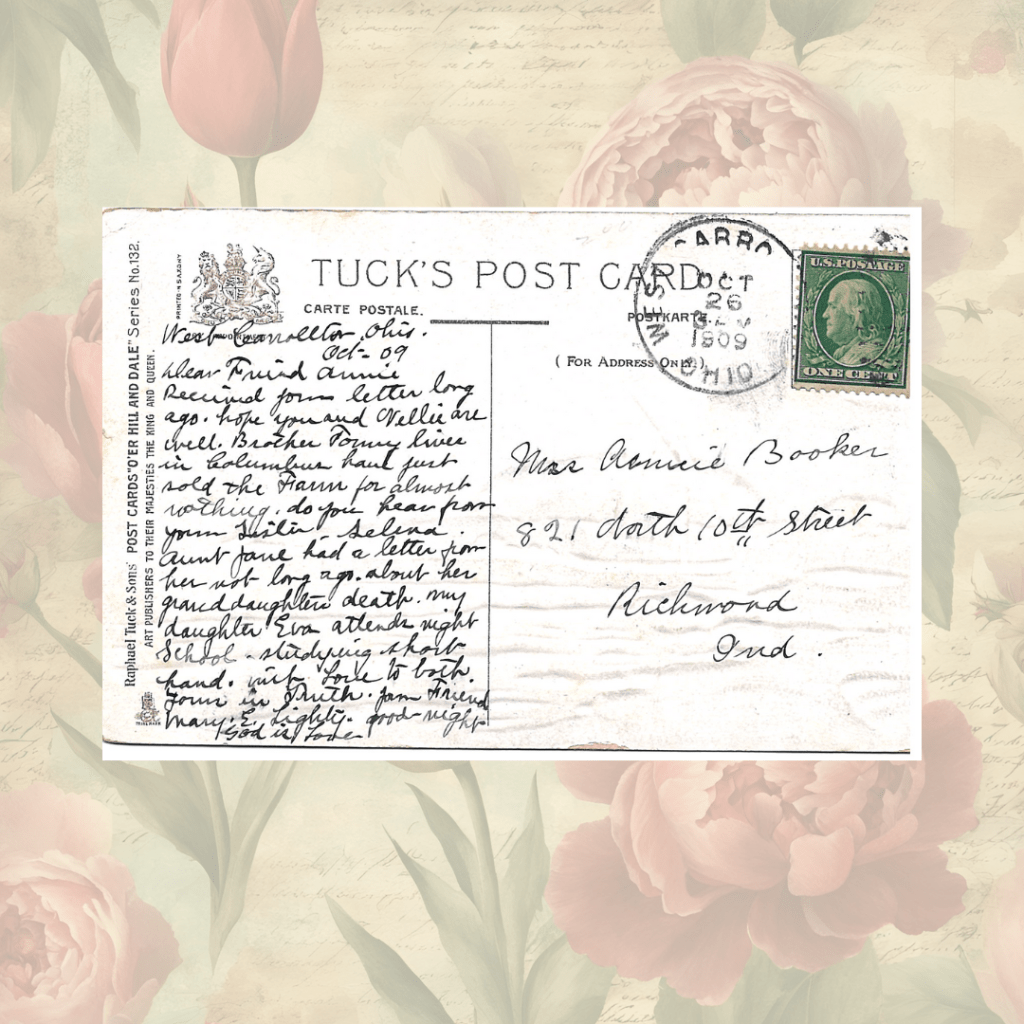
Sold the Farm for Almost Nothing

Miss Annie Booker, 1909

Oct. 09

“Dear Friend Annie,

Received your letter long ago. Hope you and Nellie are well. Brother Tommy (?) lives in Columbus. Have just sold the farm for almost nothing. Do you hear from your sister Selena? Aunt Jane had a letter from her not long ago about her granddaughter’s death. My daughter Eva attends night school studying shorthand. With love to both yours in truth.

Your Friend Mary E. Lightly

Goodnight. God is Love.”

This particular letter is packed full of information and overall has (what I feel) a somber mood. Mary’s cramped writing, short sentences, and earnest tone draw me into this particular postcard. I wonder what the connection between Mary and Annie was, and if marriage separated the two friends.

Mary’s chosen postcard; a solitary boat moored on a windswept beach, further adds to the tone of the letter. It’s a beautiful postcard, textured in a way that photo doesn’t show. The boat and ridges of the waves are raised giving the entire postcard a tactile and satisfying feel.

Front of Postcard

Categories
History Postcards Writing Prompt

Didn’t Get the Job They Promised

Miss Sophia Carlson, 1913

“Dear Sister,

I am back to working and it goes fine and dandy. I am feeling good and I hope you are the same. I didn’t get the job they promised me. Was away too (long?). This is alright for in the summer there is other (work?)

Bro John(?)”

This is one of my more tattered cards, and is frustrating because parts of the text are damaged, so I can only make an educated guess about what the author is saying. Like anything in history, context and audience matters. So although the overall message of the card seems optimistic, I have to wonder how much the sender muted his disappointment about the job he didn’t get. I hope the summer went better for him.

This card also has a post script on the front that, try as I might, I can’t quite make out. It seems to be playing with the “Iron Hub” motto. I think it says “She’s on the bum” or “she’s on the run”? What do you think?

“What’s the Matter with Iron Hub. She’s All Right.”

Categories
History Postcards Writing Prompt

Hope You Have a Nice Trip Down

Mrs. Thorn(?) Porter, 1941

Dear Friends,

Re- your card saying you would be here after Thanksgiving. Will be so pleased to see you and hope you have a nice trip down.

Love,

Dr. & Mrs. Kounce

A theme I’ve seen over and over in these postcards are lines dropped letting a person know they are coming for a visit. Phones existed, but considering they were still a bit of an extravagance a postcard seems like a quick and easy method of communication.

Another note is that this was sent in November of 1941. Pearl Harbor was just around the corner. This was the last Thanksgiving before America officially entered World War II.

Front of Postcard. Natural Bridge, Virginia.

Interestingly, I have a few of these Natural Bridge postcards. It must have been a widely accessible or popular set. I’m a story collector, not a postcard collector. So if anyone knows more about this particular postcard, I’d love to hear.

Categories
History Postcards writing

By Any Means

Miss Mabel Huss (or perhaps Husr?) 1909

Not forgetting by any means.

(unclear) me

S.E.P.

This particular postcard has an interesting postscript, on the front of the postcard it states “The original Garden of Eden. Just here is (unclear) #2”

I love this postcard because there’s so much unknown context from which we can create our own stories. Based on the “miss” Mabel was unmarried, so is this a postcard from a lover, a friend? Is there an inside joke that caused the means to be underlined? Whomever it was also wrote in an emerald ink which I think is entirely fun and whimsical. It’s a beautiful postcard with a timeless sentiment.

I’d also love to know what you think the second to last word is. Seems to start with a “c”, but could be an “i” or even an uncrossed “t”.

Front of postcard “Garden of Eden, Seattle”