
To: Miss Anna Johnson. From: Harry. 1908
Wensday (misspelled but an attempt at correction),
Am having a good time. Will go over to Newark tomorrow evening. Was out to the park last night.
Harry
1908 is a year oft discussed on this blog. I tend to gravitate toward postcards that are turn of the 20th century, so I have a lot of 1907-1911 postcards (though I’d love some WWI and late 1800s postcards). As a reminder, Theodore Roosevelt was in his last year as president, the Model T was rolling off the production line, and the Wright brothers were demonstrating flight.
I’ve dropped us into history, now…on to the postcard.
Prior to 1907, senders of postcards were not allowed to write on the back, or address side, of the postcard. Therefore, any message they wanted to send had to go on the front of the postcard. During this period the space for writing was often limited and cramped. This is the “undivided back period.”
After 1907 we enter the “divided back period.” This is where we get the postcard format you’re probably most familiar with: a message and address on one side, a photo or some sort of artwork on the other.
This postcard is sort of a transition postcard. By 1908 it was legal for senders to write messages on the address side of the postcard, but clearly not all postcards were being made with a “divided back.” It’s sort of like when cars and horses and buggies all existed at the same time. Or cell phones and pagers. Or blackberries and Iphones. Or…have I aged myself?
Anyway, it’s fun to see a transition period piece like this. There’s a beautiful image of Gant Park in Zanesville, Ohio, but also a small space on the bottom that the sender can use to write a brief message — which Harry chose to do.
I was unable to confidently find Anna Johnson. There are a few contenders, but none I was positive was our Anna. However, it’s clear that Harry went to Gant Park. This is a piece of land in Zanesville that was created by Nelson T. Gant and though I couldn’t find Harry or Anna, Nelson is an interesting fellow.
Nelson Gant grew up enslaved on a tobacco plantation in Virginia. There he lived, and married, and eventually gained freedom in 1845 when his enslaver died. Unfortunately, his wife was enslaved by another family, so when Gant came to Ohio, he did so without his wife. Eventually, her purchased her out of enslavement in 1847. He’d later become a respected citizen of Zanesville, and provided the park as an integrated space for picnics, baseball, and even circuses.
Every postcard gives us a glimpse into the lives and thoughts of the senders and recipients. However, they also offer us historical bits of information that we’d never otherwise learn about. I wish I knew more about Harry’s visit. What was the park like when he was there? What were his thoughts? Why was he in Zanesville? But because his card survives I managed to learn about the remarkable life of an enslaved man turned underground railroad conductor who donated a place for everyone to come together. That, in itself, is remarkable.
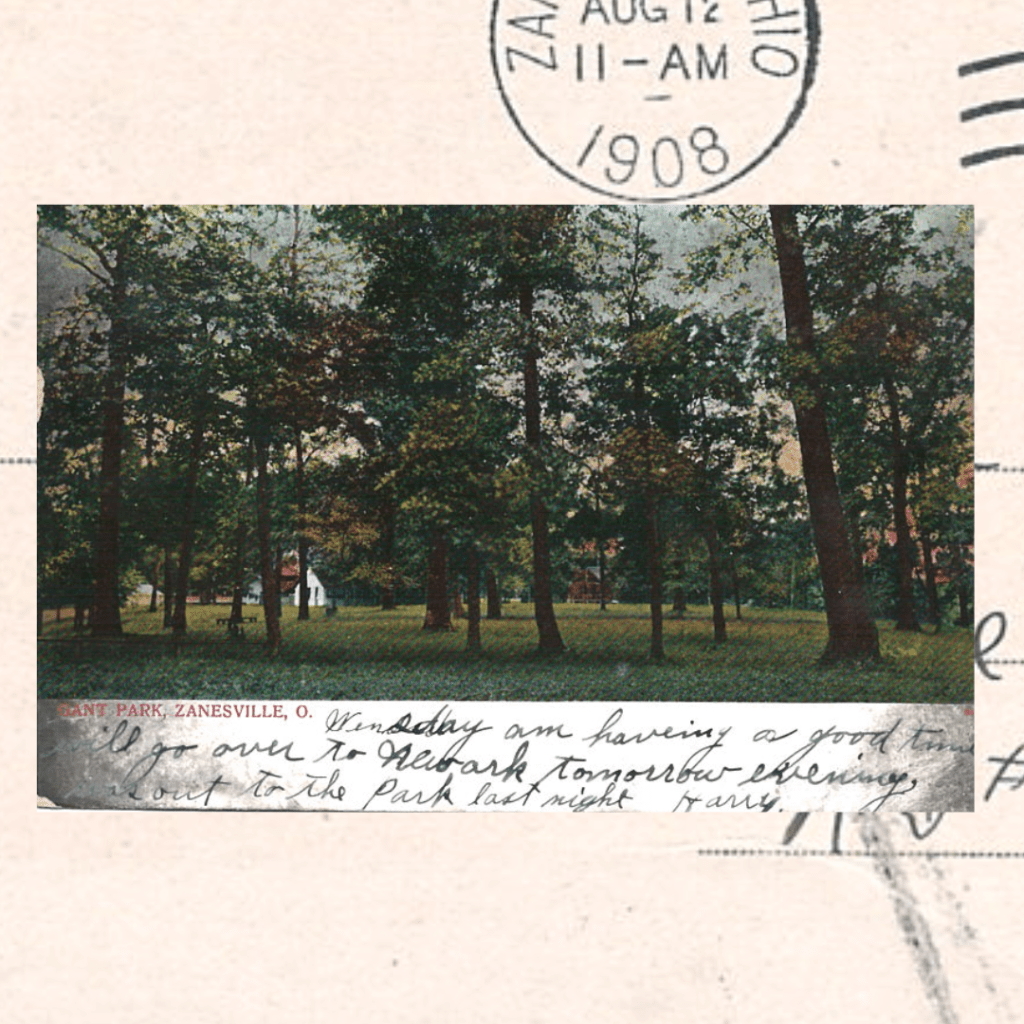
Front of Postcard: Gant Park, Zanesville, Ohio

 Hipstory
One reply on “A Glimpse into Historical Transitions and a Serendipitous Find”
[…] written somewhere between 1905-1910. Yes, I’m dating it after the divided back period began, because as we’ve seen before, just because you could write on the back of postcards beginning in 1907, didn’t mean […]
LikeLike