I am a lazy teacher. What I mean by this, is that I prefer to utilize resources in the classroom that I can tweak slightly and re-use over multiple units. My personal favorite resource for this is a one-pager. While, yes, I often post about the politics of teaching and education, on occasion, I would also like to provide resources for teachers to use for free. My goal for this particular post is to answer the “what, how, when and why” of one-pagers. I figure we do not need the “who” because it’s you, and your students. With that, let us begin.
What Is a One-Pager?
A one-pager is a visual technique created by AVID that allows students to think deeper about topics through creative engagement. In layman terms, a one-pager is quite literally a one-page assignment that includes words, images, symbols, and colors. Usually, a one-pager has different sections, and each box has its own instruction. My personal favorite format for a one-pager is a five box split with a border (pictured below) but you can make a one-pager anything you need. The goal is simply provide information in a visually creative way.
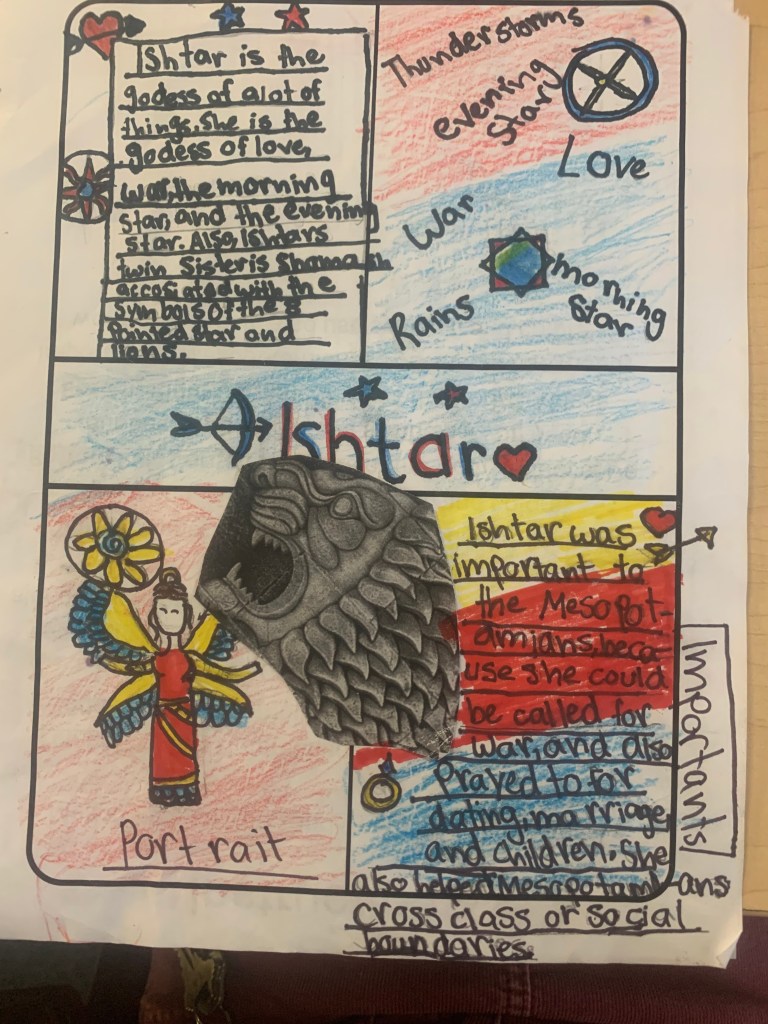
Image of my Gods and Goddesses one pager that I rolled out for a unit on Mesopotamia and again during Greece
When do I use a One-Pager?
The beauty of a one-pager is that it is incredibly versatile. You may use a one-pager during a formative introduction to a unit, vocabulary, topic, or idea. OR, you may use a one pager as a summative wrap up to…you guessed it, a unit, vocabulary, topic, or idea. One-pagers are also fantastic sub-plan assignments. I, personally, like to use one-pagers as creative summative assessments. So, I will often use them somewhere in the middle of my units. For example, in my “Road to Revolution” unit, my students created a propaganda one-pager in which they had to take either a Loyalist or Patriot stance. The students had to reference at least two things we had learned up to that point in class (taxes, Boston Massacre, etc). They had to come up with a slogan, include images, and explain their thoughts all on the one page. I’ve included an image of one of the completed projects below:
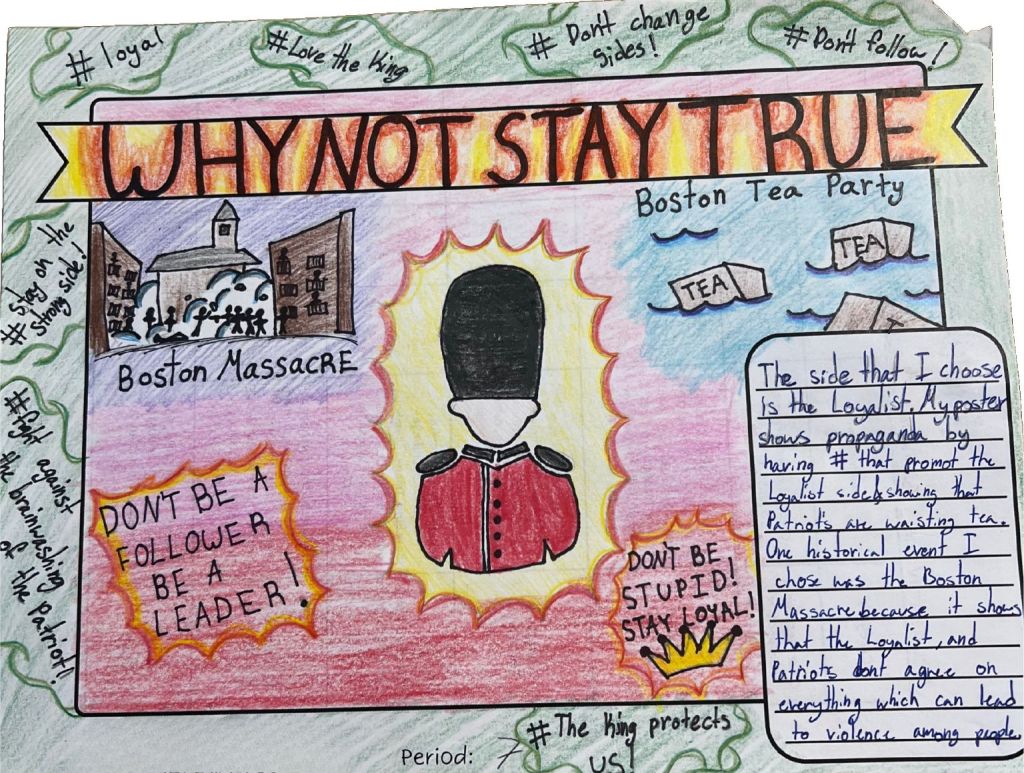
This student chose to take a Loyalist perspective, and utilized the events leading to the Revolution as proof the colonists should “stay loyal”.
How Do I use a One-Pager?
A one-pager is great because it’s low-prep and high engagement. However, that doesn’t mean you can pass out a piece of paper and say “draw”. When using a one-pager you need to ask yourself a series of questions like:
- How many days am I willing to spend on this project?
- Will the students work alone, or in groups?
- Is this a formative or a summative assessment?
- What do I want to include in the grading scale?
- What does each box represent?
You also need to figure out if you want to use multiple boxes (like the Gods and Goddesses one-pager pictured) or if you want fewer boxes (like the Propaganda One-pager pictured). For me, fewer boxes means a heavier emphasis on drawing. This is fantastic if you have a particularly creative class. However, it can be harder on students who can not draw. Alternatively, more boxes usually means more written words or symbols. This works really well for historical figures, characterizations, article analysis, etc.
Ultimately, once you’ve figured out your favorite template to use, you can tweak it slightly and roll it out for different units throughout the year.
But…How do I create one?!
If you have not already hopped on the Canva train, I highly recommend doing so. Canva will give you the ability to play around with different designs, and find one that works for you. It is super easy to use, even for those of us who aren’t artistically inclined (me). But, if you’ve stuck around this long…then guess what? I will give you a free, fully fleshed out one-pager that can be used in almost any 5th-12th grade classroom. You may download it below:
In my opinion, this article analysis one-pager is the easiest way to introduce students to the idea of of a one-pager. It can be used in any class, from English to Science, History to P.E. All you need to do is have an article, then print the one-pager and instructions for the students. I suggest giving them the entire day to complete this assignment, especially if they are younger. If the article is long, you may want to give them the article and comprehension questions the first day (formative) and the analysis one-pager the second day (summative). Of course, if you have questions, you can reach out.
Also, I hope that once you’ve used this one pager, it will help you generate ideas for how a one-pager would work in your classroom. You can use the idea to create your own resource tailored for you and your classes.
Ok…so what?
My approach to the classroom is low-tech, low-prep, and high-engagement. I have found that one-pagers check all these boxes. As I have already said, with slight tweaks, you can use a one-pager over and over again with minimal prep required. Use them for formative and summative assessments, upload them as emergency sub-plans or fast-finishers. Heck, even roll one out during your formal observation and prepare for your administration to be amazed by how awesome you are! The sky is the literal limit. No matter what you use a one-pager for, you will walk away with an easily gradable, easily displayable project that allows students to really engage with their critical thinking skills.
AND, although I do believe resources should be shared, I don’t believe that my time and creativity are free. Please use the one-pager I’ve given you, but please do NOT upload it as your own work, or reproduce online without referencing myself and providing a link to this post. Preferably, I’d also like you to send your colleagues to this post to get their own copy, rather than hand them the already printed product to use.
If you like this resource, you can support me and my TPT store at THIS LINK. I have a variety of already created one-pagers, simulations, and worksheets. If you have questions, ideas, or want to share what you’ve done with the one-pager, please comment or reach out.
Happy Teaching, friends!
“The function of art is to do more than tell it like it is-its to imagine what is possible”
–Bell Hooks

Leave a comment