Categories
Education family History Photographs Postcards Teaching Vintage Writing Prompt

Vacation Vibes and Weigh-Ins: A 1946 Postcard with Hidden Stories

To: Mr. and Mrs. Melvin Else From: Alas(?) 1946

Hi!!

Came up here Sun. for our second week. Herb stepped on the scales last nite — but not me! I can walk right past them. Temp. was 101 yesterday 0n the mainland but in our “no.12” it wasn’t so bad. Is Waterloo still only nine miles from Lake?

Alas(?)

In 1946, Harry S. Truman was president, the Philippines is granted independence by the United States (lest we forget that we for sure held territories and still do), the first underwater test on a nuclear bomb is conducted at Bikini Atoll, Dr. Spock released The Common Sense Book of Baby and Childcare, and It’s a Wonderful Life is released in theaters. Civil and social strife are still rampant, with a variety of lynchings that take place in the south, but the government is (slowly) moving toward civil rights laws.

In 1946, World War II was over, and the age of the United States had begun. The US had escaped from the war almost unscathed, and although this was a time of prosperity (for some), values began to move further and further right as the US struggled against Russia. Although it would be another 8 years before “under God” was added to the Pledge of Allegiance (1954), the US still felt the need to “prove” our superiority. This began the age of the baby boom.

When researching this postcard, the first thing that struck me was Alas’ mention of “Herb stepped on the scales.” I don’t know enough about vacationing in the 40’s to know if that was something that people regularly did (weigh themselves on vacation…) or if the “stepped on the scales” phrase means something different than what my modern mind understands. But, I did find a pamphlet for the lodge for sale on Ebay, and it looks nice! Horseback riding, tennis, shuffleboard, golf nearby, a pool and a lake. There’s also winter sports apparently. So, it seems that perhaps if you’re being active you might want to see if you’ve lost weight. But not Alas. I love a queen who knows how to protect her peace.

As for Mr. and Mrs. Melvin Else, I believe I found them. Though, I do think this postcard was written from a woman to a woman, so let’s begin by uncovering Mrs. Melvin Else. Mable Setz was born in 1907 in Waterloo, Wisconsin and lived nearly a full century, passing away on March 29, 2004. She and Melvin married August 28, 1936 when they were both 29 years old. Melvin died relatively early, in 1984 at the age of 76. Mable, however, kept on, living her whole life in Waterloo. No children are listed on the family search, so I’m unclear if they did have children, or if the children just aren’t listed.

What was their tie to Alas and Herb? I had hoped that either Melvin or Mable had a brother or sister that would help me find the other couple, but neither had siblings that even remotely matched with the names. I’m thinking perhaps cousins, or even old friends from Melvin’s military days (he served in WWII)? It would explain the question of “Is Waterloo still only 9 miles away from Lakes” Which…is a strange question since I can’t imagine a lake or a city are going to move.

Either way, the connection was strong enough that Mable and/or Melvin kept the postcard. Now, I have the pleasure of recounting Alas and Herb’s adventure to you, my dear readers. May we all have the strength of Alas to “walk by” those proverbial scales.

Deer Trail Lodge, Lake Nokomis, Heafford JCT., Wisconsin
Categories
Education family History parenting Photographs Poems Postcards Vintage Writing Prompt

Promises, Procrastination, and Postcards: Unraveling a 1912 Tease to Frank Van Gordon

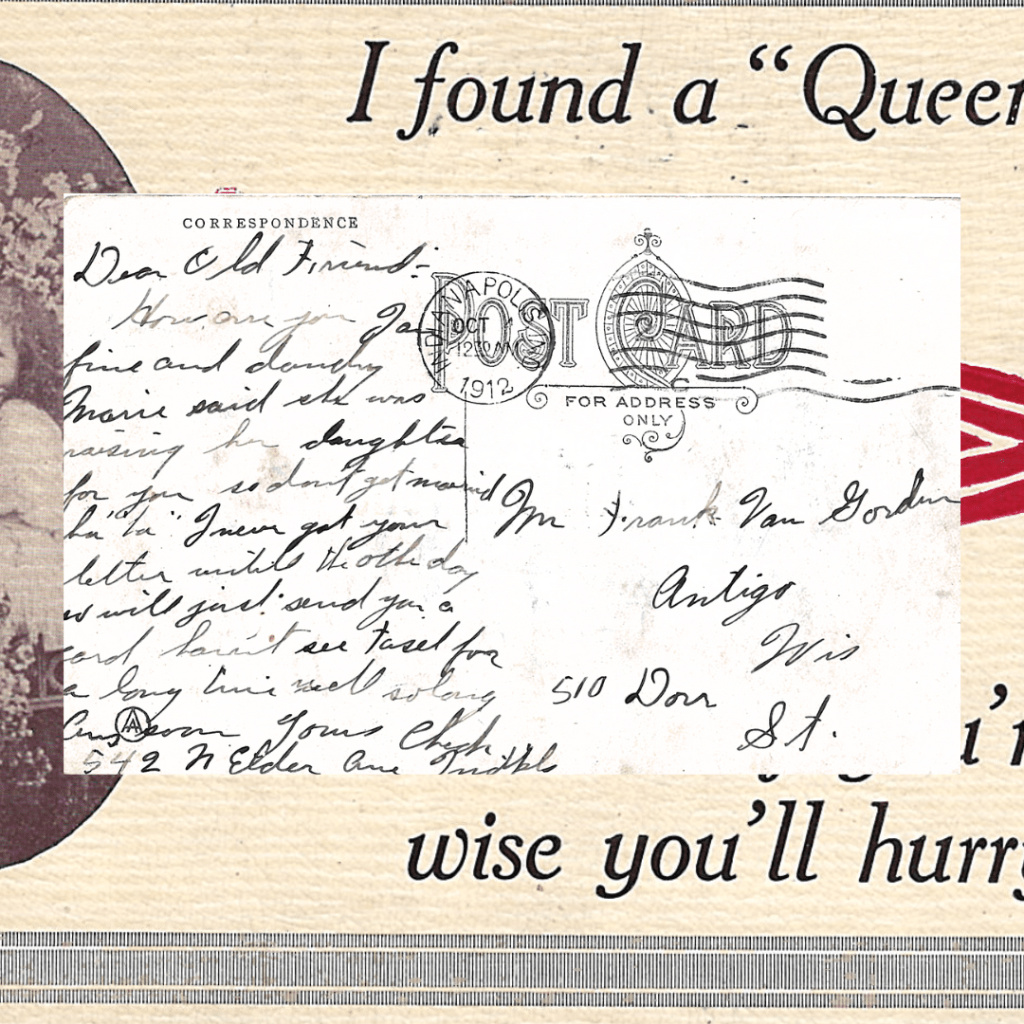
To: Mr. Frank Van Gordon. From, Chuck(?) 1912

Dear Old Friend:

How are you. I am fine and dandy. Marie said she was saving her daughter for you so don’t get married. “Ha Ha”. I never got your letter until the other day and will just send you a card. Haven’t seen tasel(?) for a long time. Well so long and soon.

Yours,

Chuck

542 N. Elder Ave, Indpls

In 1912, William Howard Taft was the president, New Mexico and Arizona were admitted as the 47th and 48th U.S. State (respectively), and in the early hours of April 15, the RMS Titanic sank in the chilly waters of the Atlantic Ocean. Suffragettes paraded in New York City, and Theodore Roosevelt was shot in Milwaukee, Wisconsin, proceeds to give a speech, then goes to the hospital.

It was a crazy year.

This card is one of the first postcards I put on this blog, though I felt like I never quite did it justice. There is just so, so much going on. First, there’s the innuendo that “marie” is “saving” her daughter for Frank. Which…I guess the jibe is fun but it gives me a bit of the ick. I also wonder why Chuck “never got” Frank’s letter. As a professional procrastinator, I wonder if Chuck did in fact get the letter, forgot about it until he saw Marie, then remembered to send a card.

Much to my chagrin, I couldn’t find Frank at all. There were a few decent candidates, but none of them fit the timeline well. I have to assume that in 1912 Frank was somewhere between 20-30 (I’d guess 22), especially seeing as his friend is teasing him about getting married. Also, Antigo is a relatively small town, though it’s part of the lumber industry. It’s possible that Frank was a lumber worker.

Which might be why he’s hidden from us in the archives. If he only worked in Antigo as a seasonal worker, or for a year or two, then there would have been no reason for the census to record him living in that city. Also, I wonder if he’s listed in the archives as simply “Frank Gordon”. It’d be strange, since “Van Gordon” isn’t that crazy of a last name, but it’s still possible I suppose.

Well, I revisited this card in the hopes that I could shed a little more light on Frank and his friend. I’m sorry that I couldn’t find them! At least I feel like I’ve given the card it’s due — especially since so much happened during 1912! I do wonder what happened to Frank. I hope he lived a good life, and managed to sit down to dinner with Chuck at some point.

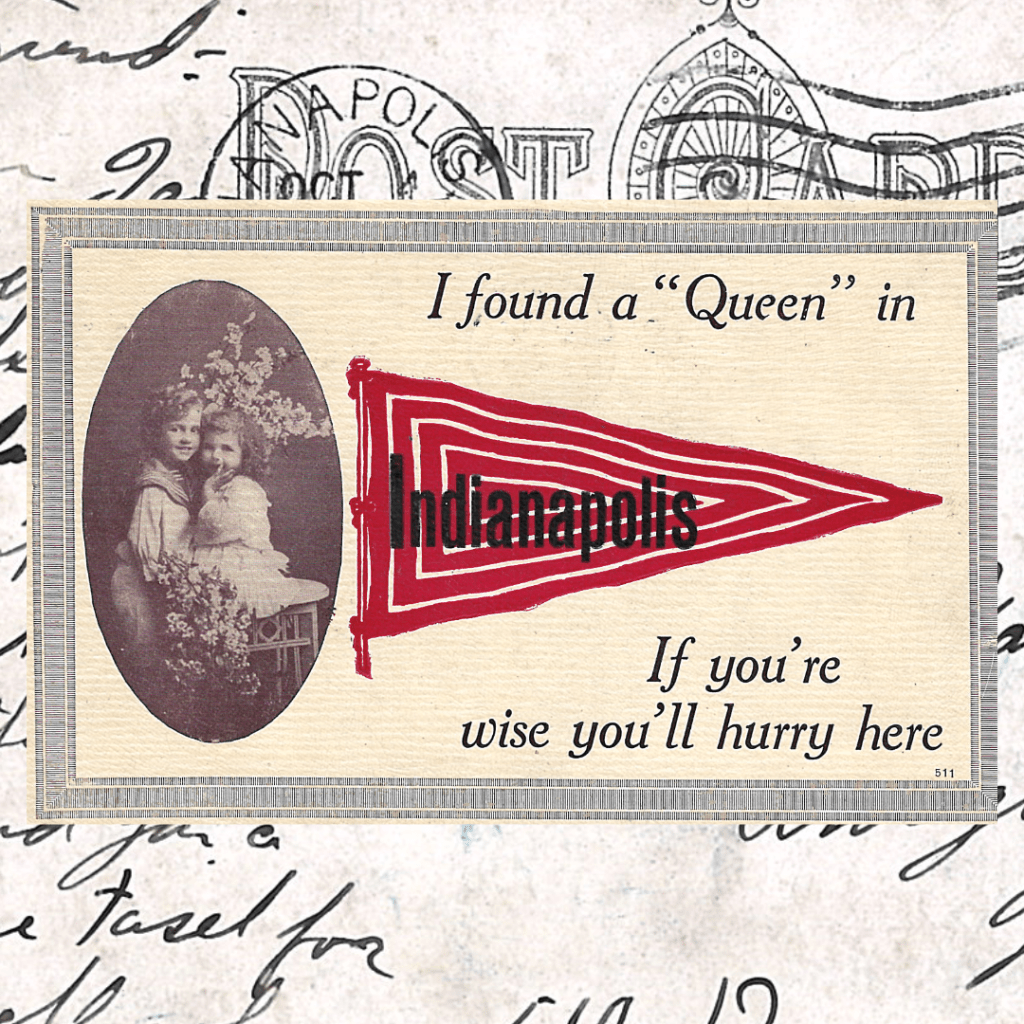
As an aside, the postcard front is so silly when you connect it to the message on the back. Chuck is teasing Frank about a wife, then sends a card that reads “I found a Queen in Indianapolis. If you’re wise, you’ll hurry here.” That’s more than a hint, it’s a smack across the head with a trowel.

Front of Postcard. “I found a Queen in Indianapolis If you’re wise you’ll hurry here.”

Categories
Education History Photographs Poems Poetry Postcards Teaching World War II Writing Prompt

No Rest for the Wicked: The Life of a Teacher in 1945

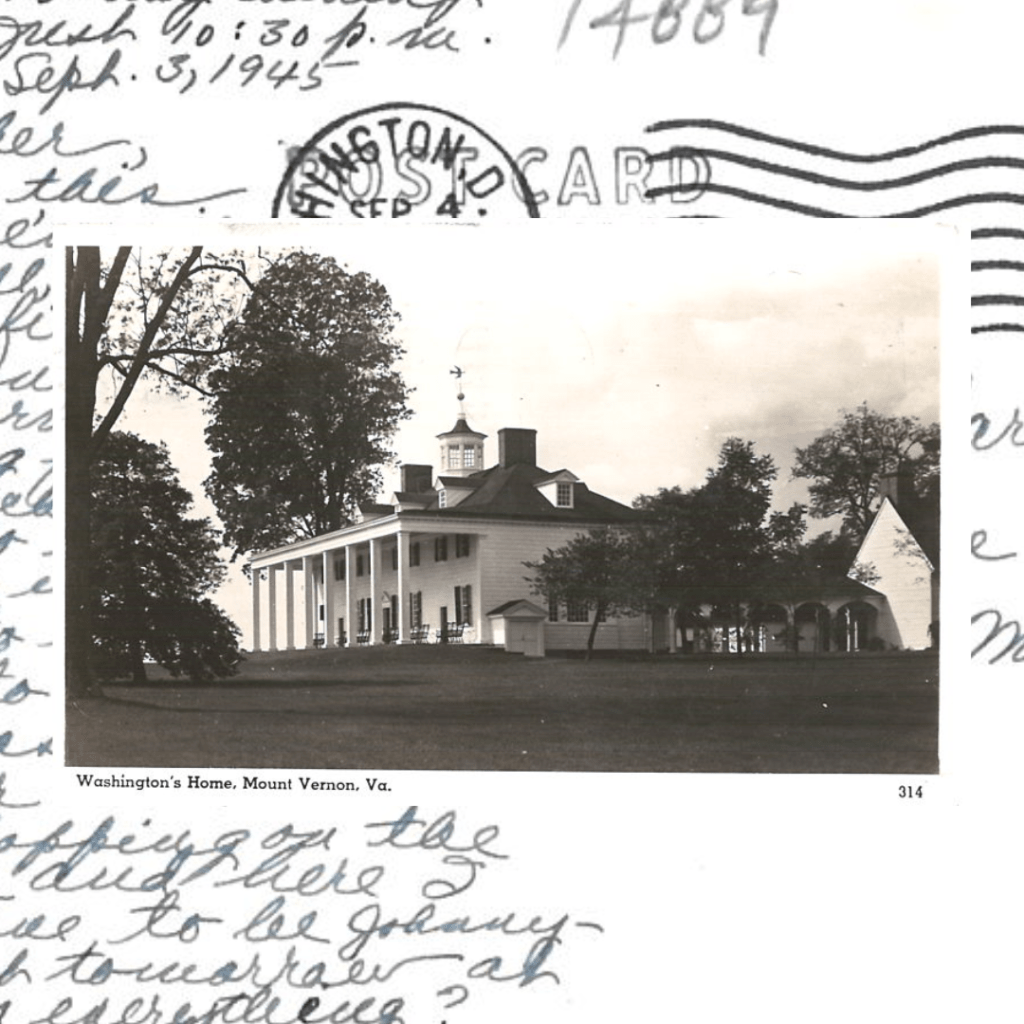
To: Mrs. J. Clarkson, From: Ruth. 1945

Monday Evening

10:30 PM

Sept. 3, 1945

Dearest Mother,

Haven’t seen this yet, but there’s a view for you. (unclear) badly put in our first work day and it wasn’t too bad. Spent the morning registering and signing forms. Had a picnic lunch out on the lawn and back to lectures and instructions until 5 p.m. Came back to hotel, changed, and (unclear) to a place called “Treasure Island” for dinner. Did some window shopping on the way back and here I am. Have to be Johnny-on-the-spot tomorrow at 9 a.m. Howe’s everything?

All my love,

your, Ruth.

September 3, 1945 was “Victory over Japan” day, or V-J Day, as that’s when Japan officially signed documents of surrender. Though, you wouldn’t know it from this particular postcard. In fact, there’s no mention of the war at all, not even a passing relief that it was finally over. As a historian, I find this fascinating.

In 1945, citizens of the United States had borne witness to the horrors that came out of the end of World War II. Liberated concentration camps, sunken faces of POW’s, and Nuclear Bombs pervaded newspapers for months. It’s no wonder, then, that Ruth simply tried to lead a normal life. As we know so well, when everything around you feels like it’s tumbling down, you cling to what you can control. Perhaps that’s what Ruth was doing, leaning into the mundane because she could control it.

When I started out, I wasn’t sure I would find Ruth or her family. I did have her first and last name, but I didn’t have the name of her mother, or father. However, after digging a bit on the internet, I found that in 1938, Ruth was teaching high school. The entry is as follows:

Miss Ruth Barbara CLARKSON
Who has taught at the Lincoln School for several years and is completing her first year at Manistee High School, received her A.B. degree from the University of Michigan. She teaches civics (12), economics (12), sociology (12), and English (11). Miss CLARKSON was born in Highland Park, Illinois, and is a graduate of Manistee High School. She assisted the Junior Class sponsor with the J-Hop.
(“Most Popular” female faculty member)

Since Manistee is a relatively small town, and since the time-frame sits right, I figured I had our Ruth. More digging, and I confirmed that Miss Ruth Barbara Clarkson, the most popular female faculty member at Manistee High School in 1938 is very likely our Ruth. I managed to find her grave, which lists her father as Joseph W. Clarkson. Hence, “Mrs. J. Clarkson.”

Ruth was born on October 9, 1910 to Joseph and Bessie Clarkson. Because of that wonderful yearbook blurb, we know that she earned a degree at the University of Michigan, and taught high school for several years. She died on April 13, 1963 at only 52. Unfortunately, I wasn’t able to find an obituary.

Why was she in Washington D.C? The tone of the card indicates she was doing some sort of work, and that she planned on going to Mount Vernon. And, I have to wonder, did she take students on a trip out there? Was it some sort of Civics convention? I myself will be taking the 8th graders I teach to Washington D.C. this Spring. It’s possible that she was on some sort of school trip. Perhaps that’s why she went through a list of everything they did. And maybe that’s why she had to be “Johnny-on-the-spot” in the morning. She had a bunch of students to wrangle!

It’s only conjecture, of course. The postcard gives us a lot of detail, but very little actual knowledge. What is apparent, however, is that she must have been close to her mother.

I do love this postcard. I hope Ruth had a wonderful time, and I hope she spent more lovely days in Washington D.C. seeing the sights, and taking picnics on the last days of summer.

“Washington’s Home” Mount Vernon, VA.

Categories
Education family History Photographs Poems Postcards Vintage Writing Prompt

A Friendship Through Time: Robert and Colby’s Story

To: Mr. Colby Reed. From: Robert Hensley, 1927

Dear Colby –

I am feeling fine and having a good time swimming. How would you like to take a dip with me.

Yours Truly,

Robert Hensley

Another postcard from the Roaring Twenties! I must be feeling the vibe of flappers and speakeasies! And, honestly, 1927 was a bit of a wild year. Actress Mae West was sentenced to 10 days in jail for her play titled “sex” because she “corrupted the morals of youth.” The Supreme Court decided the case Buck v. Bell which allowed for the compulsory sterilization of people with intellectual disabilities. I hate to tell you that this precedent hasn’t been specifically overturned, though it fell out of use in 1942 after Skinner vs. Oklahoma. In other news, the last Ford Model T is produced (later replaced with the Model A) and the Jazz Singer opened to great success; the beginning of the end for silent films.

There is a lot that is interesting to me about this card. One of the main points of interest is that I have two of the exact same cards (“A Rough Day on Lake Michigan”) postmarked 30 years apart. I decided to post this one today, and I’ll do the second one tomorrow. Sort of a fun trek through time to see that, when it comes to vacations, not much changes.

And so Robert Hensley found himself on Lake Michigan and decided to write to his friend, Colby Reed. Unfortunately, even though I have Robert’s full name, I couldn’t be positive I found him in the records. As is often the case with postcards, the people who wrote them are obscured by the card itself. Colby knew Robert, did not need an address, or probably even a last name. Thus, the act of recording a message and sending it to a friend becomes an act of erasure when it comes to family searches.

Colby, however, was much easier. With the city and state, I found him quickly. Colby P. Reed was born October 25 of 1909. At the time of this postcard, he was about 17 years old. Which honestly tracks, because the handwriting on the card is stilted and juvenile. It’s clearly two friends writing to each other, and I’d assume Robert is roughly the same age as Colby.

In 1923, Colby’s father died at the age of 56. His mother remarried that same year. Still, Colby would have been about 14 when this happened, and must have impacted him significantly. In 1938, Colby married Jean Cordelia McConoughey. What’s interesting is that there aren’t any draft records for WWII attached to his profile. This doesn’t mean that he didn’t register for the draft — at 33 he would have had to — but it is a gap in the records that makes my historian spidey senses tingle. Was there a medical ailment that made him unfit for service? In the census of 1940, he was working as a shop foreman, so I can’t imagine that he had a job that would prevent him from registering. I’m sure the record just hasn’t been attached yet, but it does make me wonder more about him.

Colby had one child, Ardis, and sadly outlived her. She passed away in 1999 to his 2000.

Since I couldn’t find any mention of Robert in Colby’s family line, I’m guessing they were school chums. Close enough for a 17 year old to hold on to a postcard for nearly 100 years.

If that’s not friendship, I don’t know what is.

Front of Postcard: “A rough Day on Lake Michigan”

Categories
Education History Photographs Poems Postcards Teaching Vintage World War II writing

1945: The Canal Zone’s Unique Postcard History

To: Mr. Scott R. Galbreath From: Robt. (Robert) 1945

Dear Scott —

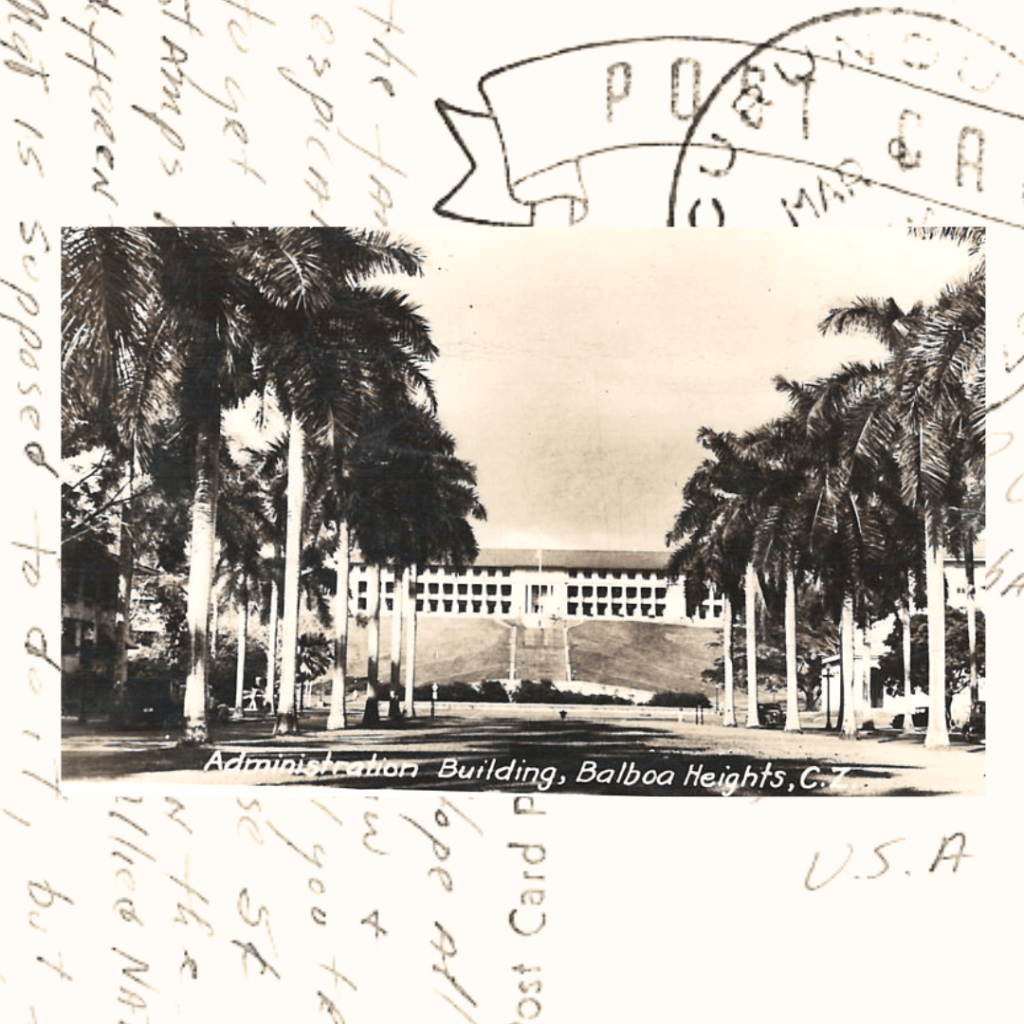
Hope all the family are ok by now and especially Exa. Scott will you try to get me a set of those 5¢ stamps recently issued on the different nations of the Allied Nations. Mgt (Margaret?) is supposed to do it, but I’m afraid she has slipped up. Also any other recent stamps, just 1¢ mint and send them to Mgt and I’m telling her to send you whatever they cost. I’m trying to get some nice ones here for both of us.

Best Regards,

Robt. (Robert)

I talked about it in a recent post, but in March of 1945, WWII was on it’s way towards being over. Allied troops were pushing Germany ever inward. FDR would be president for just over 30 more days, Americans launched the Battle of Iwo Jima in the Pacific Theater, and the Academy Awards were broadcast over radio for the first time. I don’t know why, but it always seems so strange to have something as incongruous as WWII and Academy Awards happening at the same time. As we know, the world rarely stops moving for big events (except Covid!), but still, it’s strange to see something as normal as the Academy Awards next to the Battle of Iwo Jima.

This particular postcard is super interesting, first because it’s postmarked from the Canal Zone (as in Panama Canal). Second, you can’t tell, but the postcard has a sort of metallic sheen to it. I’m unsure if it’s from age or if it was always the nature of the card, but it’s super cool to see in the light. I’ll try and capture it on video and post it to my Instagram account if you’re interested.

Through 1945 (and beyond) the Canal Zone was also deeply segregated by race. The “Gold” roll workers were almost all white US citizens, while “Silver” roll workers were non-white, non-US workers. The titles “gold” and “silver” stems from an earlier practice of literally paying white Americans in gold and non-white, non-Americans in silver.

Interestingly, the Canal Zone also issued their own stamps until 1978. The stamp is on the card, and not super obscured, but I’ve added a picture of it at the bottom as well. Even though the zone had their own stamps, that sort of mundane existence may be exactly what Robert chafed against — hence his request for various other stamps from his friend Scott. Poor Margaret, I wonder what she did to muck up his stamp order so poorly.

And what of Robert and Scott? Surprisingly, I found Scott immediately, largely because the name of his wife is so unique. Though, I’ll admit I thought it was Eva at first. Scott Robert Galbreath Jr. was born in Paris, Texas on September 13, 1908. In 1945, he would have been 36 years old. He lived with his wife, Exa, and his daughter Ammie, who was 7 in the census of 1940. From what I can tell, he was a manager at an insurance company. At least that’s how the census listed him in both 1930 and 1940. I even managed to find Exa in the record, though obscured by her husbands name, attending a silver tea for charity.

Although Family Search does not list any children, I did find his daughter, Ammie’s, obituary, which indicates that Scott had at least one son…yep…you guessed it…Scott Galbreath III. It’s always very rewarding when I’m able to track down snippets of a life from a postcard.

Robert and Margaret, however, remain a mystery. I had hoped that one of them was related to either Scott or Exa, and perhaps they were indirectly related (cousins or something), but they were not direct brothers or sisters of either one of the Galbreath’s. Though, judging by Scotts photo (on Find a Grave), I have to believe that he got poor Robert the Allied Nations stamps he so desired. I hope Robert enjoyed the heck out of them.

Front of Postcard, featuring the Administration Building of the Canal Zone

Categories
Education family History parenting Photographs Postcards Vintage Work In Progress writing Writing Prompt

Across the Pond: Exploring the Innuendo of a British Postcard

To: Miss D. Ekins From: Unknown Date: 1902-1920

Do you like this. If so don’t have to much

First, I want to give a huge shout out to Gemma at The Seafood Picnic Gift Company for this postcard. She sent the image to me about a week ago and we had fun trying to dissect what all of the innuendo might mean. I apologize in advance that I cut your thumb out of the card!

Second, what’s wonderful about this postcard is that it’s from Northampton, UK. I love this so much, but I don’t know postcard lore, nor have I tried to research outside of the United States. But, there’s always a first, so thank you again for giving me the opportunity to share this amazing card.

My guess is this card stems from around 1915, but it could date as early as 1902 and as late as 1930. For those of you who have been around for awhile, you might be thinking “but the divided back began in 1907!” You’d be right — for the United States. The UK introduced divided back postcards in 1902, a full five years before the US. Seeing as the image on the front is late 19th and early 20th century attire, and seeing as the handwriting is still flowery, I’d guess this was written 1902-1915.

I also think it was written by a man. Partly, because honestly a ladies handwriting would be significantly better (sorry dudes). Also, there’s a weird innuendo going on in the whole card. There’s the front of the card, which says “methinks the lady doth protest too much” (which smacks of Baby it’s Cold Outside“), and the vague (threat?) of “Do you like this, if so don’t have to much.”

I wonder what the card is actually asking Miss Ekins. Does she like what…dancing? Being forced to dance? The sender? Gemma thought maybe it’s a strange affair saying something to the effect of do you like me (the sender) if so don’t have too much (dancing with other men). I think it could be something like do you like dancing? If so, don’t have too much (liquor).

And what of D. Ekins? I found a decent match. A Mary Dolly Ekins lived in Northamptonshire and married John Bennett in 1919. The dates and places seem to align with our D. Ekins, and I’m inclined to think this may be her, but I’m not confident enough in my research abilities to say that it’s more than 50/50.

It feels like a long shot, but let’s say this is our Miss D. Ekins. She was born in 1888 and passed in 1926 at only 38 years old. This is a tragedy, as she was taken both too young, and only a few years after her marriage. With the date of 1919, I have to imagine the marriage was put on hold due to World War I.

Also, if this is our couple, could it be that John sent the card to D during the war? Perhaps he’s imploring her not to dance too much while he’s away? It’s hard to tell since both the stamp and the postmark are missing on the card. But it’s an interesting story…if it’s true.

What do you think? What vibe or story do you get from the card? What could the sender be implying? Let me know!

Front of Card: “Methinks the Lady doth protest too much.”

Categories
family History parenting Photographs Postcards Vintage Work In Progress World War II writing Writing Prompt

May 8, 1945: A Momentous Day

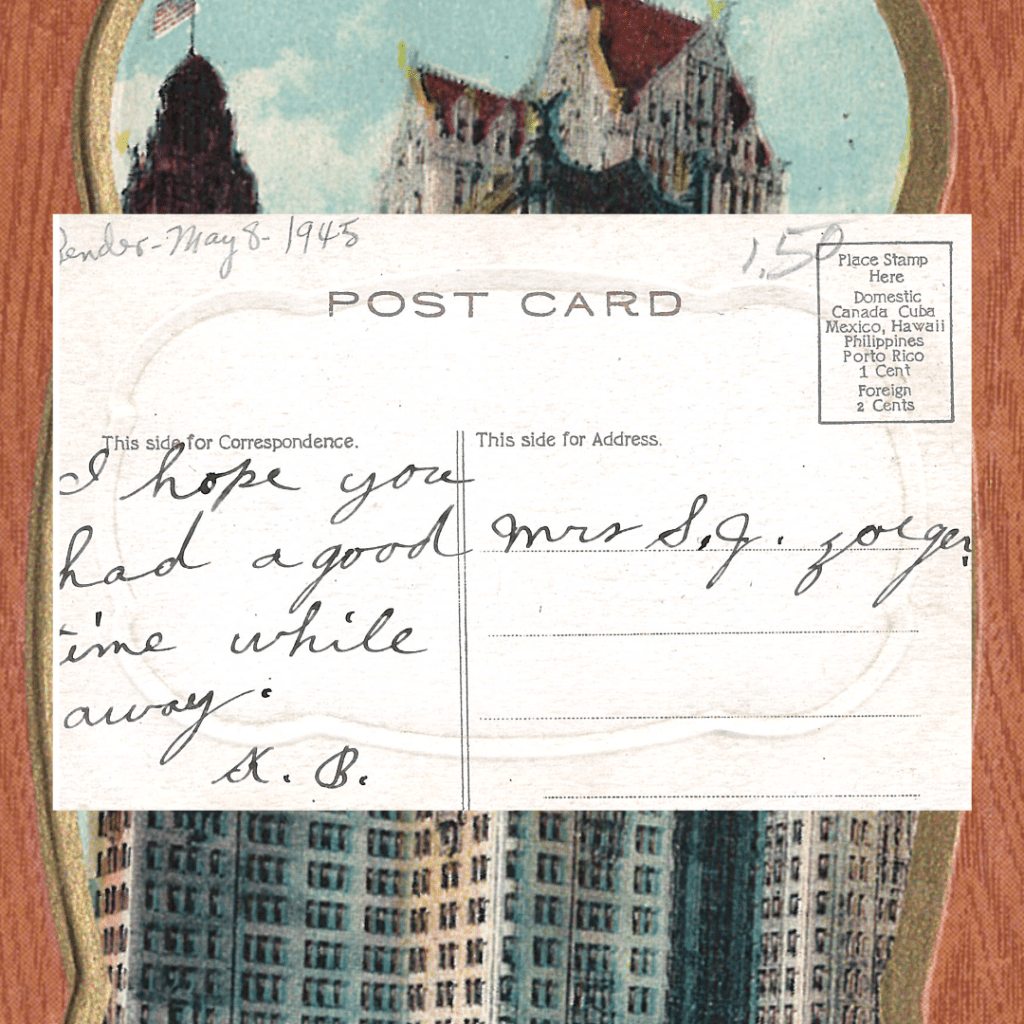
To: Mrs. S.G. Zoeger From: K.B 1945

I hope you had a good time while away.

K.B.

May 8, 1945 was a momentous day for the Western World. In the lead up to this day, we were nearing the end of the storm that was World War II. With the knowledge that allied forces were advancing on Germany, Adolf Hitler took his life and effectively ruined any hail mary on Germany’s part. And, on May 8, 1945, the Allies accepted Germany’s unconditional surrender.

This was Victory in Europe day.

Which is likely why the date was added posthumously, perhaps by Mrs. Zoegler herself. As historical dates often do, when we wake up and go about our lives, we don’t imagine that particular day will become important. But, of course, some days are filled with significance, and this was one of those days.

After hitting such a jackpot yesterday, I decided to choose a card that I’d been holding off on, particularly because I had the feeling that the research would be difficult. Not only is this card not postmarked or addressed, but the two people involved are obscured beneath their initials. However, we still have the clue of the card itself: an image of the City Investing Building in New York City, so that’s where I started.

Surprisingly, I found a few Zoegers. One family in Illinois even seemed promising, though not promising enough for me to be confident in telling their story. Alas, we will never know about the trip they took, or who K.B. may have been. My instinct tells me that K.B. may have been a neighbor who dropped a card into a mailbox when they saw their neighbors were back. From what trip? We won’t know.

But, perhaps that’s not the story this postcard is supposed to tell. Maybe, this card is to remind us that eventful days are just like all the others. They stream in and out of our lives like spider silk. It’s only once we step back for a moment that we can see the huge web of significance that tells our own stories.

Front of Postcard: Image of the City Investing Building

Categories
Education family History Photographs Poems Postcards Teaching Vintage writing Writing Prompt

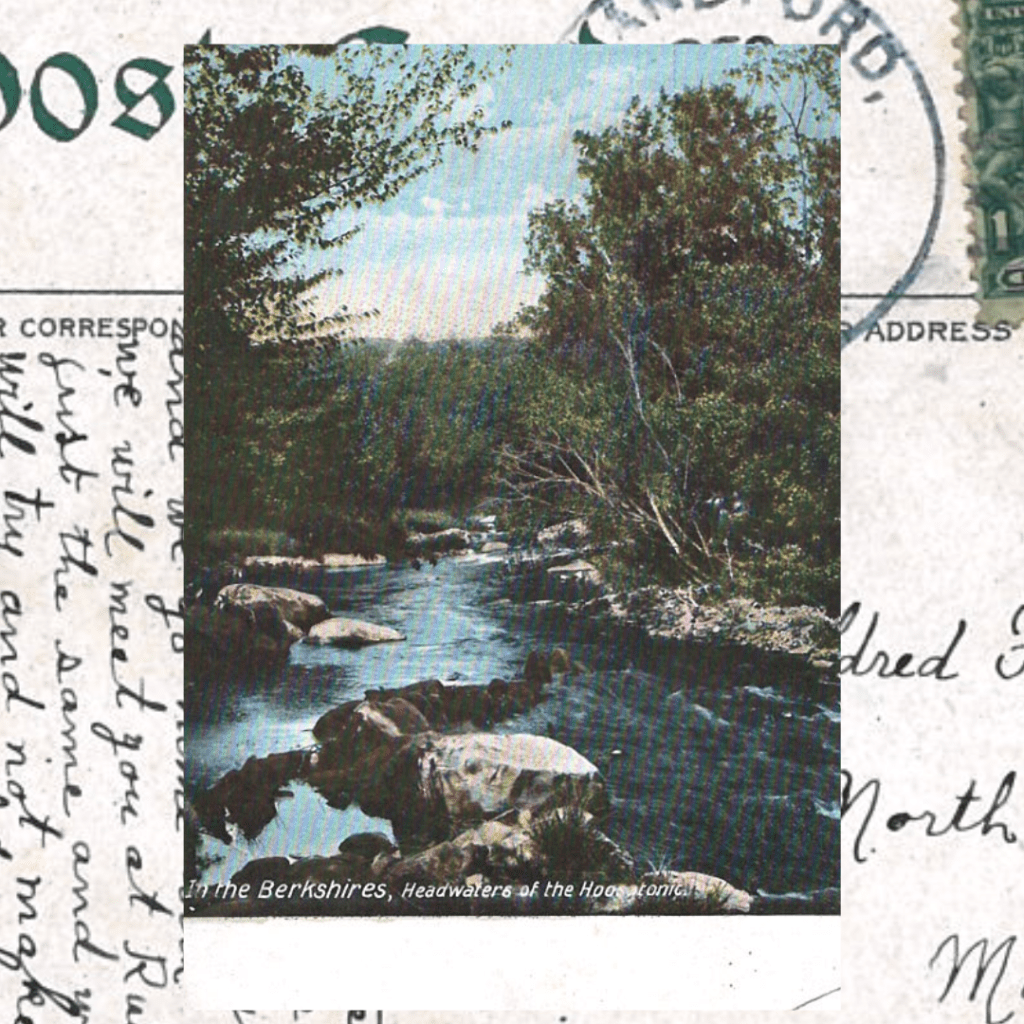
“He Was Here Last Eve”: Capturing Girlhood and Family Bonds in a 1909 Postcard

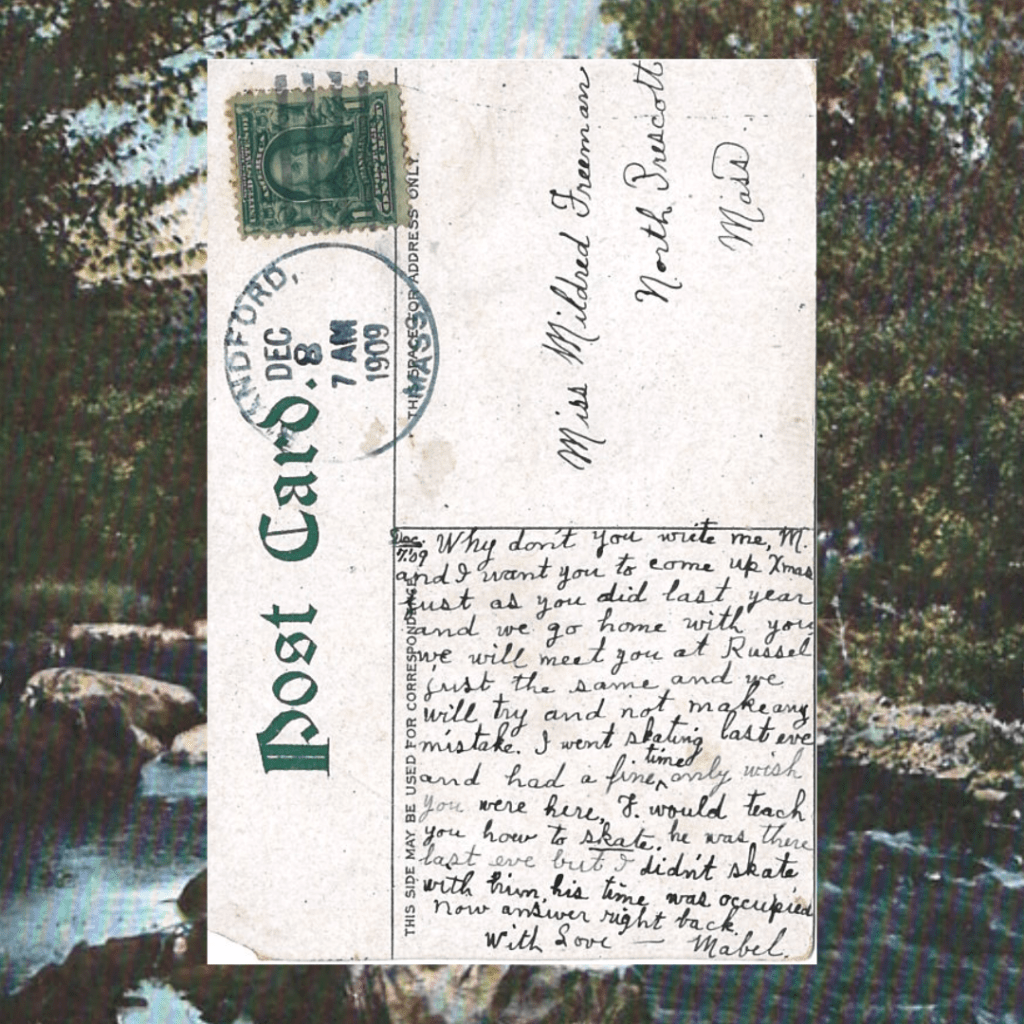
To: Miss Mildred Freeman From: Mabel 1909

Dec. 7, 09

Why don’t you write me, M. and I want you to come up Xmas just as you did last year and we go home with you. We will meet you at Russel just the same and we will try and not make any mistake. I went skating last eve and had a fine time only wish you were here. I would teach you how to skate. he was there last eve but I didn’t skate with him. his time was occupied. Now answer right back.

With love,

–Mabel

In December of 1909, William Howard Taft was president, Pearl Harbor is founded, and the Manhattan Bridge opened. Women couldn’t vote, neither world war had broken out, and we were still three years away from the Titanic sinking to the bottom of the Atlantic.

While I love the many different postcards that I write about, and while each of them is a gem unto themselves, this particular postcard feels like something special. Partly, because it reads like it came directly out of a period movie. I can almost hear Mabel’s sweet but chastising voice, almost picture her coy and playful smile, can practically hear her nonchalant frustration at his time being too occupied to skate with her.

It is a perfect snippet of girlhood. The longing, the frustration, the all encompassing angst of (unrequited?) love. So rarely does a card capture the essence of a moment so wonderfully.

Yet this is undeniably Mabel. And she is amazing.

I love this card so much that I almost didn’t want to research the people involved. I know that sounds counterproductive, but I enjoyed the picture painted by the correspondence, and worried that research might ruin that image. And, as I’ve stated time and time again, researching women is complicated. They are obscured by their fathers and husbands, and maiden names can be just as difficult to research as married names.

But this gem of a card just kept on giving. One quick search and I immediately found Mildred Freeman, and her story is just as interesting as Mabel’s story on the card. Mildred Freeman was born September 28, 1894 in North Prescott, Massachusetts. At the time of this card, Mildred was 16 years old. However, she was only months away from her wedding to Charles Fiske, a man 7 years her senior. For reference, he was 23 to her 16 when they married. Perhaps that’s why Mildred wasn’t writing Mabel back…she was being courted by Charles. Mildred had one son and died in 1988 at the age of 94.

And what of Mabel? The letter suggests the two girls are related (especially since Mabel suggests they spend Christmas with each other’s families), so I went through each of Mildred’s aunt’s and uncles in the hopes I could find a cousin that matched.

And I did…sort of.

Mabelle Florence Beach was born on June 16, 1889. At the time of the postcard, she was 20 years old. This surprised me a little, since the voice of the card reads a tad younger. However, it still tracks. The tragic thing about Mabelle, or perhaps not so tragic depending on how you view it, is that she never married. Her father died in 1907, and in the census of 1920, Mabelle was working as a stenographer. Mabelle died in 1944 at the age of 55. She was buried with her father and mother, which I find endearing. Though, I’m saddened he never gave her the attention she hoped to receive.

What a lovely, lovely card. The love between these two cousins endures, and I’m so grateful to tell their story 115 years later.

Front of Postcard: “In the Berkshires”

Categories
Education family parenting Photographs Poems Postcards Teaching Vintage writing Writing Prompt

“Greetings”: The Art of Succinct Messages From A 1908 Postcard

To: Mr. Andrew Berlin From: Martin 1908

Greetings from Martin

The beauty of this postcard is astounding, and I’ve loved it since I first saw it. Yet, I’m in the business of connections, not art and the brief greeting on the back of the postcard always left me a little sad. Unlike so many of my cards, there’s almost a lack of connection here. It’s cold, formal, almost a card of obligation rather than desire.

In my (limited) experience, there’s two reasons why a greeting might be so short on a postcard. First, the writer is young. Let’s face it, kids can pepper you with questions, and string stories from their imaginations, but when asked to write a card or a thank you — they freeze up.

Second, short greetings are usually reserved for undivided back postcards sent before 1907. Those required the sender to write on the front and often left little to no space to send more than a “wish you were here.”

This card doesn’t seem to fit any of the above. The handwriting is too elegant to be considered a childish scrawl, it’s dated 1908 with a divided back, AND there’s plenty of blank space on the front for the sender to write a message if they had wanted.

In going into my research on the addressee, I now have a set of questions in my mind. Like, how old were they when the postcard was sent? Is there a Martin in their family tree? And why might the postcard be postmarked in the same city?

It would be a lovely thing if archives opened up and the answers to all our questions spilled out of their coffers. Unfortunately, that’s not the case. I am not positive that I found our Andrew Berlin. However, I did find record of an Andrew Berlin living in Minnesota at the 1910 census. In that year, he was 7 years old.

If this is our Andrew (which I am not positive that it is) then the short greeting is appropriate for a five year old. Perhaps an Uncle or a cousin sent the card in the cold March months to cheer the boy up. It’s plausible. A beautiful picture, a succinct greeting, calling him “Mr. Andrew Berlin” as though he’s older than his five years. It’s certainly something I might send to my niece or nephew.

The only sort of broken cog in the machine is that I couldn’t find a relation named Martin for this Andrew. But, I didn’t scroll through the myriad of cousins on both sides of the family, so we can hope.

In the meantime, please enjoy my own maiden meditation.

“Maiden Meditation” front of postcard

Categories
Education family History parenting Photographs Postcards Vintage World War II writing

Tripping the Light Fantastic: Exploring Chicago Through a 1942 Postcard

To: Mr. Jim Henry From: Private Shorty Martin, 1942

Taken in the big city of Chicago. We would like to have sleepy here. I am having the time of my life with all the trimmings. Just got here, budies are waiting , tell all hello, will see you all later.

Pvt. Shorty Martin

By November of 1942, the United States had entered into World War II with fists swinging. Although the US had instituted a peacetime draft in 1940 — which required all able bodied men ages 18-45 to register, many of the enlistees were volunteers. Chicago, a city bustling with industry, was a vital crossroads for war preparation.

Not only was Chicago a major industrial city, producing parachutes, bombs, metal sheeting, and airplane engines (among many other things), but was also within easy reach of various military training facilities like Fort Sheridan, Glenview Naval Air Station, and Great Lakes Naval Training Station. It’s no wonder, then that Pvt. Shorty Martin tripped the light fantastic in the bustling streets of Chicago.

Unfortunately, I couldn’t find Jim or Shorty. There were a few decent contenders, but none that I could link to Waco definitively. Though, there were more than two “Shorty’s” running around Texas before and after the war. Although I couldn’t find our sender or recipient, it’s fairly easy to imagine a young soldier experiencing a big city for the (maybe) first time in his life.

I do love that he’s meeting up with some of his buddies. I wonder if these are military friends, or simply connections he has in Chicago. It’s feasible that Shorty was African American. As industrialization boomed in the United States — and racism spread after the fall of Reconstruction — Black men and women left the south in waves and traveled north, many of them landing in cities like Chicago. Perhaps Shorty had friends or connections already who had made the move?

I also puzzled over the “would like to have sleepy here.” I couldn’t figure out if he wanted to spend the night, but couldn’t, or if it was a misspelled word (or a mistake in transcription). But, after a minute, I came to the conclusion that I think “sleepy” is a person. He would have “liked to have sleepy here” seems like it’s too bad another friend couldn’t join. I assume Jim knew who sleepy was but nothing is certain in the postcard game.

The card itself is a linen postcard published by Curteich with a vibrant and stunning image of the Chicago skyline. While the scan did bring out many of the colors — it’s even prettier in person.

I do hope Shorty had a fabulous time exploring Chicago. Cheers to him and Jim.

Curteich Postcard: Michigan Avenue North from River, Chicago