Categories
Education History parenting Photographs Postcards Vintage World War II writing

The Untold Story of Lizzie J. Dearwechter: A Postcard Journey

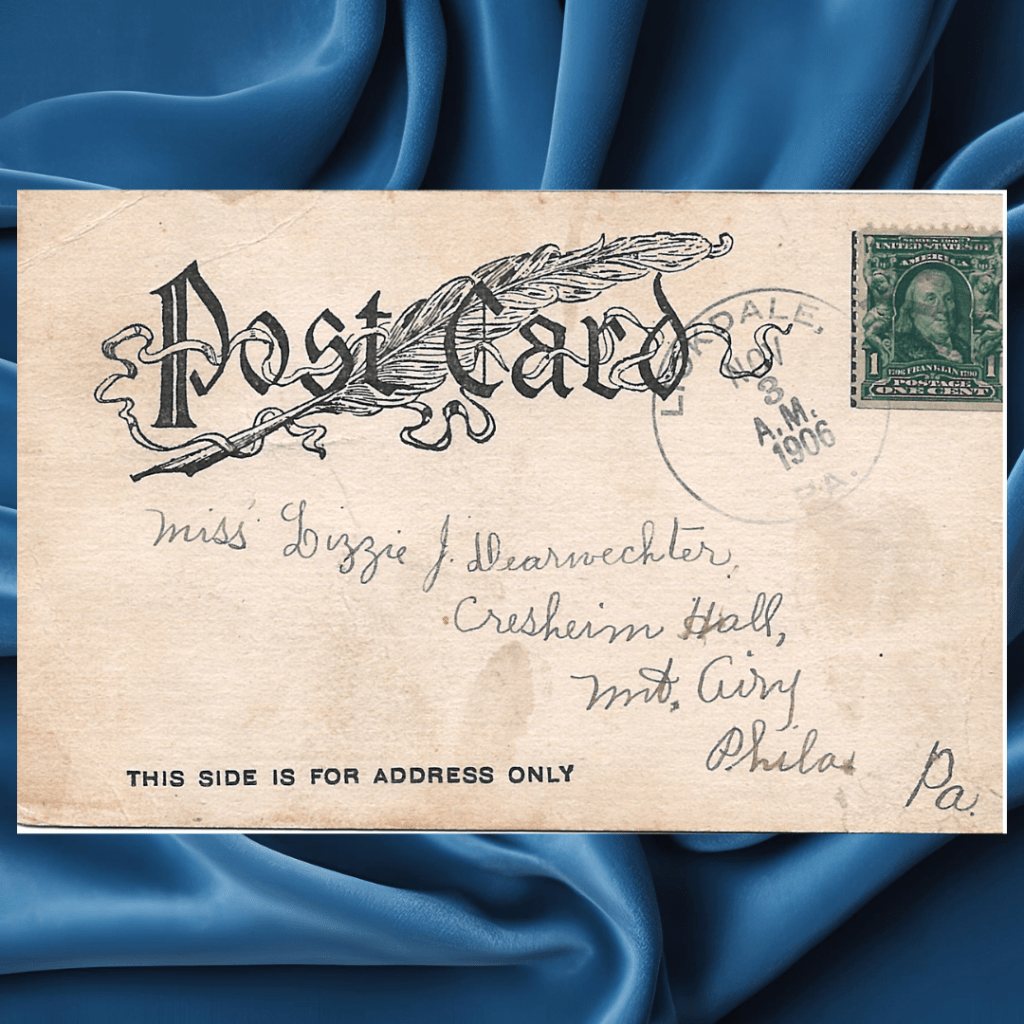
To: Miss Lizzie J. Dearwechter From: E.W.A 1906

I’ll write you next week. I am having a fine time on the cornfield.

From a friend,

E.W.A

In 1906, Theodore Roosevelt was President, Upton Sinclair published The Jungle, and Oklahoma was still a territory, and not yet a state. By November, San Francisco had been devastated by a 7.8 magnitude earthquake, and in what the newspapers called the “crime of the century” Harry K. Thaw shot Stanford White in Madison Square Garden. The Progressives were making their mark on the American landscape…in whatever way possible.

And, as we know a little bit about postcard history, 1906 was an undivided back period. This is a time where postcards favored the front image and had very little space for any sort of message as the entire back was to be utilized only for the address. Although undivided back postcards often lack details for research, they are beautiful. Even the printed word “postcard” with a feather in the background is luxurious and hints at a fancier, more formal time.

This postcard is funny to me, largely because the sender has chosen a postcard of a “typical California home,” but sends the card from Lickdale, PA. Lickdale is a small, unincorporated town in the south east of Pennsylvania that shares a zipcode with a few other cities. The total population for the zip is upwards of 8,000 people.

Pretty far from California if you ask me. As a historian, I understand the magnetic pull that the west coast has on the American psyche. I have to believe that the image of curated palm trees in front of a Victorian/Gothic-esque house was a bit of wishful longing. Perhaps the two friends had dreams to move west, or loved the idea of California. Perhaps E.W.A just liked the postcard.

As for Lizzie J. Dearwechter, with a little bit of luck, and a lot of elbow grease, I managed to find her in the records. I had to follow a few lines of Dearwechters, but I did it! Lizze was born October 13, 1888, so by November of 1906, she was 18 years old. I was curious about Cresheim Hall, so I looked it up. It seems that it was a School for the Deaf in Mt. Airy, Pennsylvania. The only real problem that I’ve run into is that –other than this postcard — I can’t place her at this address with the sources available.

Miraculously, Find a Grave included more than a picture of the tombstone, it included Lizzie’s obituary! It’s a rarity, especially since she passed in 1976. I had hoped that maybe the obituary might allude to her time at the hall, or perhaps indicate whether or not she may have been Deaf. However, it provided no further insights. What we do know is that she was single in 1906, but had met and married her husband by 1908. She went on to have 13 children, and upon her death she was survived by 31 grandchildren and 42 great-grandchildren. A legacy indeed.

As for E.W.A…well they are impossible to track down. However, their quick note about enjoying the cornfields spawned a 118 year journey that led us to unravel snippets of Lizzie’s life. A life that saw the sinking of the Titanic, the Spanish Flu outbreak, both World Wars, the assassination of J.F.K, the moon landing, Civil Rights, and Woodstock…amongst other things.

Thank you, E.W.A, for the postcard.

Close-ups of both sides of the postcard

Categories
Education family History parenting Photographs Postcards Teaching Vintage Work In Progress World War II writing

1941 Postcard to Sadie Baris: Cheeky Flirtation or Simple Friendship?

To: Miss Sadie Baris From: S. B. Leuson 1941

Don’t get me wrong – I’m only mailing a postcard.

Regards,

S.B. Leuson

In 1941, FDR was the President, Citizen Cane was released in theaters, Bob Hope hosted the 13th Academy Awards, and the US froze the assets of German, Italian, Hungarian, and other occupied countries. War hadn’t yet reached our shores, but preparations for the war had.

I love postcards that are sent to or from New York City. I’m a girl from the West — used to open spaces, mountains, and warm weather – so I’m always intrigued by the thought of city living. My grandmother grew up in New York City and I often think of her as well when I see these postcards.

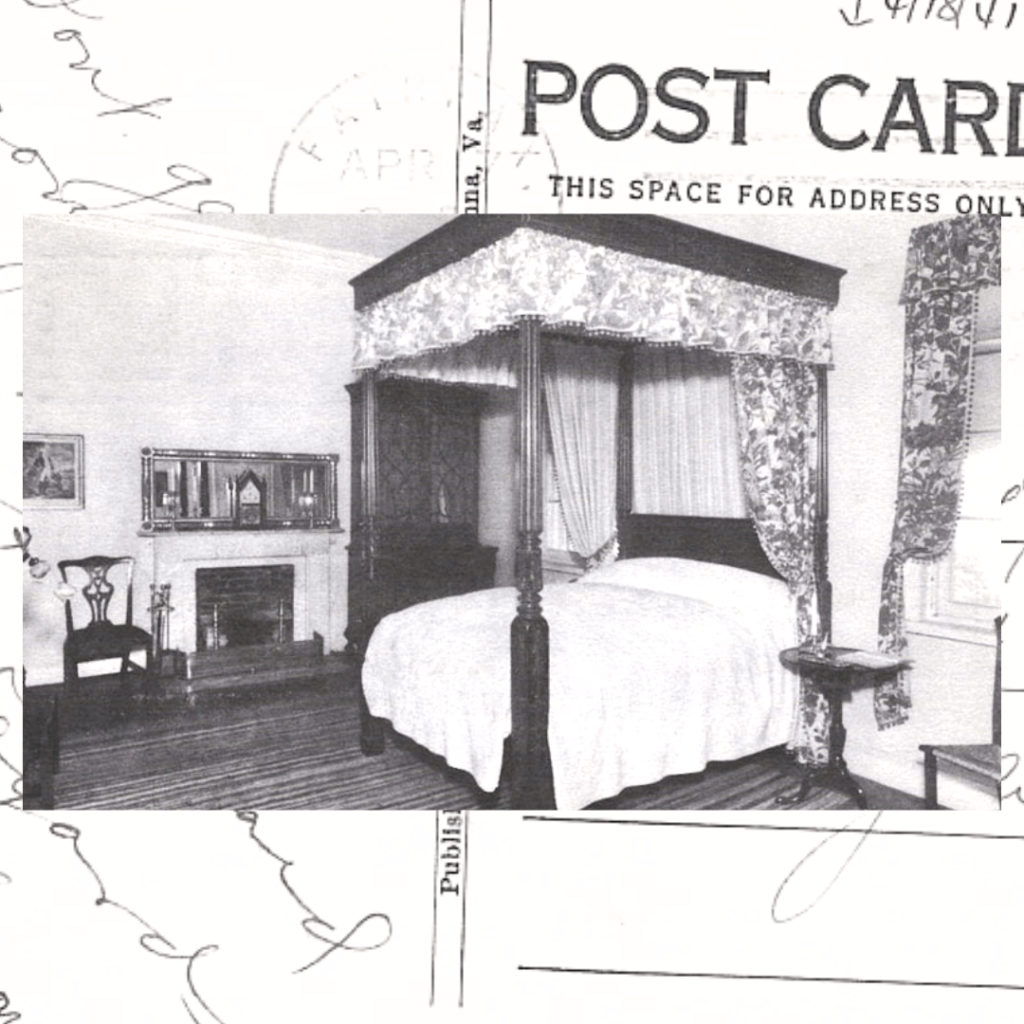
This particular card is not so much intriguing as it is…silly? Fun? In my reading of the card, there’s an implied innuendo. The front of the card depicts a bed in the Lafayette Room at Lee Mansion in Arlington (colorized in the above picture). As you’ve read, the note on the back states “Don’t get me wrong – I’m only mailing a postcard.”

Yes, friend, but it’s a postcard with a picture of a bed! If I’d received that card as young adult, I definitely would have read into the meaning. I *for sure* would have gotten our friend S.B. *wrong.* Furthermore, the writer wants to downplay the fact that they wrote a postcard from Virginia and sent it to New York.

Sure, it only takes a few minutes, but typically one doesn’t send a postcard unless you care for the recipient. Also…the fact that there’s a bed on the front and the “don’t get me wrong…” on the back? My girlfriends and I would have dissected that meaning bit by bit in the waning hours after midnight, probably while drinking.

Again, we definitely would have gotten him wrong.

As for our recipient, Sadie Baris, I thought I would have a hard time locating her, but it turns out I got some results. There was a Sadie Baris in New York City who was born in 1909. If this is our Sadie, she was quite an accomplished woman. She became a lawyer in 1933 and eventually became a judge in New York. For a woman in the 30’s this is quite a feat!

So, was this our Sadie? The postcard is addressed to “miss” meaning that Sadie would have been unmarried in 1941. If this is our Sadie, she would have been 32 in 1941. A bit “old” to be unmarried. However, the Sadie I found didn’t marry her husband (Nathan Turak) until 1943, so I feel fairly confident this is a match. If true, Sadie Baris Turak lived to be 103 years old! She retired from her post as a judge when she was 100! Illustrious indeed.

What about S.B.? I do sort of thing this is a man writing the card – though it could be a woman as well – and I will argue that the card was suggestive in nature. Perhaps I’m so far off. However, it lends a bit of fun and drama and life to the past. But, what do you think? Is this a case of flirtation, or a cheeky note from a family member? Let me know!

Front of Postcard (In original black and white)

Categories
Education family History parenting Photographs Postcards Teaching Vintage writing

Nellia and Lola Frey: A Glimpse into Childhood Innocence

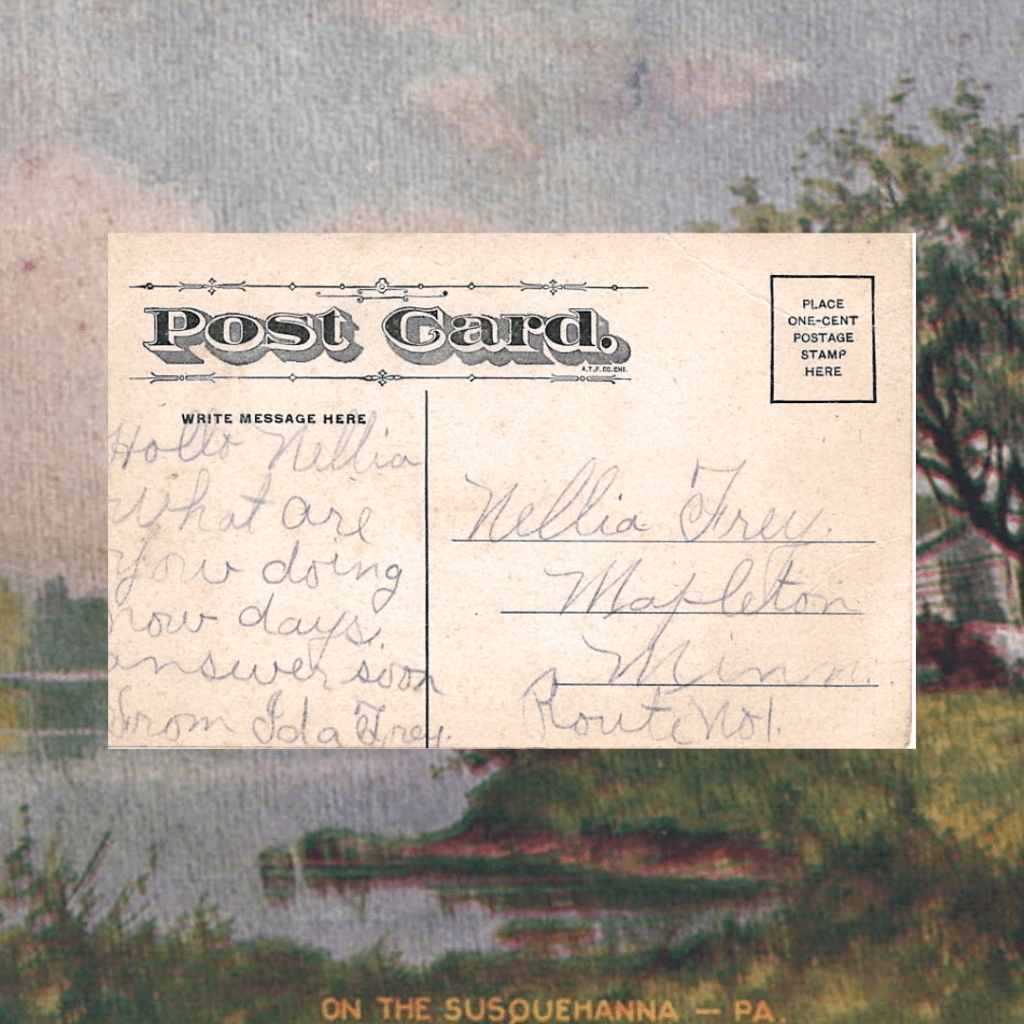
To: Nellia Frey From: Lola Frey Circa 1910-1920

Hollo (sic) Nellia,

What are you doing now days. Answer soon.

From,

Lola Frey

From the “what are you doing now days” (without a question mark) to the childish script so lovingly labored over, childhood innocence spills out of this postcard. In fact, it’s what truly draws me to this particular card in my collection. I get this vivid image of a young girl writing at a small table, her tongue stuck out in concentration, her palms sweaty as she tries to perfect each swoop of the cursive lettering. Truly beautiful.

Unfortunately, there’s no postmark, so it’s hard to say when — or even where — the postcard is from. Based on the handwriting, my guess is that it lies somewhere between 1910 and 1920. However, without a stamp the only thing we know for certain is that it was after 1907 (the divided back strikes again!).

When setting out to research this card, I felt pretty positive I’d be able to find the sender or recipient. I had both names, a place, and some sort of family connection, so I really believed that I’d be able to go down a family line and find Nellia and Lola.

Oh, how naive I am.

Much to my chagrin, I couldn’t find Nellia or Lola at all. Even accounting for the fact that Nellia may be a pet name, and is more likely to be “Nellie” in the records. I immediately found a promising family, but there wasn’t a sister or cousin that I could trace to them. In that research, however, I did find a beautiful Nellie Frey Hagburg. Her photo is blurred, but she’s staring out of the frame with a slight smile on her face and has a Mona Lisa quality to her.

That Nellie is not our Nellia, but she died of consumption at 19, followed the next year by her mother. A pattern of loss that must have devastated the family.

As for Mapleton, it’s a small town located in the southern quadrant of Minnesota. As of 2020, the town only had 1,700 people, 3 full time police officers, and a volunteer fire department. I’m willing to bet that Nellia was of German decent, and was first generation in the midwest.

Without a postmark or stamp I have to wonder how Lola got her card to Nellia. I suspect they are cousins. Perhaps one brother was visiting the other and took the card. Perhaps Nellia and Lola were of the same age, and an older cousin was visiting Lola’s house and took the card. We can’t be sure of any of it. But, the card exists in the record as a memento to the love and innocence of childhood bonds.

Front of Postcard

Categories
Education family History parenting Photographs Poems Postcards Teaching Vintage writing

Ruth’s Glee Club Adventure: A Postcard from 1907-1929

To: Mrs. F.W. Sargeant From: Ruth, circa 1907-1929

It is deeply gorgeous here. The glee club has come to Charlottesville for the day, and we’re driving (or buying?) up all the (?)

— Ruth

This postcard is maddening because the postal mark is in near perfect condition with the exception of the date! I obviously don’t know the exact year, however we can at least put a date range on the postcard if we examine the breadcrumbs left to us by history.

Between 1898-1917 it only cost 1 cent to mail a postcard. We can at least see the 19 on the postmark, and while the handwriting is luscious, it’s not the turn of the century script I’d expect to see in an early 1900 postcard. Our other clue is one we’ve seen time and time again — the divided back! So, the postcard has to be post 1907. That leaves us with a ten year range: 1907-1917. However, I have other postcards from after 1917 that have a 1 cent stamp. So…my instinct says this is closer to the 1920’s. Similar postcards are dated in the late 20’s — which is more in line with the handwriting on the card.

I adore that Ruth wrote while she was traveling with the glee club. She sent the card in April, so it’s not necessarily a summer trip, but could still have been a school trip. It’s possible she’s writing to a sister or an aunt or maybe even cousin. I don’t think it’s her mom. The tone of the card is too matter of fact. Sort of like she’s on this trip that she wants people to know about — but she’s not necessarily missing anyone.

So what of our sender and recipient? 741 Chestnut Street still stands in Manchester, NH. It was built in 1895, which lends credence to an earlier date. Like so many other times before, we run into the problem where the woman’s name is erased. “F.W.” is likely Mrs. Sargeant’s husband’s initials. Without either her first name, or her husband’s name, it’s pretty difficult to track down the original recipient.

There were a few promising matches. I found a Forest W. Sargent that I thought might lead to something, but alas I could never match the address to the name. Of course if I paid for property records I’m sure I could find them, but for this amateur postcard genealogist that’s not in the cards for now.

Suffice it to say that Ruth had a lovely time with the Glee club. I imagine that she’s somewhere in her teens or early twenties, traveling with bosom buddies, and living in the bright rays of late spring soaking up her days of youth.

Front of Postcard depicting Monticello, the home of Thomas Jefferson

Categories
Education History Photographs Postcards Vintage World War II Writing Prompt

Blackouts and Friendship: A World War II Connection

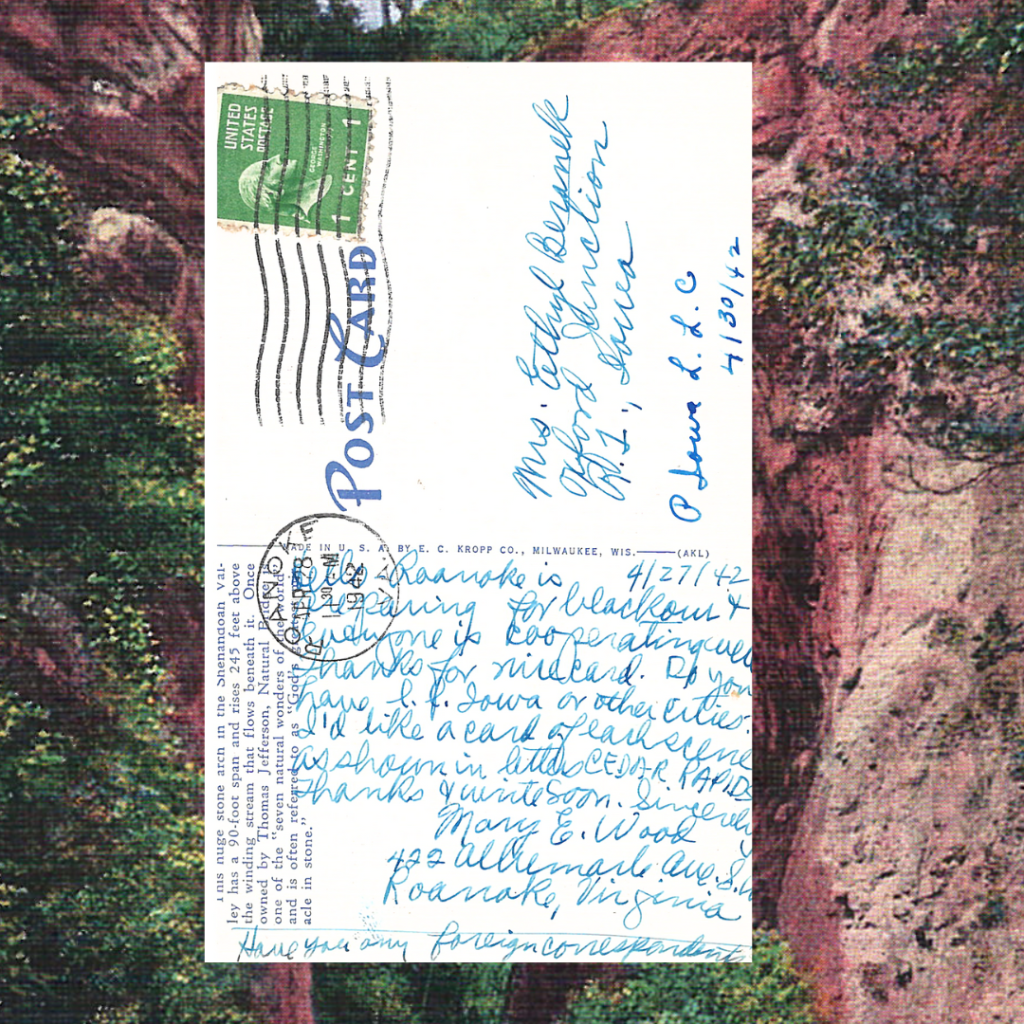
From: Mary E. Wood, To: Mrs. Ethyl Beranek 1942

4/27/42

Hello.

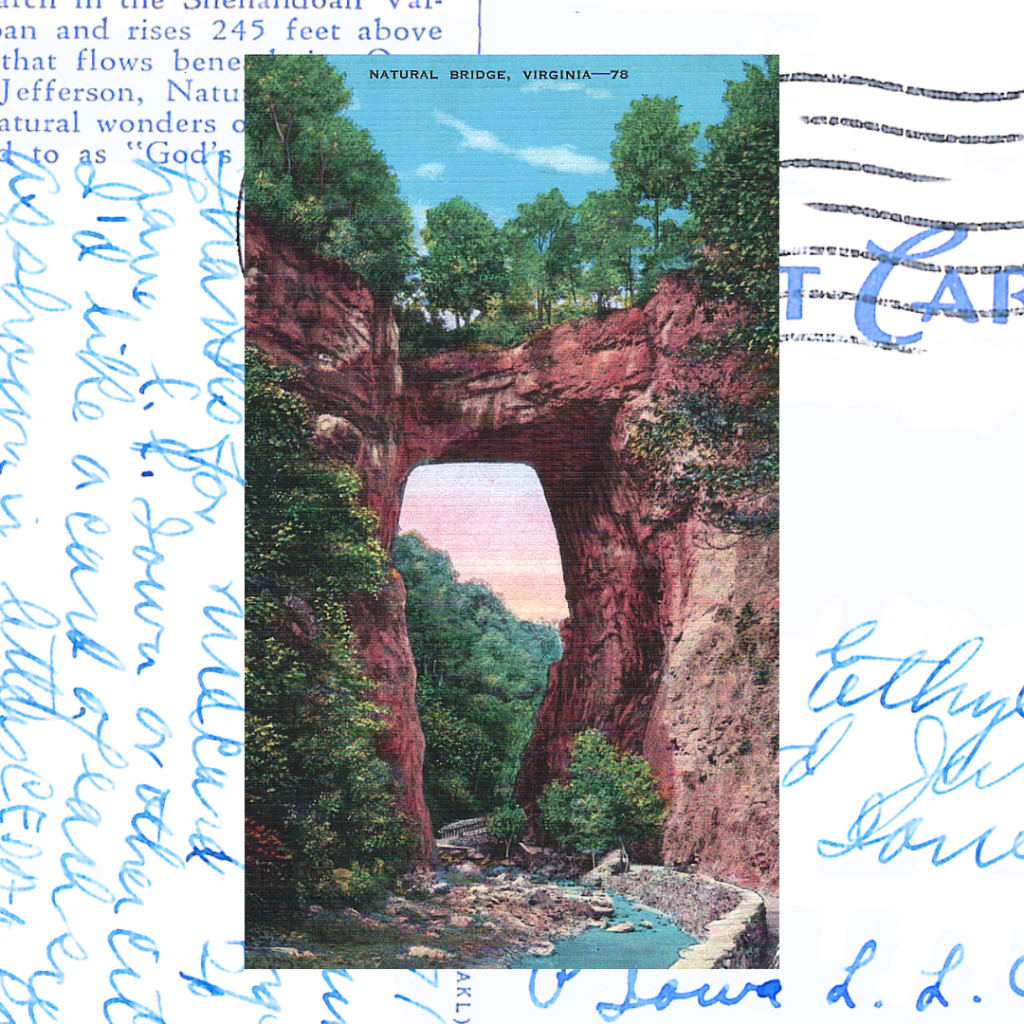
Roanoke is preparing for blackouts and everyone is cooperating well. Thanks for the card. Do you have L.L. Iowa or other cities? I’d like a card of each scene as shown in little’s CEDAR RAPIDS. Thanks and write soon.

Sincerely,

Mary E. Wood

422 Albemarle Ave S.W.

Roanoke, Virginia

Have you any foreign correspondents?

By the time Mary wrote this letter, the United States had newly entered World War II. A few months earlier, in February, a Japanese submarine had attacked an oil refinery in Santa Barbara, California. Though the attack didn’t cause much damage, fears and tensions in the United States were high. Shortly after the attack on California, FDR signed Executive Order 9066 which led to the internment of 125,000 people, two thirds of which were American Citizens.

In April, the country was already well on its way to mobilizing for war. In preparation, many cities — including Roanoke — were practicing blackouts. The city had practiced at least two blackouts by the time Mary sent her letter to Ethyl. Families bought blackout curtains for their windows and hoods for their headlights. At some point during the blackout, air raid sirens blared and people extinguished lights, pulled over and listened for the test to be over.

The fear of invasion is a type of fear I hope I never have to experience, and to see it documented in this letter is so interesting. Mary expresses prepping for an invasion first, which tells me it was probably at the top of her mind.

However, the wartime blackout conditions are juxtaposed by Mary’s request for different types of postcards. It almost seems like she’s part of some sort of post crossing program before post crossing existed! Or, as we elder millennials remember it as: pen pals. I do wonder if Mary personally knew Ethyl and the two of them were simply card collectors, or if it was a type of pen pal program. Very interesting.

As for Mary Wood, I think I found her. She was born as Mary Ellen Thurston, but her first husband had the last name Wood. She later divorced and remarried, becoming Mary Ellen Truslow. What’s strange is that I found her second marriage certificate, which listed her birthday year as 1927, but her grave and all other documentation lists 1921.

As for Ethyl, funnily enough the first thing that popped up when I searched was another postcard to her. Same address, though a different sender. Wouldn’t that have been the bee’s knees? After a little more digging on Family Search, I managed to ascertain that she probably passed away shortly after World War II — 1953 to be exact.

The obituary states that she had suffered from an “illness for the past year.” Two of her sons died shortly after, one in 1955 and another in 1958. An overall sad end to an interesting postcard.

I hope that the two women remained in correspondence until Ethyl’s untimely death. Perhaps this small blog post can help keep the memory of their connection alive.

Front of Postcard. One of a few Natural Bridge postcards that I own

Categories
Education History parenting Photographs Postcards Teaching Vintage writing Writing Prompt

Tracking Cora, Howard, and Fred: The Intriguing Tale of a 1911 Postcard

To: Miss Cora Scott From: Howard. 1911

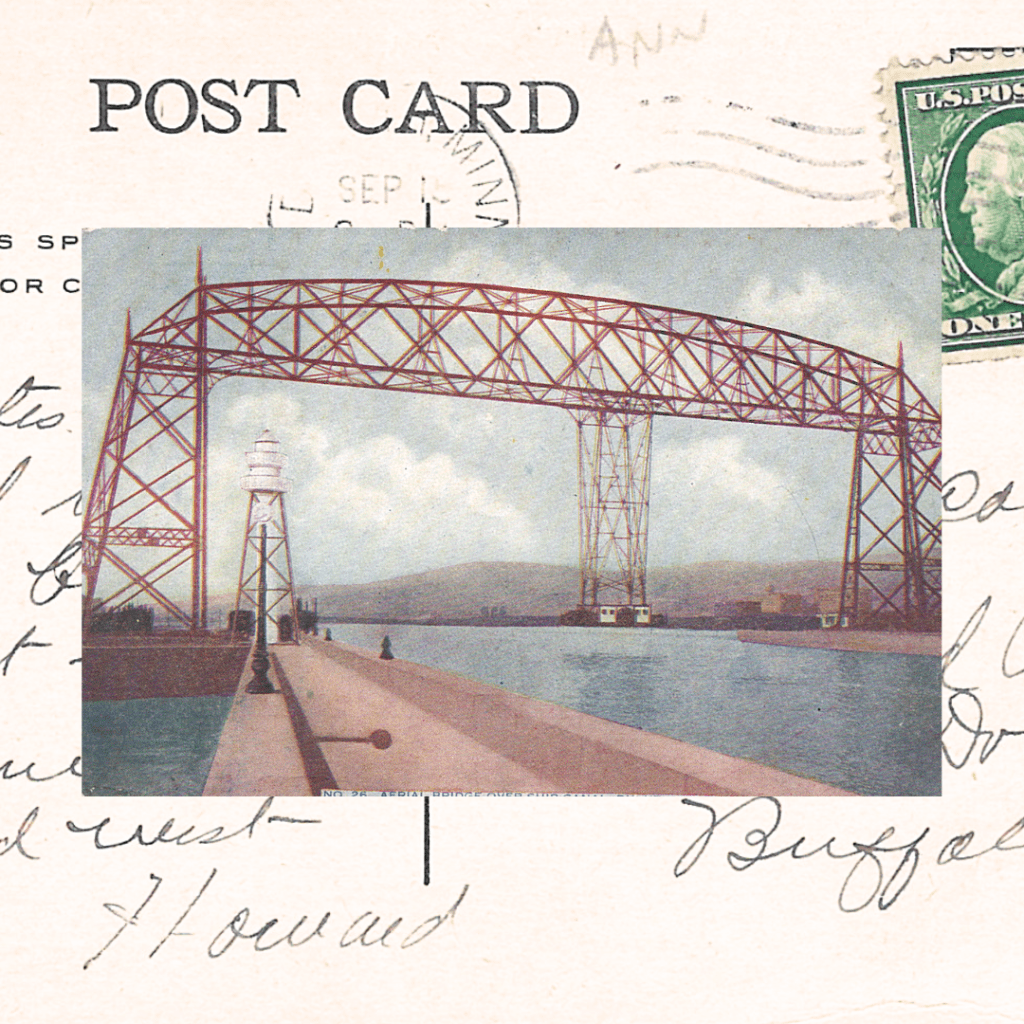
Fred writes she has telephoned you twice & again but doesn’t get you. Think of me out in the wild west.

Howard

I don’t know why, but 1909-1915 is my favorite era of postcard. The front’s are always colorful, the script on the back is beautiful, and the postcards always seem to strive for real connection over the many miles that separate the senders. By September of 1911, the New York Public Library was opened, the Triangle Shirtwaist Factory fire had killed 129 people (mostly women), and the RMS Titanic was in the final stages of being built.

By 1911, there was also roughly one phone for every 11 people. So, although telephones were gaining popularity, it must have been fairly frustrating — or concerning — that “fred” wasn’t able to reach Cora.

In fact, it feels as though Howard is chiding Cora a little bit when he says “she has telephoned you twice & again but doesn’t get you.” I have to wonder if he would have sent Cora a card if not for the letter he received from “Fred”. “Fred” being Winnifred, or maybe Freda? Was our ellusive Fred concerned or annoyed when she wrote to Howard? In turn, was Howard also concerned, or was the letter more of a paternalistic scolding?

It seems the entire point of the message is to let Cora know that Fred is trying to get in touch, and honestly a postcard is bit of a roundabout way of doing so. What was everyone’s relationship to each other? Family, friends, or something more?

Unfortunately, I wasn’t able to easily find Cora Scott. It seems there were quite a few living in Buffalo, New York around the turn of the century. I was able to weed some of them out based on age (too young or too old), but I couldn’t be certain about any of the others. There’s a small penciled in note at the top of the card that says “Ann”. Based on the style of writing, it was obviously added much later in time. I had hoped that “Ann” might be a sort of bread crumb that I could use to track Cora. Alas, no luck. I couldn’t find any Cora’s with a sister or daughter named Ann. Such is the way of things sometimes.

As for Howard and Fred, without last names there’s not much I can do. We know that in 1911 Howard was in Minnesota, but that’s all we know. I’m not really sure Minnesota qualified as the “Wild West”. I mean, yes, it’s in the midwest. But…the American frontier officially “closed” in 1890. By then, most of the people in the Western territories lived in growing cities. There were still many rural, small towns, but Duluth? 78,000 people. More like an urban jungle not the O.K. Corral.

That doesn’t mean Howard wasn’t on his way further West. These cards made their way to a California estate sale, so who knows where Cora, Howard, and Fred all ended up. They remain inextricably tied to one another 123 years later, thier memories of their connection captured in the postcard.

Categories
Education History parenting Photographs Postcards Vintage Writing Prompt

1919 Surprise Party: Social Change and Post-WWI Celebrations

From: Ella Bettinque To: Mr. and Mrs P. Madson. 1919

Dear Friends,

I am going to have a surprise party for Hilmer(?) Wed. Eve the 30th and would like to have you folks come. Will you please let Ges. and Pete Allan(?) know about it too?

As ever,

Ella Bettinque(?)

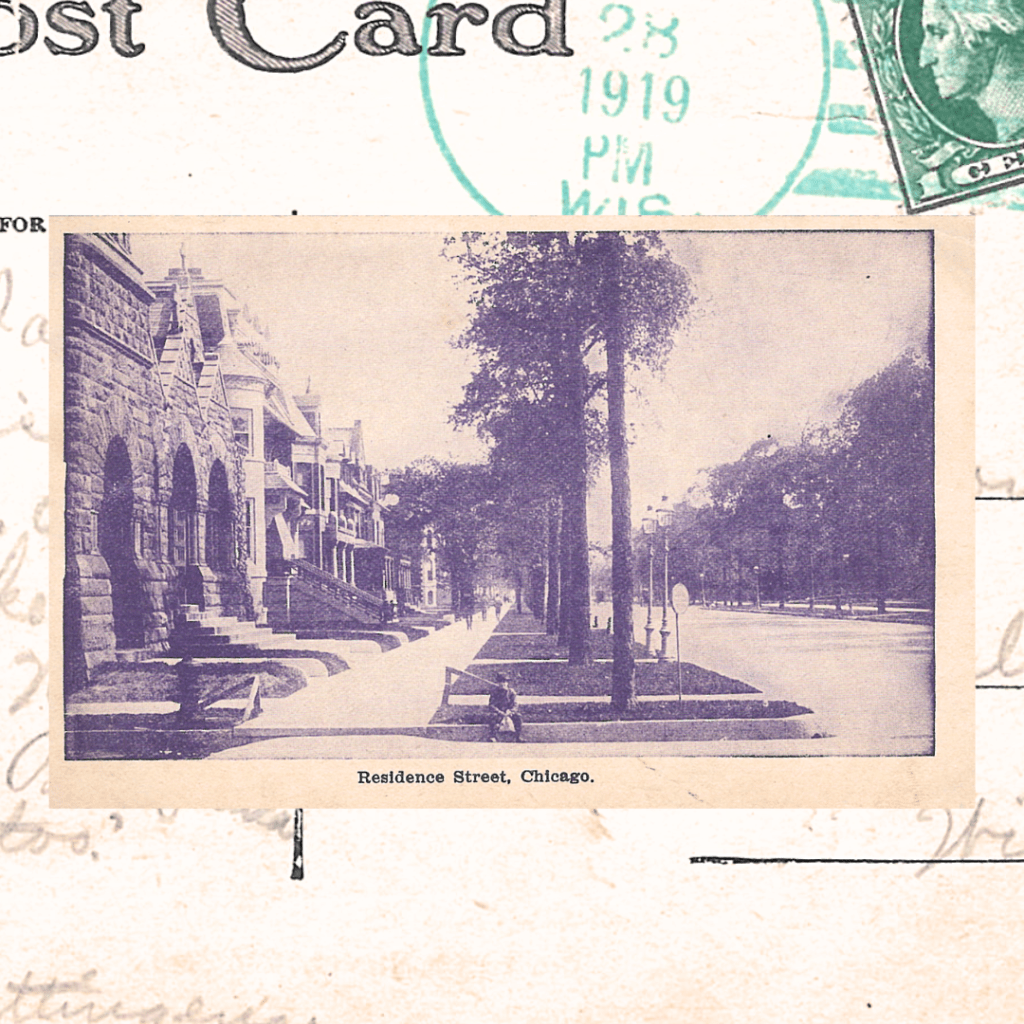
The guns of war had ended by 1919, but that didn’t stop violence. I’ve talked about the Red Summer of 1919 on the blog before, but since this postcard has a picture of Chicago, I felt I should touch on the violence again. WWI provided an opportunity for Black men and women to move out of the rural South and into the North where factories needed workers. However, as the war ended and white servicemen came home, tensions increased. This hit a fever pitch in the summer of 1919. Riots and massacres broke out all across the United States, resulting in loss of life as well as loss of property.

1919 in fact marked a great shift in social change. As Black Americans were fighting for their civil rights, women had just won the vote, and prohibition was about to take effect. The Treaty of Versailles was signed — an event which would lead to the second World War. The winds of change swept away stagnant customs, leaving the world on the brink of social revolution.

And Ella had decided to throw a surprise party. There’s something so wholesome about this postcard. Although telephones were gaining traction by 1919 (roughly 1/3 of homes had a telephone by 1920), they still weren’t the norm. That left communication by postcard, which seems like a fairly easy way to keep a secret. However, I do wonder about Ella’s hosting skills since for whatever reason she couldn’t (or wouldn’t?) let Ges and Pete know about the party herself.

Who were these lovely people? Unfortunately, I didn’t have enough information to be sure I’ve found any of them. There was a Paul Madson in Wisconsin that seemed promising, but without a first name it’s just a guessing game. As for Ella, I’m very unclear on her last name. It could be Brettingles, Bettinque, Brettinque, or any other combination of two “t’s” a g or q and maybe an s at the end. If you have any other thoughts, please let me know and I’ll see if I can find her.

What’s even more frustrating is that I’m not sure what season the party fell on. We know the card was postmarked the 28th, and we know that the party was on 30th (which seems like a quick turn around Ella! People need to plan!), but the month isn’t listed or wasn’t stamped well enough. Was it a summer party? A winter party? Perhaps a close to Halloween party? I don’t know. I want to think that it was a fall party. A day where the sun set early, so everyone gathered close around a table with a low light. Maybe they drank the last bit of alcohol they had before Prohibition really took hold, maybe they played cards, ate cake, and reveled in the coming ease of the roaring 20’s.

No matter what, I hope people came and laughed and enjoyed themselves. Especially since Ella gave two days notice and basically said “spread the word.” Bad planning, or perfect surprise? You be the judge.

Front of Postcard. Image of Residence Street, Chicago

Categories
Education family History Photographs Postcards Vintage writing

The Perfect Carriage Ride and a Birthday: Suzie Radley’s 1909 Letter

From: Suzie A. Radley To: Mrs. E.G. Richardson, 1909

Adams, MA. Sept. ’09

This is your birthday. Many returns of the same. Went up this road awhile of weeks ago with Nathan Dickinsons daughter Ruth (17) and son Boyd (13) in a cart with four horses. Such a long winding road in the woods and such a magnificent view from the summit as well as many on the way. William comes in a week. I am not very much better but some.

Yours,

Suzie A. Radley

In September of 1909, news reached the world that both Dr. Frederick Cook and Admiral Peary had reached the North Pole, the United States passed a law that allowed postal workers to skip houses with aggressive dogs, and union members were locked out of their jobs at the Triangle Shirtwaist Company.

It was also E’s birthday. How old she was, or what her first name was, I don’t know. I wasn’t able to find her easily in the records. However, we know that Suzie was thinking of her, which I think is sweet.

On my hunt for information to bring to this post, I really ran into a wall. I couldn’t find a Suzie or Susan or Susannah Radley, I couldn’t find E, I couldn’t even find Nathan, Ruth, or Boyd Dickinson. Usually I can find something, but alas, no luck for me.

Although I don’t have biographical information for our main characters in the post-card, the card itself provides quite a bit of personal and life information. As you can see, the writing was on the front of the postcard, not the back. Again, we have an instance of a transition period postcard. It was legal to split the back, but for whatever reason Suzie didn’t use a divided back card.

Because the photo is so small and because Suzie didn’t have to contend with a divided back, we get a lot of detail about her that we can use to infer other information. The fact that she went on a carriage ride through the woods with a 17 and 13 year old tells us she’s probably somewhere between 15-19. I’d guess she’s closer to Ruth’s age — since that’s who she named first.

The ride through the woods probably took place in the waning days of August. The idea of it is lovely. A warm ride through a shaded wood with the crisp scent of fall on the horizon. Perhaps a bag full of bread and apples, and the joyous chatter of fellow teens to keep you company and a “magnificent” view at the end. What a great way to spend the last bright days of summer.

We also know that Suzie was expecting William. I am guessing he’s a brother or cousin, though I couldn’t find him either. My questions linger on the relationship between E and Suzie. Were they friends, cousins, or sisters? Was Suzie visiting Adams for the summer months, or did she live there? It’s the personal histories that fascinate me. The everyday lives of ordinary people that simply tried to do their best with what they had — it’s heroic. I wish I was able to find more.

But I’ll still bask in the thought of Suzie’s perfect summer day, and hope that E’s birthday brought her much joy and happiness.

Categories
Education History Photographs Postcards Teaching Vintage Writing Prompt

Mystery Postcard from May to Miss Gertrude Jayne, 1910s: Miscommunications Through History

From: May (or Mary) To: Miss Gertrude Jayne. Date Unknown

Dear Sister,

Rec’d your letter yesterday but didn’t understand if you was coming this Sunday or next sunday so let me know for sure so that I will know what to do.

May

This particular postcard is a bit of a mystery, as there’s no stamp and no postmark whatsoever. There’s a divided back, so we know it has to be after 1907. It’s also probably before 1930 because of the style of the card and handwriting. My instinct tells me it’s somewhere between 1912-1922, though I lean towards the twenties.

There’s an urgency about this postcard that’s not apparent in some of my more recent cards I’ve analyzed. May is clearly anxious that she won’t be ready for her sister to arrive, and I have to wonder what the two were planning? Was Gertrude simply coming to visit May or was there something more involved? Maybe it was an event of some sort that May was helping plan, but Gertrude hadn’t been clear on the details.

The other question that burns at my mind is…how was this card delivered? The postage stamp area doesn’t have any sticky residue or tearing that would suggest the stamp was peeled off — though of course it could have been. But there’s also the lack of postmark which indicates that the card was never in fact mailed. Did May have someone take it to Gertrude? Maybe another family member or friend?

Or, was the card never delivered? Simply filed away in the back of a box somewhere only to be discovered and end up in the collection of James Woodruff? The card itself is sort of unremarkable. A pretty photo, but a bit damaged and weathered over time. There’s no embossing or gilt edges, so it’s strange that it’s survived the test of time.

Ok…what about our sender/recipient? Well, after two fantastic finds over the last few days, my luck ran a little dry. I can’t guarantee that I found Gertrude or her sister. I did find a Gertrude Jayne born in 1891 who had a sister named Mary, which I suppose could be our Gertrude. But, I feel like it’s a bit of a stretch. Especially since I don’t have a date on the postcard.

That leads me to James A. Woodruff who I thought might be the son or perhaps nephew of one of our ladies involved in the postcard. His mother did have the middle name of “Mae”, but doesn’t seem to have a sister named Gertrude. I was able to find some information on James. According to Find a Grave he was involved in historical research around his community. He died in 2004 at a relatively young age. I suppose his effects must have been donated, and I like to think that he’d be happy that the postcard became a bit of a public history project.

Though, I do wish I knew more about May (or Mary), Gertrude, and even James. I hope that Ma(r)y managed to get in touch with Gertrude and “knew what to do” for the Sunday that her sister arrived. Whatever happened, this postcard is so very human. We’ve all been on the other end of a vague message where we need more information. It’s good to remember that, for most of history, communication was not instantaneous, but long, muddled, and often fraught with worry.

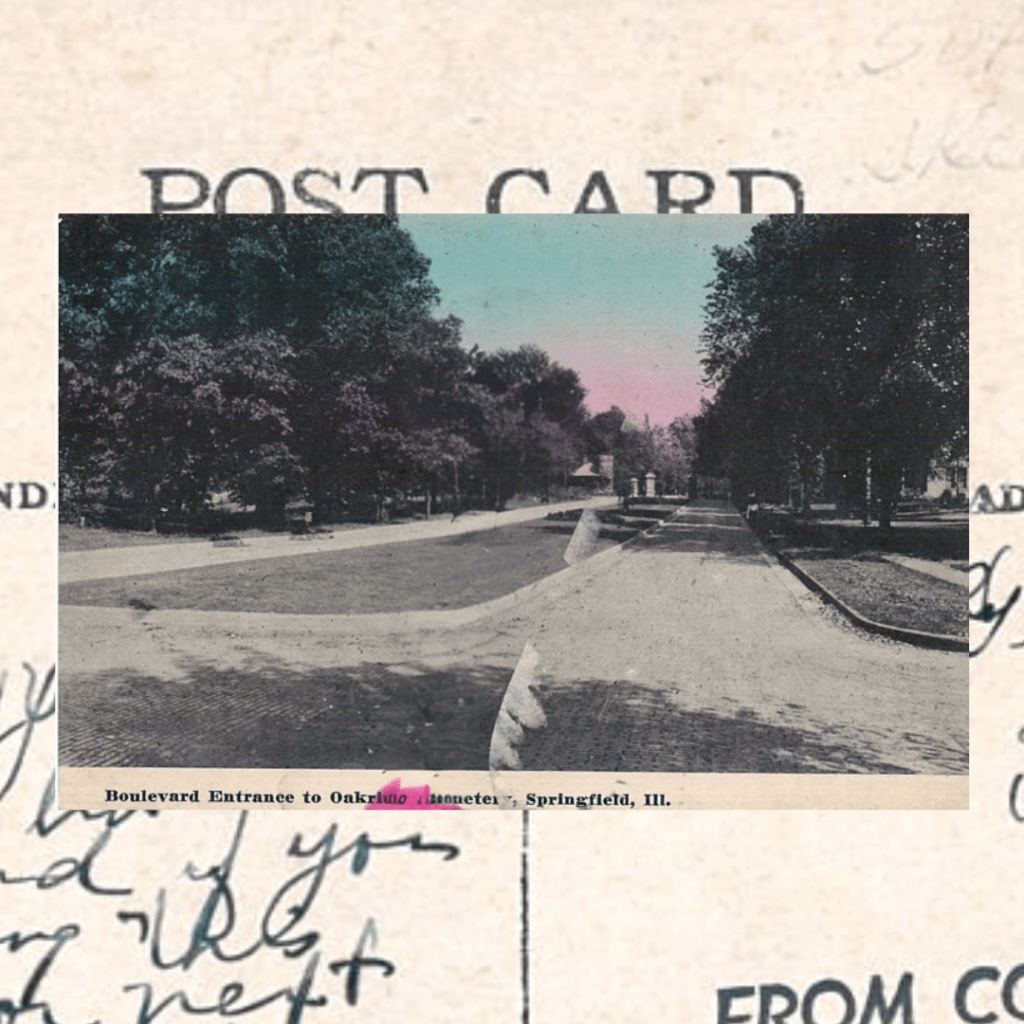
Front of Postcard. Entrance to Oakridge Cemetary

Categories
Education History Photographs Postcards Teaching Vintage Writing Prompt

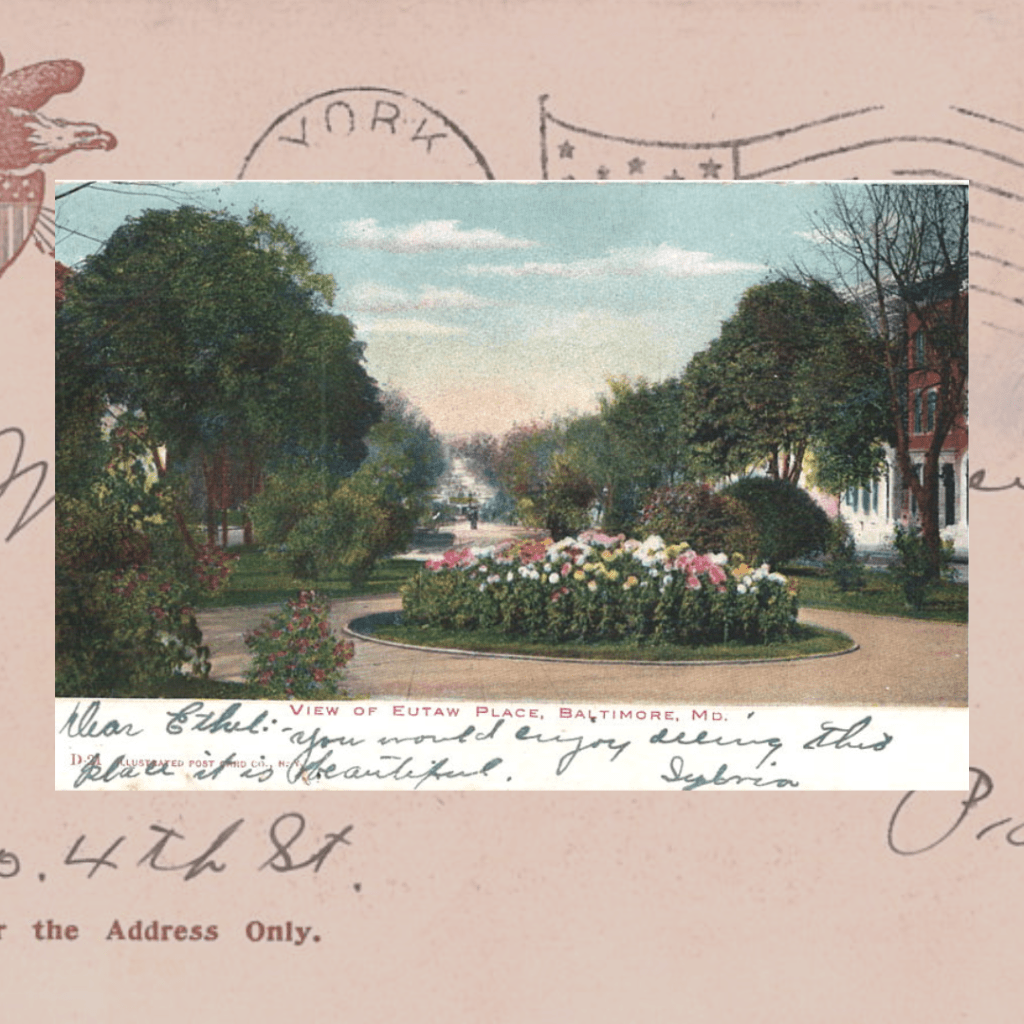
A Timeless Bond: Uncovering Sylvia and Ethel’s Correspondence

From: Sylvia To: Miss Ethel Maurey. (1906-1910)

Dear Ethel,

You would enjoy seeing this place it is beautiful.

Sylvia

For the very few of you who are avid followers of my blog, you’ll notice something right off the bat about this postcard. If you’ve recently started following me, fret not sweet friend because you’re about to learn something that *may* help you win a random trivia night.

For those of you who don’t already know, the unique thing about this postcard is that the text is written on the front. Therefore we know that this is part of the “Post Card Period”. Simply put, the period between 1901 and 1907 where it was prohibited to write anything other than an address on the back of the postcard.

Although the postmark date is unreadable, my estimate is that the postcard was written somewhere between 1905-1910. Yes, I’m dating it after the divided back period began, because as we’ve seen before, just because you could write on the back of postcards beginning in 1907, didn’t mean everyone did.

Despite the short message, it truly is a lovely postcard. That’s likely one of the reasons Ethel kept it, and why it’s survived for over a hundred years. The soft glow of the sunset (or sunrise) in the background mingles with the bright cheeriness of the flower arrangements. I love the thought of the postcard itself exchanging hands time and time again, all of us agreeing with the sentiment of the sender.

But who was Ethel Maurey? And who was Sylvia? Well, it turns out I found both of them!

Ethel was born in Sunbury, PA in May of 1892 to Henry and Emma Fritz Sanders Maurey. That would put her anywhere between 9 and 15 during 1901-1907. Based on her obituary, Ethel led a life of great service, raised two sons (though one predeceased her) and was married for 56 years to Jesse Lloyd. Obituaries are difficult, because there’s so much left unsaid. We can’t know the day to day of her life. But we do know she lived through two major wars, could cast her first vote at the age of 28 (!!) and witnessed the assassination of JFK, the Civil Rights Movement, and the first man walk on the moon. Interesting indeed.

And what of Sylvia? Well, if my gut is right, Sylvia is actually Sylvania Maurey, Ethel’s sister. Sylvania was born in 1880, which made her 12 when Ethel was born. Why was Sylvia in Maryland visiting Eutaw Park? I’m not sure. The area still exists as an architectural district that housed many important residents at the turn of the 20th century. Was Sylvia visiting a friend? A college? Was she simply on a trip? Unfortunately the postcard doesn’t tell us.

However, it stands as a testament to the bond of the two sisters. Despite their age gap, Sylvia took time out of her trip to send a quick, and stunning, postcard to Ethel. Because of her bond with Sylvia, Ethel kept the card likely until the day she died. It took another 50+ years to make it into my hands. Which, frankly I find miraculous and serendipitous. It’s as though Ethel and Sylvia wanted me to share their bond with you, my dear readers. So, as you go about your day, think of Ethel and Sylvia, and reach out to your sibling, or best friend, or parents. I think they’d be glad you did.

Back of Postcard with Ethel’s address