Categories
Education family History parenting Photographs Postcards Teaching Vintage Work In Progress Writing Prompt

Patricia’s 1954 Postcard: A Historical Exploration of Old Town San Diego

To: Miss Patricia Baker From: Warren, 1954

Hi Pat,

This is an interesting spot in “old town.” Best Wishes

From,

Warren

“Old Town,” San Diego was founded in 1769 by Spanish settlers. The town survived three governments (Spanish, Mexico, then American) before being usurped by “New Town”, or modern day San Diego, primarily because it was closer to the water. Now, a monument to the original settlement stands on the site. It’s full of restaurants, tourist shops, and the Whaley House, the “most haunted” house in America.

In 1954, Dwight Eisenhower was president, Marilyn Monroe married Joe DiMaggio, and Brown V. Board ruled that segregated schools are unconstitutional. The United States was in our Nuclear Era. Suburbs were growing, cars were getting faster, the movies were glamorous, and people had more money for leisure. It might sound great, but the racial and gender divide in the US was huge. The Cold War was raging, and Senator McCarthy was conducting hearings on communism.

This is one of at least two postcards that I have from Warren. I may have more in my stash that I haven’t identified yet. The postcards are separated by a period of years, but both are addressed to the Baker household, both are written in the same all caps handwriting, and both postcards are short and to the point. Nonetheless, they both provide distinct information about the spots Warren has seen or traveled.

When I started my research on the card, I really thought I’d be able to find Patricia and Warren. I have a date, a name, an address…but alas, no real luck. This may be a symptom of using only free sites to conduct my research (what can I say, I’m a cheapskate), however there were SO MANY Patricia Bakers in or near El Monte. Add to the fact that El Monte is in Los Angeles County, and now I’m dealing with a ton of records from LA and, phew, it was a lot.

Plus, our old foe: the maiden name! We know that Pat isn’t married because Warren uses the “Miss” title. Therefore, if she married, her name can get easily obscured in the records and make it much more difficult for us to uncover.

There is a Patrica Baker who lived in El Monte and married a William. She was one of 9 sisters and passed in 1982. I thought this was a good match, except it seems she married in 1946. So, my hopes were dashed.

Sometimes that’s how the cookies crumble. Hopefully next week I’ll have more luck with research!

Categories
Education History parenting Photographs Postcards Teaching Vintage writing Writing Prompt

Amway Shopper or Distributer? The Story of Mildred Becker

To: Mildred Becker From: Dan and Didi 1979

Keep smiling!

It makes people wonder what you’ve been up to.

Love,

Dan and Didi

In 1979, Jimmy Carter was President, McDonald’s released the Happy Meal, Nickelodeon debuted on cable, and the Department of Education was established. The year also saw a large number of walks and protests supporting LGBTQIA+ rights. A nuclear disaster on Three Mile Island experienced a partial meltdown, American Airlines flight 191 crashed (still the worst aviation accident in US history), and the Iran Hostage Crisis began.

An eventful year to be sure, especially for Amway. Founded in Ada, Michigan, the company is a pioneer in the multi-level-marketing bracket (if you haven’t watched LuLaRich on Amazon Prime, I recommend!), and by 1980’s they reached one BILLION in sales. However, in 1979 a judge for the FTC commission, ruled that Amway was NOT a pyramid scheme. So, although the ruling required Amway to comply with retail rules, it largely allowed (and still does) MLM’s to sell a get rich quick dream to distributors.

By the time Dan and Didi sent Mildred their card, she was 65 years old, and living in Crystal, Minnesota. On paper, she lived a somewhat hard life. She had four stillborn children, her husband died in the 1960’s, and it seemed she had to hustle for a living. Three years prior to this card, her mother, whom Mildred had lived with since the 40’s, passed away. Mildred would live another 32 years (until the age of 97!), and despite her hardships, she left behind a large legacy, including 6 great-great-grandchildren.

So who were Dan and Didi? My initial thought is that one of them was a grandchild. Howver, the phrase “Keep smiling, it makes people wonder what you’ve been up to” was something my grandpa always said. So, based on that alone I sort-of think that Dan and Didi were contemporaries of Mildred. They don’t seem to be a brother or sister, so that leaves friends.

However, seeing as it’s on an Amway postcard, and there’s nothing really personal about the card, I do wonder if Mildred was part of a downline for Dan and Didi. Meaning, I wonder if Mildred sold Amway products, and the people who got her into sales were Dan and/or Didi. It would make sense. Why else send an Amway themed postcard with a quippy message on it?

I’ll never know who Dan and Didi were, but thanks to a beautiful obituary, I got to know Mildred a little bit during my research. It’s always touching and rewarding to find a lovely memorial to the person who owned one of my postcards. I love breathing a little bit of life into these captured snippets of time.

Front of Card: Amway Complex at Ada

Categories
Education History parenting Photographs Postcards Vintage World War II writing

The Untold Story of Lizzie J. Dearwechter: A Postcard Journey

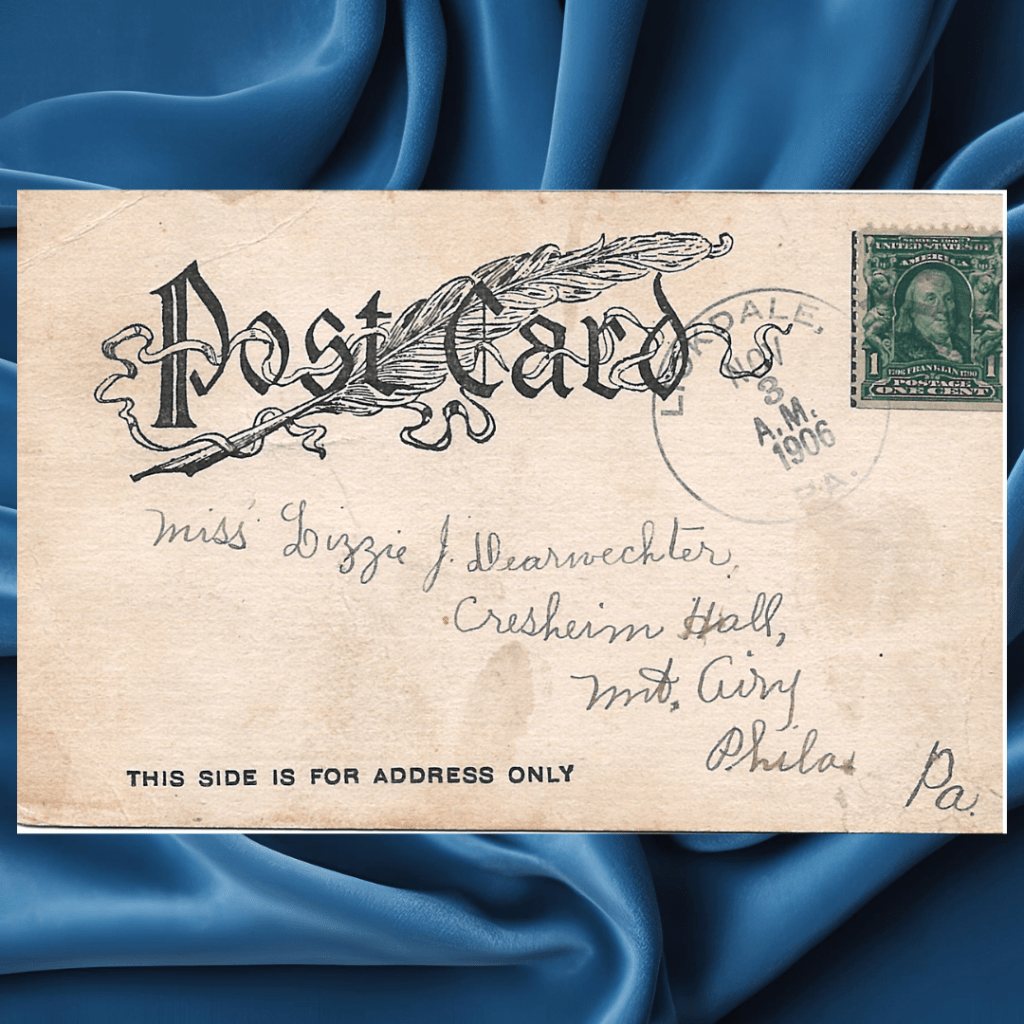
To: Miss Lizzie J. Dearwechter From: E.W.A 1906

I’ll write you next week. I am having a fine time on the cornfield.

From a friend,

E.W.A

In 1906, Theodore Roosevelt was President, Upton Sinclair published The Jungle, and Oklahoma was still a territory, and not yet a state. By November, San Francisco had been devastated by a 7.8 magnitude earthquake, and in what the newspapers called the “crime of the century” Harry K. Thaw shot Stanford White in Madison Square Garden. The Progressives were making their mark on the American landscape…in whatever way possible.

And, as we know a little bit about postcard history, 1906 was an undivided back period. This is a time where postcards favored the front image and had very little space for any sort of message as the entire back was to be utilized only for the address. Although undivided back postcards often lack details for research, they are beautiful. Even the printed word “postcard” with a feather in the background is luxurious and hints at a fancier, more formal time.

This postcard is funny to me, largely because the sender has chosen a postcard of a “typical California home,” but sends the card from Lickdale, PA. Lickdale is a small, unincorporated town in the south east of Pennsylvania that shares a zipcode with a few other cities. The total population for the zip is upwards of 8,000 people.

Pretty far from California if you ask me. As a historian, I understand the magnetic pull that the west coast has on the American psyche. I have to believe that the image of curated palm trees in front of a Victorian/Gothic-esque house was a bit of wishful longing. Perhaps the two friends had dreams to move west, or loved the idea of California. Perhaps E.W.A just liked the postcard.

As for Lizzie J. Dearwechter, with a little bit of luck, and a lot of elbow grease, I managed to find her in the records. I had to follow a few lines of Dearwechters, but I did it! Lizze was born October 13, 1888, so by November of 1906, she was 18 years old. I was curious about Cresheim Hall, so I looked it up. It seems that it was a School for the Deaf in Mt. Airy, Pennsylvania. The only real problem that I’ve run into is that –other than this postcard — I can’t place her at this address with the sources available.

Miraculously, Find a Grave included more than a picture of the tombstone, it included Lizzie’s obituary! It’s a rarity, especially since she passed in 1976. I had hoped that maybe the obituary might allude to her time at the hall, or perhaps indicate whether or not she may have been Deaf. However, it provided no further insights. What we do know is that she was single in 1906, but had met and married her husband by 1908. She went on to have 13 children, and upon her death she was survived by 31 grandchildren and 42 great-grandchildren. A legacy indeed.

As for E.W.A…well they are impossible to track down. However, their quick note about enjoying the cornfields spawned a 118 year journey that led us to unravel snippets of Lizzie’s life. A life that saw the sinking of the Titanic, the Spanish Flu outbreak, both World Wars, the assassination of J.F.K, the moon landing, Civil Rights, and Woodstock…amongst other things.

Thank you, E.W.A, for the postcard.

Close-ups of both sides of the postcard

Categories
Education History Photographs Postcards Teaching Vintage Writing Prompt

“Hello Chimmie”: Insights into Childhood Friendship at the Turn of the 20th Century

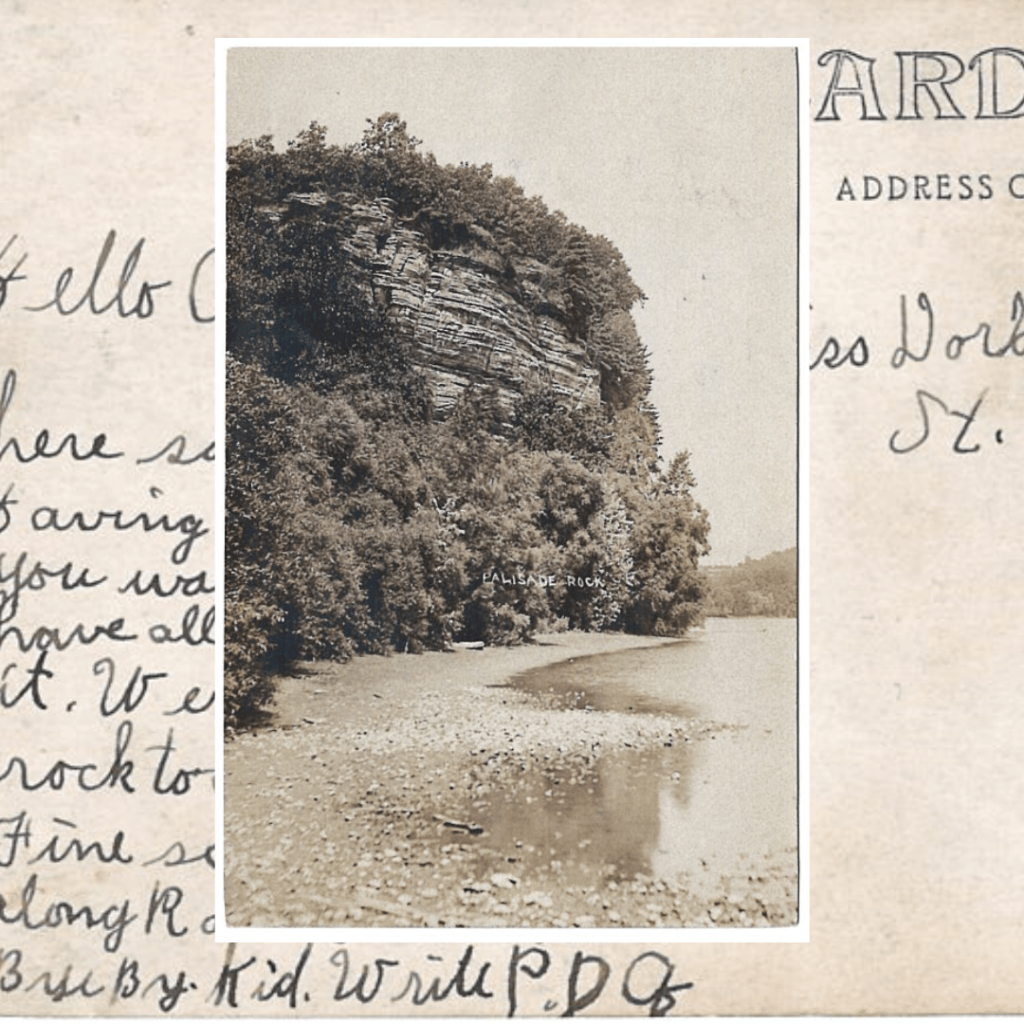
Miss Dorothy Termansen, 1910. Sender Unknown

Hello Chimmie,

We got here safe and sound. Having a fine time. I wish you was here we would have all the more fun ain’t it. We are going on this rock today. It is 100ft high. Fine scenery out here along Rock River. Well bye by kid. Write P.D.Q.

1910 had already been a lion of a year by the time October arrived. In July, race riots broke out all across the nation after African American boxer Jack Johnson defeated James Jefferies in a heavyweight boxing match. In August, a wildfire devastated large swaths of the Pacific Northwest, and on October 1, the LA Times was bombed. A tragedy that resulted in 21 deaths and multiple more injuries.

Although we know that this postcard was sent to Minnesota, what’s less clear is where it was sent from. The ink on the postmark is either worn down, or was never there in the first place. So it’s hard to tell how much the events of the nation impacted both our sender, and the recipient. Though, there is a spot in Minnesota called “Palisade Head” which looks similar to the photograph on the front of the card. But, Rock River flows out of Wisconsin, so maybe they are there? Hard to know. I’d love to hear any information any of you might have.

Though we don’t know the place, I’d wager a tidy sum of money that the sender and Dorothy were children. Maybe siblings or cousins or friends from school. If this is the case, they would have likely existed in the sort of bliss that stems from being protected and somewhat oblivious to the events of the surrounding world. Especially since our sender seems to be on a vacation.

This postcard speaks oodles to me, especially because of how familiar the sender seems to be with Dorothy. From the pet name “Chimmie” to the gentle urging to write “P.D.Q” (or pretty darn quick). The card reads more like a note my students might write to each other complete with it’s own lingo and poor grammar. “I wish you was here, we would have all the more fun ain’t it” tells you this card was not meant for adults. It was a gesture of friendship and love from one friend to another.

As for Dorothy, I had a bit of a difficult time finding her. I found a few Termansen’s, but none that would fit our Dorothy. I’m fairly certain I have the last name correct and although the sender sounded Dorothy’s name phonetically (Dorathy), I’m also pretty sure it’s actually “Dorothy”. Though it is possible that was a middle name. Well. That’s the way it goes sometimes.

Overall, this postcard is a fantastic peek into the everyday lives of children living in a changing world.

Categories
Education family History Photographs Postcards Vintage Writing Prompt

“Dear Uncle Gust”: A Charming Glimpse of Innocence and Family Ties

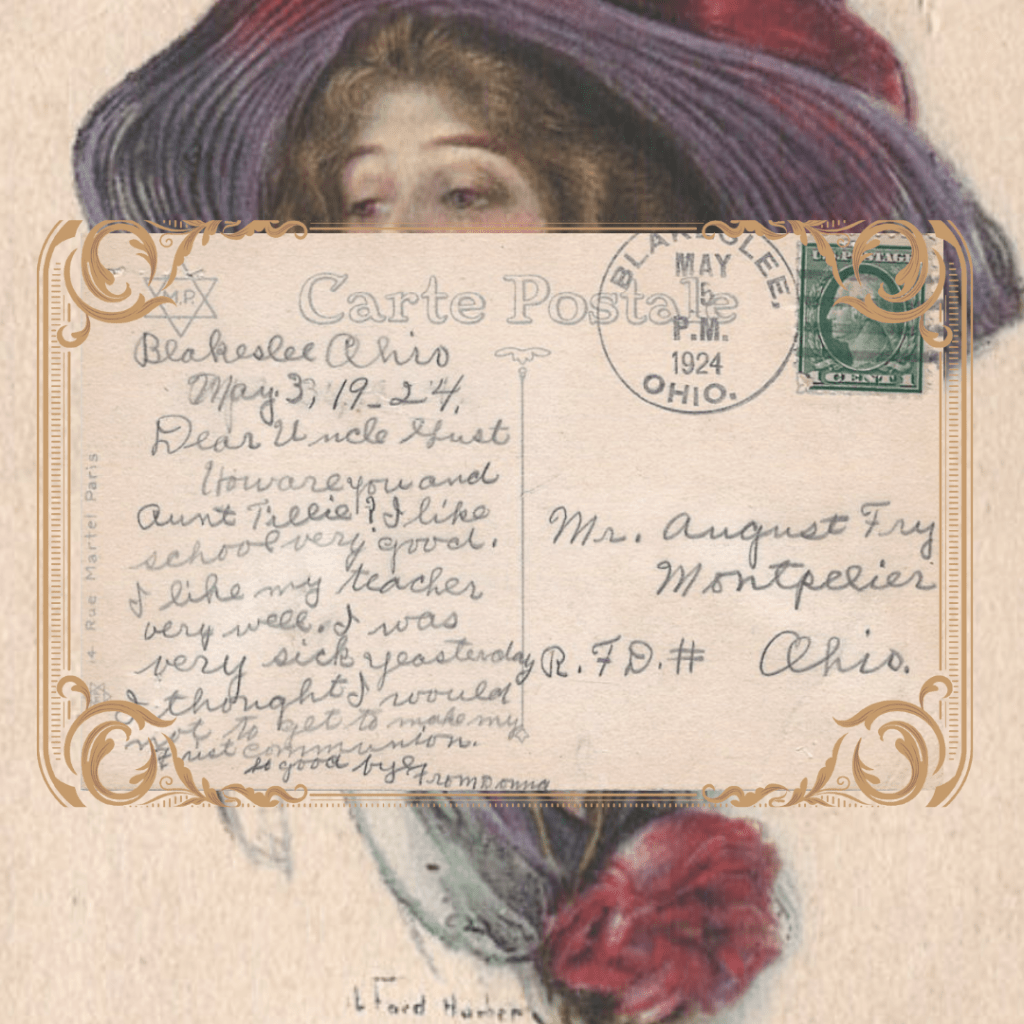
To: Mr. August Fry. From: Donna. 1924

Blakeslee Ohio

May 3, 1924

Dear Uncle Gust,

How are you and Aunt Tillie? I like school very good. I like my teacher very well. I was very sick yesterday. I thought I would not to get to my first communion.

So good bye.

From,

Donna

In the United States, the 20’s were a relatively prosperous time. World War I was over, our production was booming. Movie stars graced the silver screen, roads began to stretch across America, and shopping became an experience. On May 4, 1924, the Summer Olympics opened in Paris — a fun coincidence since the games have returned to Paris 100 years later.

At the time that Donna wrote her card to “Uncle Gust,” Calvin Coolidge was president, Adolf Hitler had begun his jail term for the Beer Hall Putsch (he would serve 9 months), and the Soviet Union was in the process of becoming recognized as a nation. Though things were looking bright, there were ominous signs on the horizon.

But, not for little Donna, eight years old and living in Blakeslee, Ohio. For her, the glittering lights and industry hadn’t reached Blakeslee, Ohio, a small village of primarily German and French immigrants in the Northwest corner of Ohio. Currently, it houses some 100 odd people. In 1924, it was much the same, though it grew because of the railroad that went through town.

There’s something perfectly sweet about this postcard. Here we have a young niece not far from her uncle (roughly ten miles), but still far enough that a postcard is warranted. Further more, she calls him “Uncle Gust” which is adorable. AND, she has an Aunt Tillie? Fantastic. This postcard holds all the innocence of childhood: school, sickness, fear of missing something important, stilted, yet careful writing. It conjures an image of a little girl sitting in her room carefully and dutifully writing out the postcard, perhaps with her tongue sticking out of her mouth, maybe by candlelight. Even in the 30’s most rural spaces had yet to be strung up with electricity.

I’ve also had quite a stroke of luck in researching our sender and recipient. I found August AND Tillie Fry (or at least their graves). According to find a grave, August was a veteran of World War I, and raised dairy cows on a farm in Montpellier, Ohio. In 1924, he was 35 years old and Tilli 34. According to their find a grave, the two were married in 1922 and went by “Gust and Tilli.” There are pictures on the website, and they look like a beautiful couple.

And I even found Donna! This is a first for me, as I’ve never been able to find everyone listed on a postcard, however after some digging through the family tree, I found our postcard writer. She was blood related to Tillie. Her mother, Viola Elizabeth Walley Wherle, was Tillie’s older sister. Donna was an only child, and raised on a farm in Blakeslee. Donna grew up to have two children and was beautiful. I’ve linked her information a few times, but if you are interested, you can do a deep dive on her family tree here.

It’s so rewarding when I’m able to find a bit of information about my senders. I feel so privileged to be the custodian of Donnas hopes, worries, and childish scrawl, and I know I will continue to think of her writing a postcard to her Uncle Gust and Aunt Tillie.

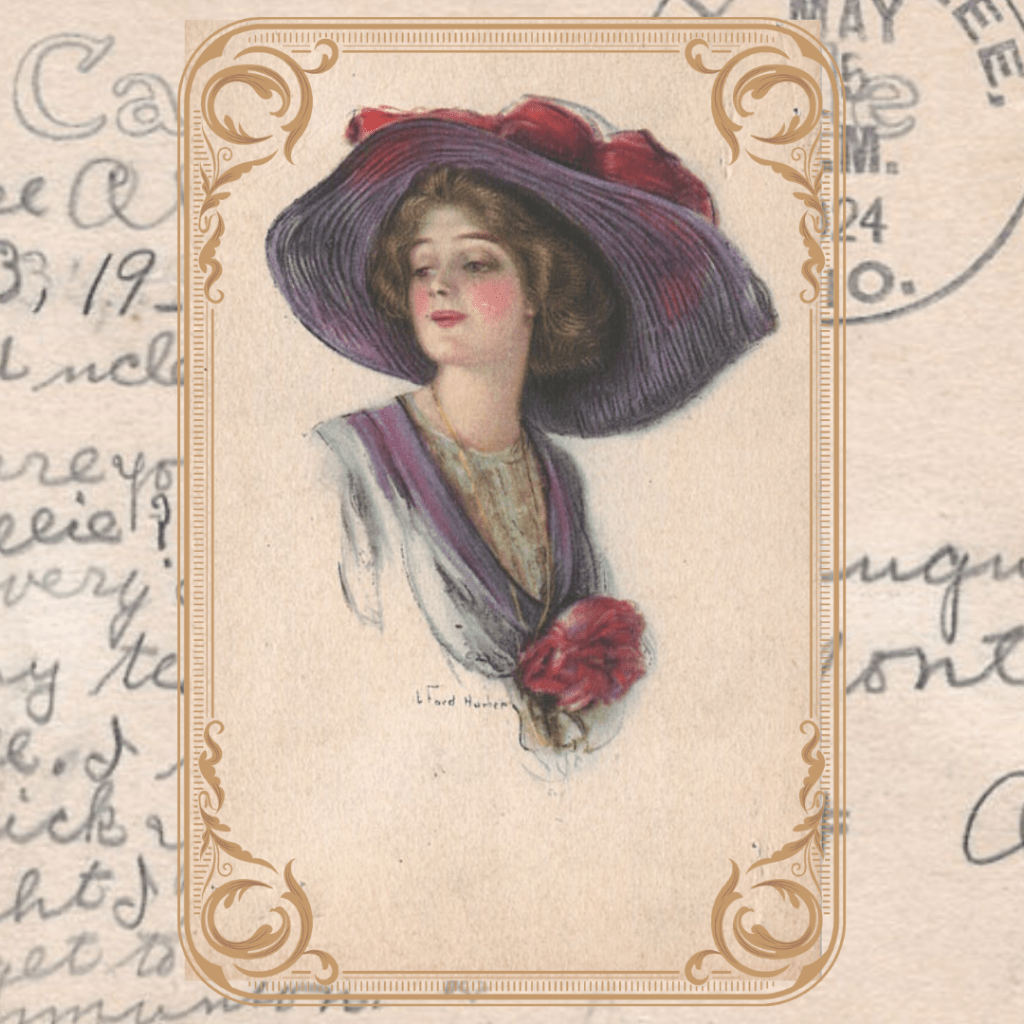
Front of Postcard. A beautiful watercolor.

Categories
Education History Photographs Postcards Teaching Vintage Writing Prompt

Mystery of Miss Bessie Harkness: Unraveling the Threads of a 1905 Postcard

Miss Bessie Harkness, 1905

Miss Bessie Harkness

Durand, Wis

C/O Mr. Will Alkire

In 1905, the great Progressive Era president, Theodore Roosevelt, had just completed his first full term. This after having become president because of the assassination of President William Mckinley. The Progressive Era had begun, but the Gilded Age was hanging on with it’s perfectly manicured nails. 1905 also saw the “greatest ball” of the Gilded Age — a Versailles themed spectacular that later *almost* caused a panic on Wall Street.

The rich will always be rich, but 1905 was the beginning of the end for monopolies after the Supreme Court ruling Swift and Co v the United States allowed the federal government to regulate monopolies. Though we were “advancing” in some areas, we were falling behind in others. Three days before the Supreme Court ruling, the Nelson Act was signed into law, allowing segregation in the schools of the territory of Alaska.

I’ve noted before that the practice of sending postcards began in 1870, however the years of 1901-1907 are considered the “Post Card Period”. This is simply the transition from “Private Mailing Card” to “Post Card”. This particular period is noteworthy for the the fact that the back was exclusively reserved for the address — nothing else. If anything was to be written, it would be done on the front of the card.

This post card is unique for it’s scrawled address in childish script, as though each cursive letter was well thought out and formed when addressing the card. The sender also continued the last name down the side of the card, as they ran out of space on the line — another indication that the sender was young.

Unfortunately, there’s nothing printed on the front of this card, so the sender’s name is lost to time. Emulating Alice, I went down a rabbit hole in searching for Bessie Harkness — and I believe that my search was well rewarded. There was a Bessie Harkness that lived in Durand, Wisconsin. In 1905 she would have been about 17. Public records indicate that she attended the University of Wisconsin and by 1919, had become a high school teacher. Unfortunately, if this is our Bessie, she died in 1930, a mere 42 years old.

It’s rare to find this much information on a person from one of my postcards, and I’m reasonably sure I’ve found the right woman. However, I do wonder who sent her the postcard. She had a brother, but he was older. The handwriting indicates someone young, I’d guess somewhere between 10-14 (though in my gut I think the sender was probably 12/13).

The card is also sent in care of Will Alkire, another well respected Durand resident. It seems Will married in 1885 and had one daughter — Anna Belle. It’s feasible that Anna Belle and Bessie were friends, and either Anna was the sender of the postcard (in care of her father), OR, Bessie was staying with Anna for the winter break. I tend to think Anna Belle was not the sender, simply because the handwriting is so young. But, I suppose she could have been four or five years younger. It’s also feasible Bessie was some sort of tutor or mentor to her (given her later job title).

Either way, for a post card that provides nothing more than a beautiful picture of a Maine lighthouse and a name of the recipient, I managed to find a lot of information. Further, given the fact that Bessie died in 1930, I’m impressed this post card survived. I wonder who saved it, why, and how it ended up in a thrift shop nearly 120 years after it was initially sent.

What a beautiful find.

Categories
Education History Photographs Postcards Teaching Vintage Writing Prompt

“A Chilly Morn”, 1908: A Glimpse into Small Town Life

To: Miss Dena Berends(?) from Srona K(?). 1908

Dear Cousin,

I received your card a quite a while ago and think it is just beautiful. How are all the folks. We are all well so far. Got a letter from Katie S this morning and got a postal from Cousin Clara Friday. Must close. Bye always.

Sincerely,

Srona K

I’m not sure why, but 1908-1910 are some of my favorite years to collect postcards. I think because the modern world that we know was just beginning to emerge, and people lived life without the shadow of two world wars hanging over their head. That being said, I’ve already dropped 1908 into history on previous blogs, but in case you missed it, I’ll give a quick run down.

The year 1908 was a leap year. Teddy Roosevelt was president. Robert Peary began his attempt to reach the North Pole, Henry Ford rolled out the Model T, and the Chicago Cubs won the World Series. These are the “good” things.

August of 1908 also saw the Springfield Massacre; an event in Illinois where a white mob of 5,000 attacked a Black community by burning down homes and businesses, eliciting violence, and lynched or shot eight people, including an 84 year old man who’s only crime was his 30 year marriage to a white woman. This massacre resulted in the displacement of 2,000 Black men and women, and was the “catalyst” of creating the NAACP.

I’m sure the writer and recipient of this postcard knew a little something about the events playing out on the national stage, however I also have to assume that their lives were fairly isolated, especially since I believe them both to be 20 or younger (based on handwriting and marriage status).

Lake Park, Iowa is still a small, rural community situated near Silver Lake and sitting on the edge of the Iowa and Minnesota border. There was a school, banks, lodges and farms, and in 1900 the population was around 540. We can assume that by 1908 it had grown, but probably only by a hundred or two people.

Harris Iowa is only about 7 miles to the west of Lake Park, so fairly close. The cousins likely had opportunities to see one another, but they fact they sent postcards and letters indicates a strong familial bond. The names on the postcard are also a mystery to me. I’m fairly certain the recipient is “Dena” but I can’t quite make out the last name. Further more, our sender looks to be Srona, though perhaps it could be Serena or even Nona. It’s one of those mysteries that haunt me and over time I hope to be a better reader of these names.

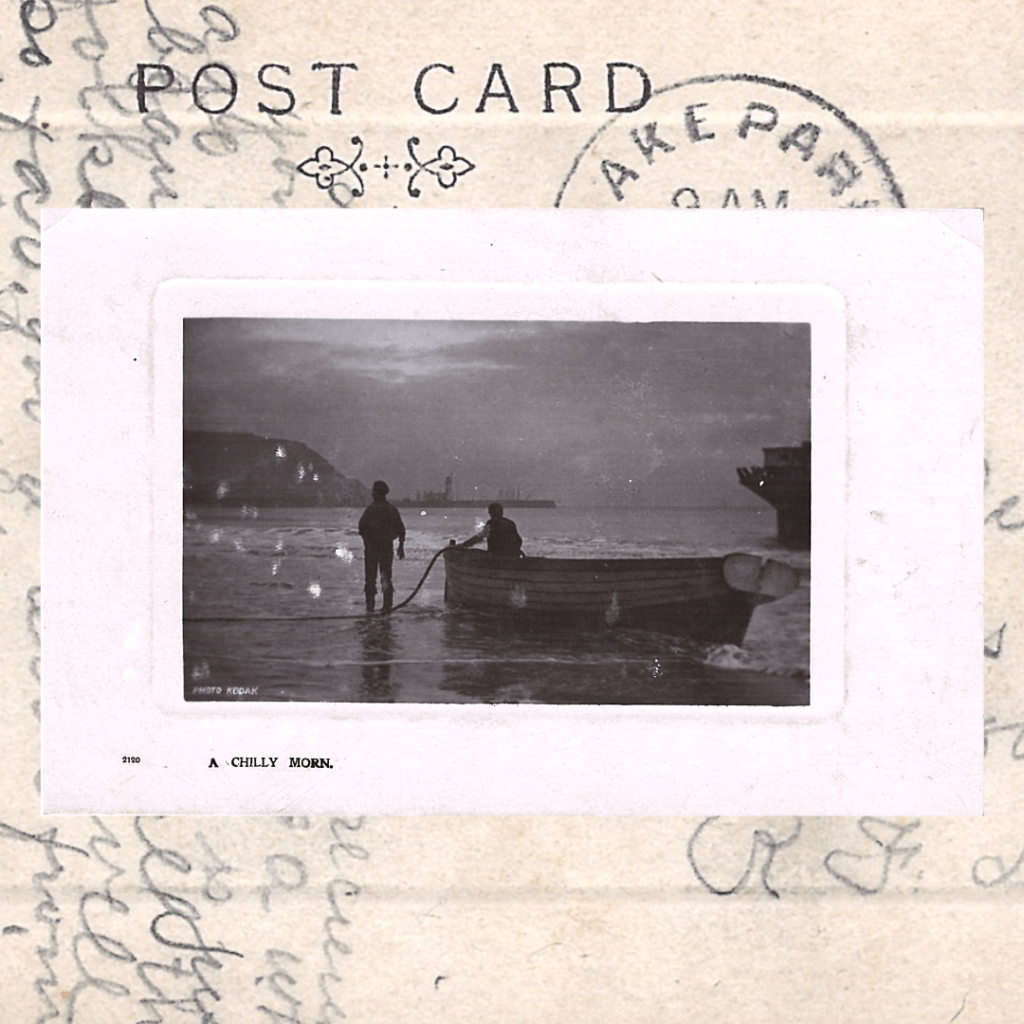
I love the front of this postcard, as it’s one of my most interesting. It’s an imbedded picture of two men on a body of water. One is in a boat with his hands on a long rope that continues off frame, and one is standing in the water. Both face away from the camera, their eyes set on the body of water in front of them and perhaps their mind already preparing themselves for the day ahead. Titled “A Chilly Morn” it’s a beautiful photograph. One filled with longing and quiet solicitude.

You can see from both the front and the back that the photo has been embedded into the postcard. This is a printed postcard (as you can see on the back) and therefore not a “real photo” postcard created by the sender. However, the indentation patterns are unique, and I can’t seem to find anything quite like it on the glorious world wide web. If you have more knowledge of postcards than I do, I’d love to hear your thoughts.

I hope the cousins remained friends and sent beautiful postcards for the remainder of their lives.

“A Chilly Morn” Front of postcard.

Categories
Education family History Photographs Postcards Vintage Writing Prompt

1941 Postcard from Arnie and Fred to Mrs. G.R. Turner: A Relic of Love

To Mrs. G.R. Turner, From Arnie, Fred (?). 1941

Dear Grandma T.

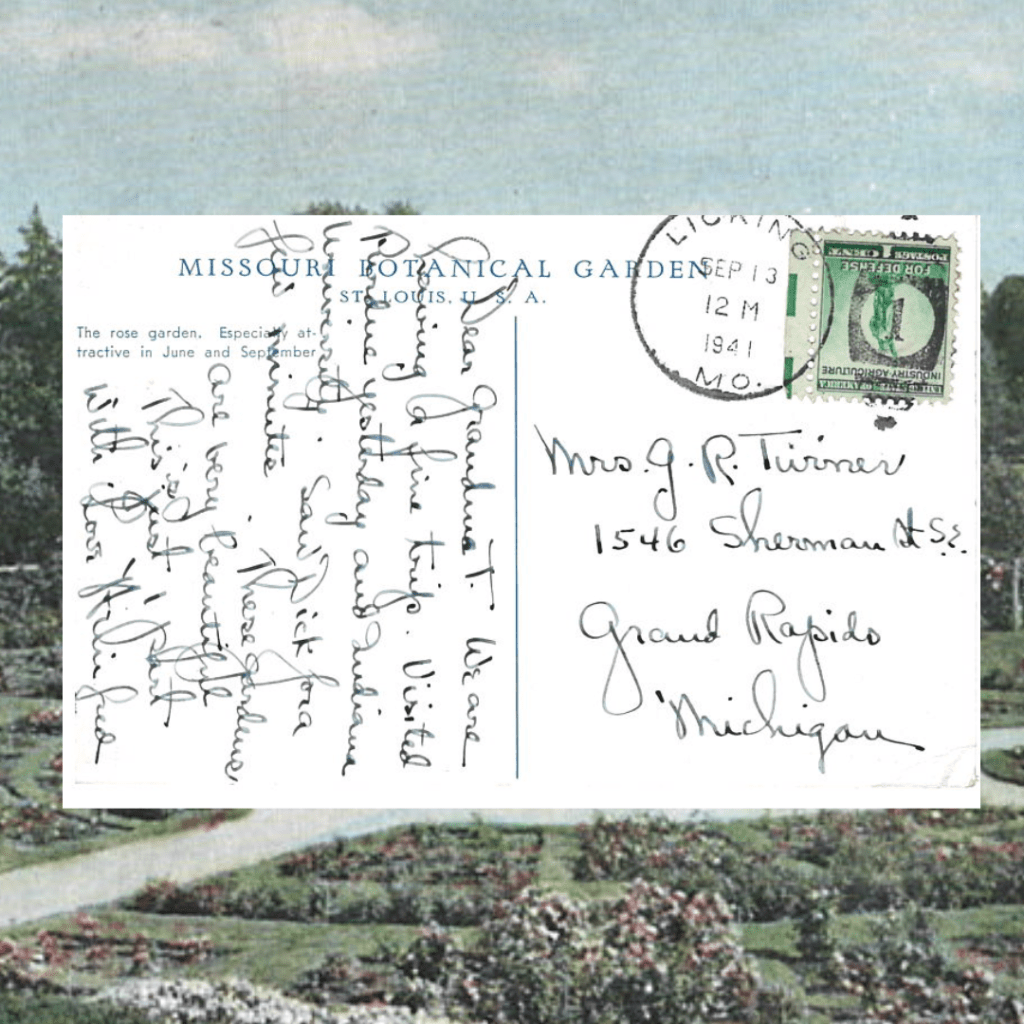
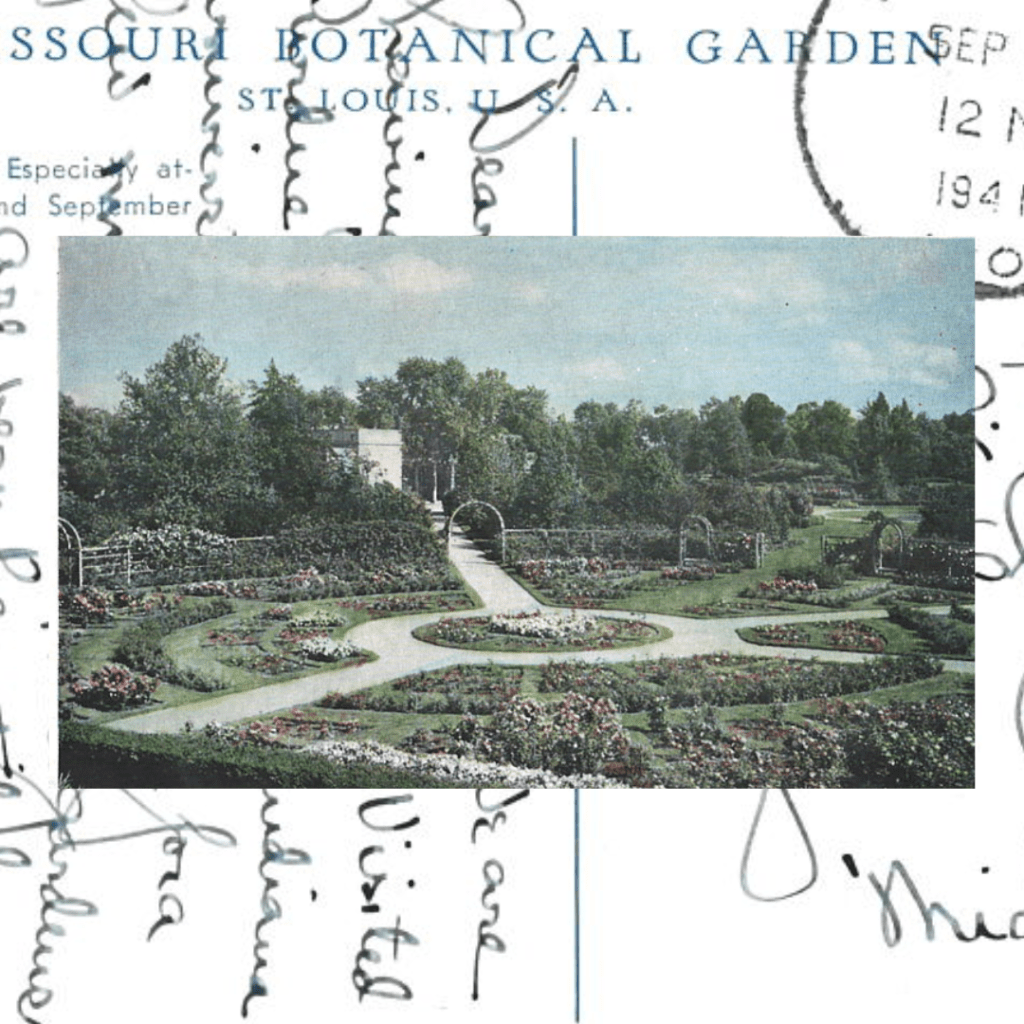
We are having a fine trip. Visited Purdue yesterday and Indiana University. Saw Dick for a few minutes. These gardens are very beautiful. This is just 1 part.

With love,

Arnie, Fred(?)

I didn’t mean to choose two postcards in a row that corresponded with the escalation of World War II, but here we are. By September of 1941, the United States was months away from entering the war. We were embroiled in the Battle of the Atlantic, and FDR had essentially declared a naval war against Germany and Italy.

With war building, I often wonder if the world felt off kilter, and time together was shadowed with the prospect of destruction. Or, did everyday life continue with the hopes that Americans would remain unscathed? I’m sure it must have been a little of both, but with war coming, Arnie and Fred*, and their family, maintained a sense of normalcy by visiting colleges.

I find many things about this postcard appealing. The curving letters and even script, the thicker parts of letters where the ink bled a little longer. However, what’s precious about this postcard is the deep bond between grandma and grandchildren. Not only did Grandma T’s grandchildren think to drop her a line, they likely took time picking out a postcard to send her. It meant enough to Grandma T that it’s managed to survive the last 83 years. This is one reason postcards feel so amazing to me. They are often relics of love.

As an aside, Purdue and Indiana University are not close to the Missouri Botanical Gardens, nor are they very close to each other. The family must have been on a road trip through the midwest, perhaps with the intention of visiting various colleges and landmarks along the way. It makes me wonder if the grandchildren sent Grandma T more postcards, and if any of those survived.

*very unclear on the names. Checked with four different people and each person had a different response to the names. Feel free to chime in.

Front of Postcard: Missouri Botanical Gardens

Categories
History Photographs Postcards Vintage writing

Manie’s Postcard to Mr. Howard Burr: A Snapshot of 1917

Postcard to Mr. Howard Burr, 1917

Portage Wis. March 29, 1917

Dear Howard: –

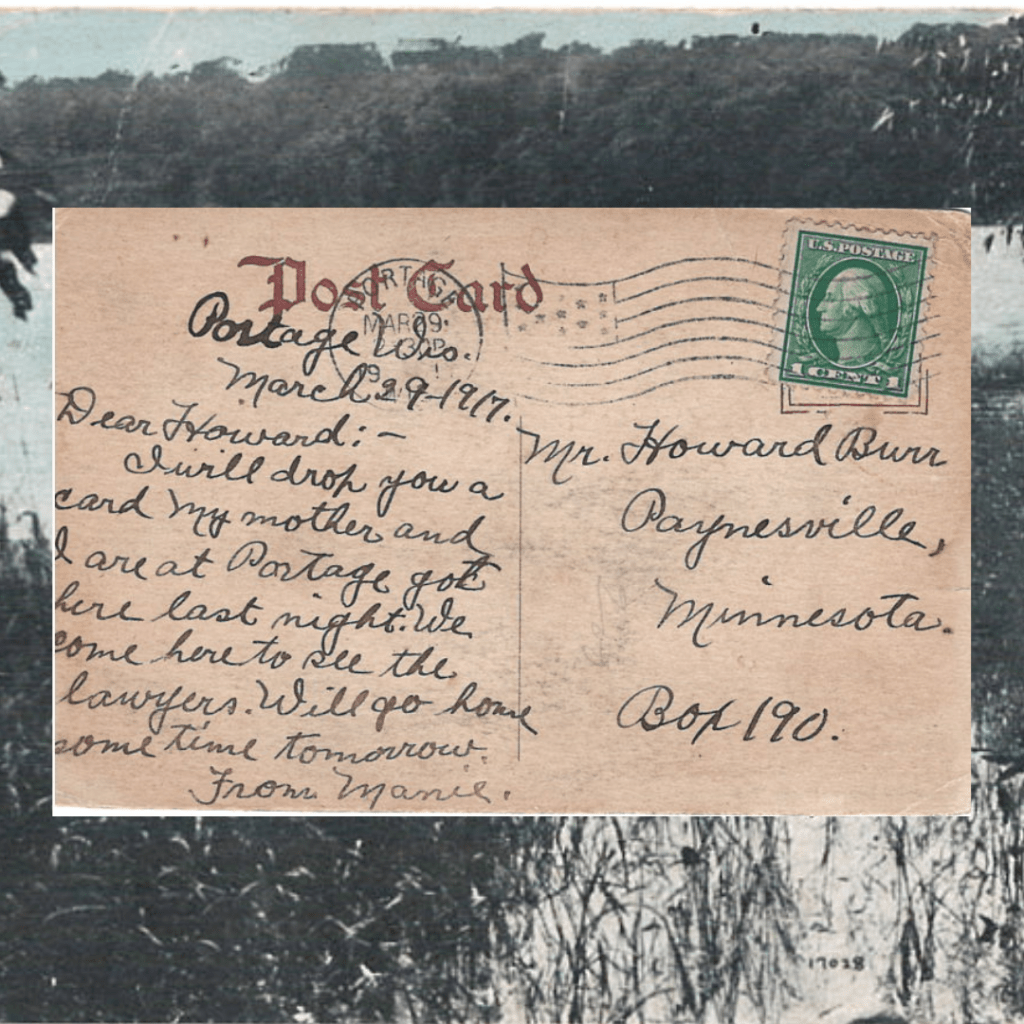
I will drop you a card. My mother and I are at Portage. Got here last night to see the lawyers. Will go home some time tomorrow.

From,

Manie

Before I get into this tantalizing postcard, let me first drop 1917 into history, as it’s a fairly pivotal year, and March an important month. Europe was at war, but in February of 1917, the Russian Revolution began. This would eventually prompt the US to enter World War 1, but war was not declared until April 4, 1917. The US would institute a draft in May, and the Spanish flu was still a year away. So, when Manie wrote this postcard on March 29, 1917, the United States was six days away from war.

I always love mementos like this, cards on the precipice of something big. I have to wonder, how anxious were they? Did they know the world was about the change, or were they fairly isolated in their midwestern towns? I suspect a little bit of both.

Without a last name, I wasn’t able to easily research Manie, the sender. Though I would love to know why he and his mother were meeting with lawyers. Did it have to do with the impending war? A family estate? A marriage? A death? A divorce? Legal troubles? Your guess is as good as mine, though my guesses tend to run the gambit of wild and unusual.

Portage, Wisconsin was somewhat easier to research — as towns tend to be. In 1917 it seemed it was a larger commercial district, which explains why Manie and his mother were there to see a lawyer. We can imagine that they perhaps did some shopping, or stayed in a quaint hotel in the city center.

I was able to find a Mr. Howard Burr who was born in Paynesville, MN in 1896 and died in Wisconsin in 1972. I wasn’t able to locate a (free) obituary, however I’m fairly confident this is to whom the card is addressed. If I’m right, Howard would have been just under 21 years old — the right age for the draft instituted in May of 1917. I’d guess Manie was around the same age. It leaves me wondering if they both fought in the war.

I also hope that whatever legal business Manie was involved with was easily resolved.

Front of Postcard. Silver Lake, Portage Wis.