Categories
family History Photographs Postcards Vintage writing

“My Dear Boy”: A Desperate Message from a Loving Mama

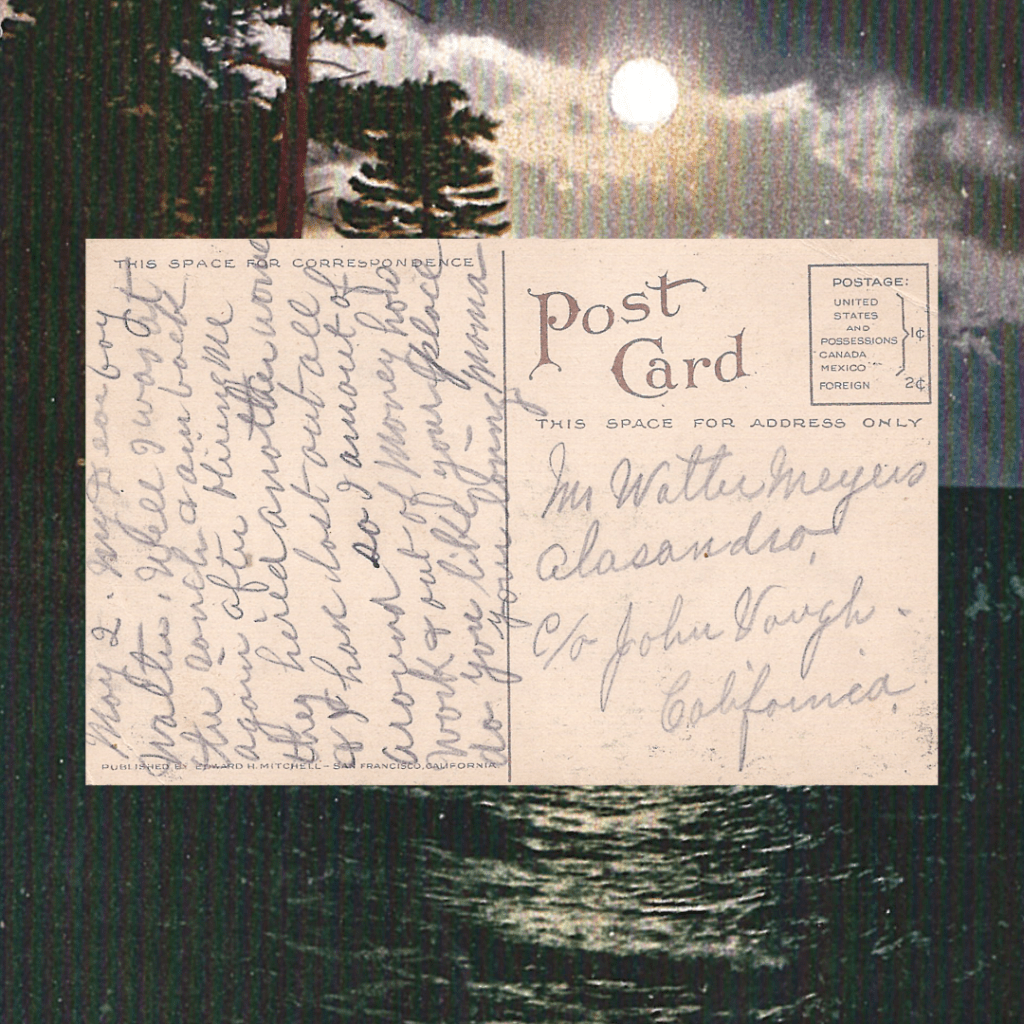
To Mr. Walter Meyers. Date Unknown

May 2: My dear boy Walter,

Well I was at the ranch and am back again after firing me. They hired another woman and I have lost out all around so I am out of work and out of money. How do you like your place?

Your loving mama

Because there’s not a postmark on this card it’s impossible to know when it was sent/delivered to Walter Meyers. My instinct tells me it’s somewhere between 1900 and 1915, though it could be into the early 1920’s. The publisher, Edward H Mitchell, was active between 1898 and 1920.

Additionally, in my experience, earlier dated postcards typically conveyed family information like illness, hardships, celebrations, or moves. However, as the ability to communicate over longer distances became easier, later dated postcards typically discuss vacations and trips. Of course, this is not always the case, but it’s something I’ve noticed.

I also tend to think that this postcard originated (and ended) in Northern California, though I suppose our “loving mama” could have been in Southern or Central California (based on the fact that she’d been on a ranch of some sort). At the turn of the 20th century, much of California was agricultural and relied on migrant workers for labor. Frankly, this is still the case. I have a feeling this mother and son lived and worked in different areas of Northern California. Especially since the postcard was printed in San Francisco.

That leads me to the message and picture of the card itself. The desolation of a dark, lonely lake only illuminated by a high moon seems to fit the desperate message of the card: “I am out of work and out of money”. Yet, something about the card makes me uncomfortable, and I can’t place why. Is it simply because the mother is in need. Is the reverberation of her fear for the future imbedded into the fading pencil marks? Or is it something else?

Our loving mama doesn’t outright as her son for money, but she makes it clear she has none. She ends the message with a question of how he likes “his place.” She’s likely referring to his job, here. Is she trying to get hired? Is she reaching out to her child only as an act of self preservation? My mind reels with questions. All parent-child relationships are complicated, but still I can’t help wondering how close these two were, and whether her son was happy or disappointed to hear from her. The overall message itself feels…cold. Desperate, yes, but also seems to lack true affection.

Perhaps I’m being unfair. In fact, I’m probably being unfair. Especially since without a date and place it’s difficult to search for Walter or the “C/O John Vaugh”. I hope that our loving mama got her job and money situation sorted, and I do hope that she and her son were able to have a sweet reunion. How and why this card was kept, we won’t ever know. But, now it exists as a testament to the hardships of life and family.

Front of Postcard
Categories
Education History parenting Photographs Postcards Teaching Vintage

The Summer of 1948: Olympics, Cold War, and a Health Crisis

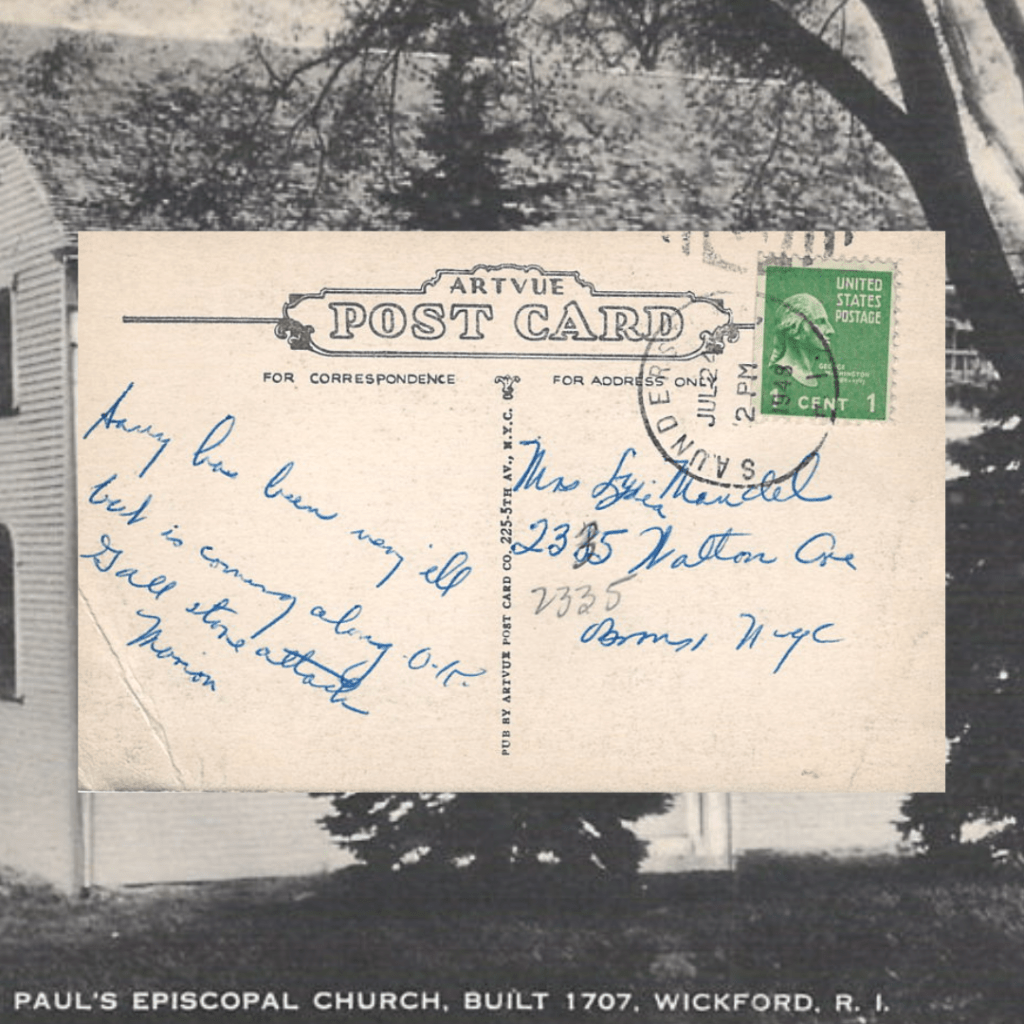
To: Mrs. Lydia Mandel. From: Marion 1948

Sammy, has been very ill but is coming along O.K. Gall stone attack.

Marion

*Alternatively, it could say “Sorry have been very ill”, however the following “but is coming along O.K.” changes tense and thus feels incongruous. Therefore, my best guess is that the first word is a name (Sammy, or perhaps Avery).

This may be one of the “later” cards I’ve blogged about, though it’s certainly not the oldest in my collection. However, it was serendipity that I chose this card today.

On July 29, 1948, the Summer Olympics opened in London. This was the first Summer Olympics held since the 1936 games held in Berlin. The fact that the games were held, and in London of all places, indicates that nations were beginning to heal after the devastation of World War II.

Despite the world uniting in sportsmanship, tensions between the United States and Russia were heating up. On July 22, President Truman issued a peacetime draft, and ten communist leaders were arrested under the Alien Registration Act. In fact, the second Red Scare had begun

It’s amidst these conflicting events (sportsmanship and fear mongering) that Sammy (or Avery, or Marion) had a gall attack. Now, I don’t know if you’ve ever had a gall attack, but if you haven’t — they are awful. I call them the “stabbies” because it’s like a sharp pain entering the space just above your stomach. Nothing helps but time. I’m lucky enough that I’ve only had two or three in my lifetime. I also have the benefit of modern medicine if they get too bad. In 1948, there’s not much to do but wait, and I imagine that time probably crept by at a snail’s pace for the poor patient.

I have no evidence of this, but I imagine that Sammy is a child, Marion the mother, and Lydia the grandmother…or perhaps sister to Marion. Again, there’s nothing that indicates any sort of relationship barring the existing postcard, but in my mind…it’s a multi-generational connection.

I did find a “Lydia Mandel”, who was a Russian artist. However, everything I see indicates she was active in France, so I find it difficult to believe thats our Lydia. The address on the postcard still exists — it’s a quaint apartment in the Bronx. For us, Sammy and Marion and Lydia’s story must therefore end with this card. However, the fifties hadn’t yet begun, and the sixties were a decade away. The coming decades were a time of great inner change and turmoil in the United States.

I guess it was sort of like a gall stone attack in that respect.

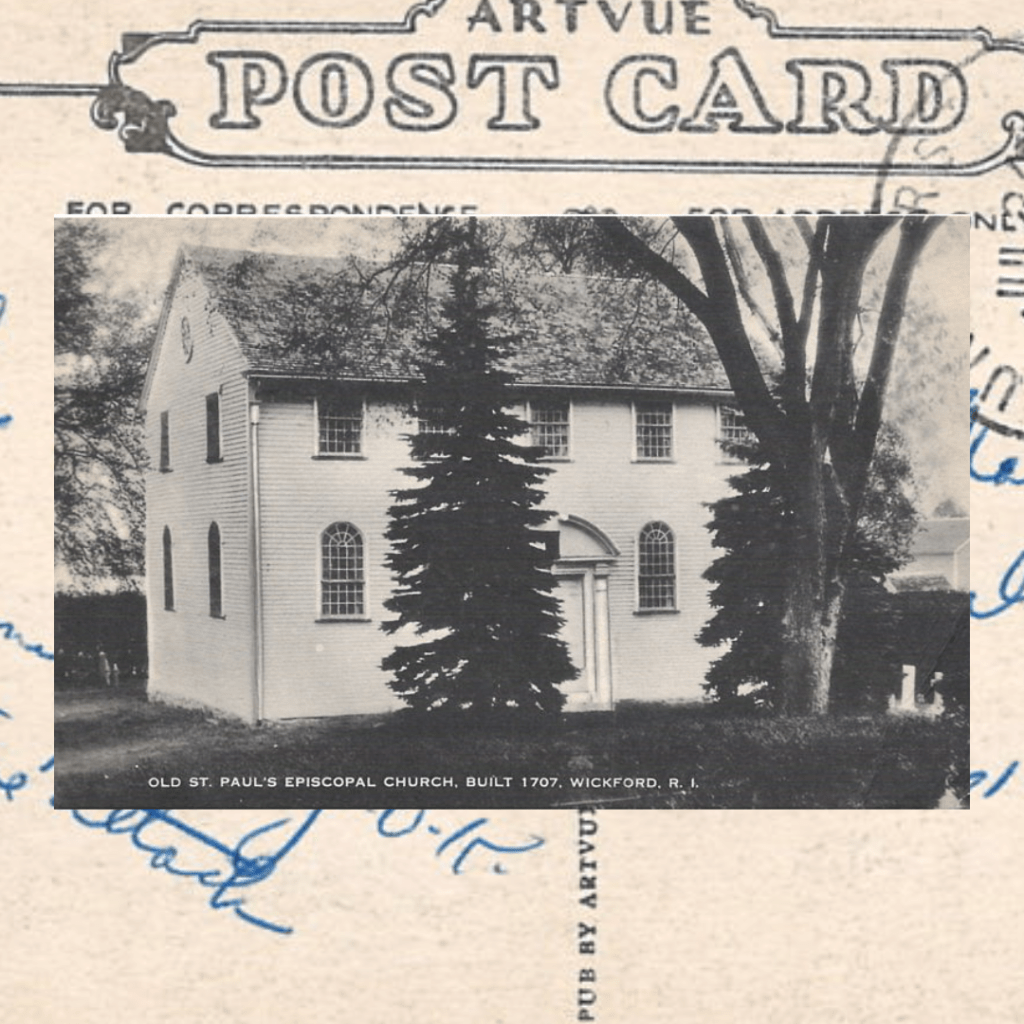
Front of Postcard: “Old St. Paul’s Episcopal Church, built 1707, Wickford R.I.

Categories
Education History Photographs Postcards Teaching Vintage Writing Prompt

Exploring Niagara Falls: From Underground Railroad Route to Postcard Romance

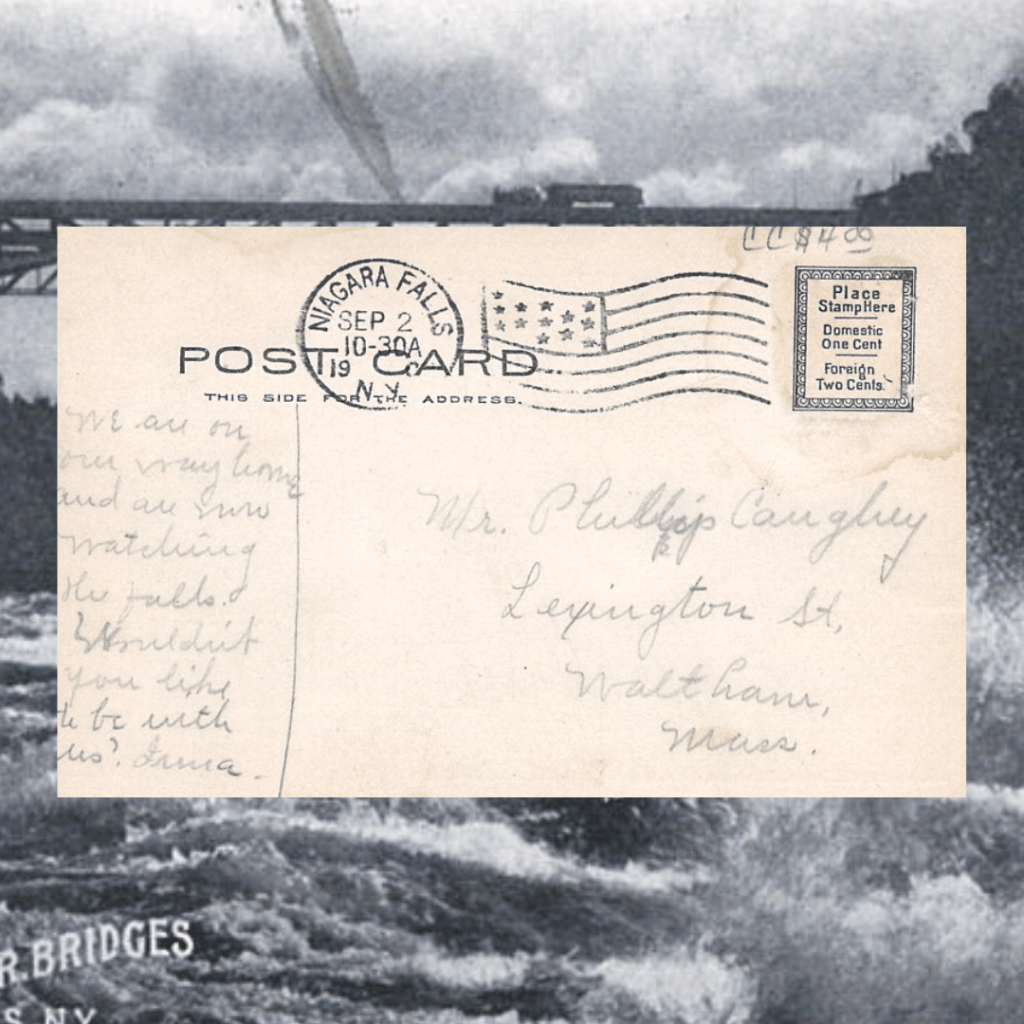
Postcard to Mr. Phillip Caughey, early 1907-1914

We are on our way home and are now watching the falls. Wouldn’t you like to be with us?

Trina (or Laura?)*

Although trips to Niagara Falls have fallen in popularity in the 21st century, the Falls was a hot spot for tourism through the middle of the 19th and through the 20th centuries. Groups of honeymooners, children, the elderly, and young adults clamored to catch a glimpse of the falls majestic beauty. Theodosia Burr and her husband were the first recorded couple to honeymoon at the falls in 1801.

Being on the Canadian border, the falls also served as a route to freedom on the Underground Railroad as laws leading up to the Civil War pushed enslaved men and women who freed themself further and further North, until finally the only safe place was Canada.

Tourism to the falls grew after the American Civil War, thanks to the trains, and then boomed again in the years after the World War I, thanks to cars.

Thus it was that our friend Trina (or Laura) came to be one of the millions of visitors who took in the sweeping majesty of 3,160 tons of water streaming over the falls every second. She enjoyed the trip so much that she bought, wrote, and sent a postcard from Niagara to her friend Phillip.

I have two ideas about this postcard. It’s a short message, written in pencil and added to the very side of the postcard almost as an afterthought. It’s almost as though at the last moment Trina (Laura?) decided to taunt Phillip (wouldn’t you like to be with us?).

Alternatively, seeing as the spot has romantic undertones I’d like to imagine that our heroine, Trina/Laura, thought of the man she’d like to be with and threw caution to the wind by sending him a postcard. At the last minute, she chose to add in a bit of cheeky flirtation — which is why the message is so squished to the left side. .

Either way, I love the message. I love the way Phillip’s name is misspelled then fixed. I love the sass, I love the idea of young people visiting Niagara Falls as a fun outing or trip. Admittedly, I didn’t look too hard for Phillip. I’d like to live in my own imagination on this one, and dream that, indeed, he would have liked to have been with his friends in Niagara Falls.

*The signature on the bottom of the card looks like Trina to me, but Laura to my husband. Neither of us could quite agree, but since it’s my blog, I decided to go with Trina. Please feel free to weigh in.

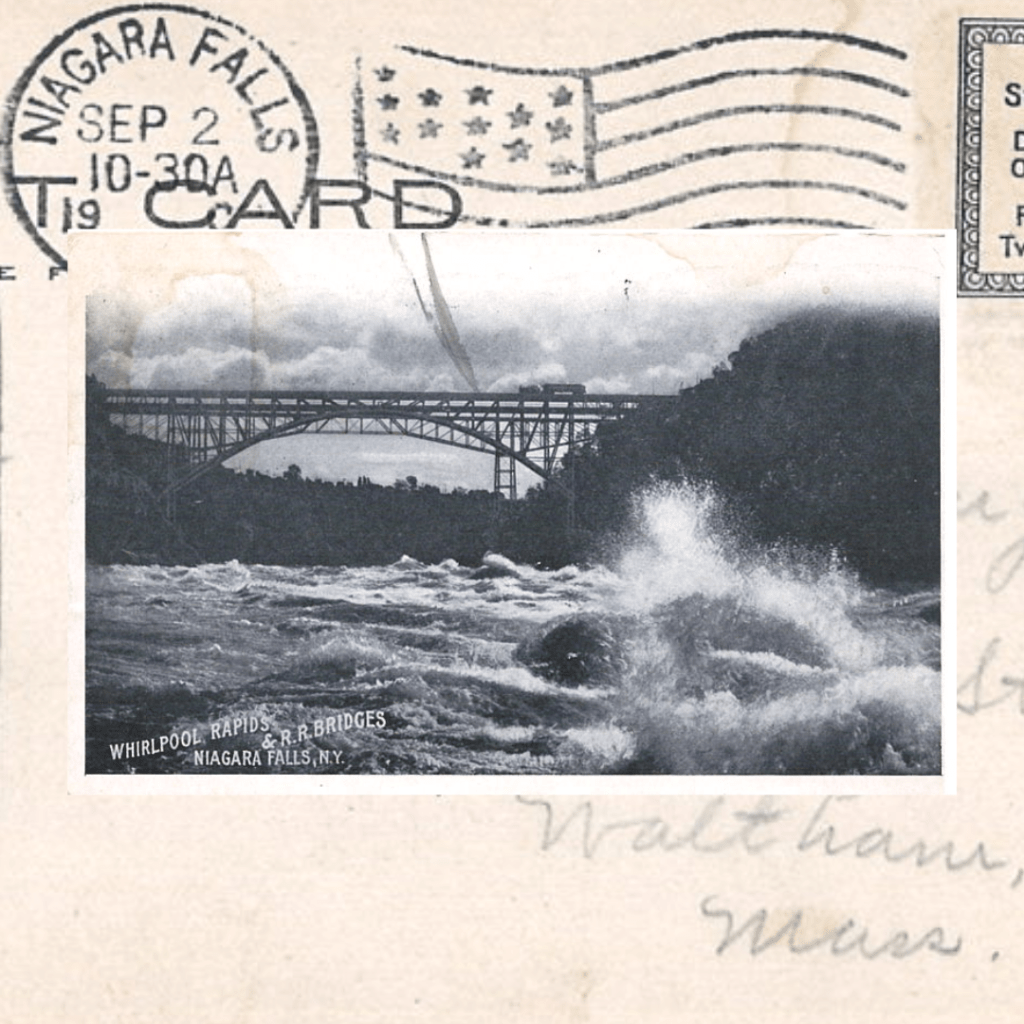
Front of card with an image of Whirlpool Rapids, Niagara Falls

Categories
family History Postcards Teaching Vintage Writing Prompt

Life of a Teacher in 1919: Hazel Truitt’s Loneliness and Connection

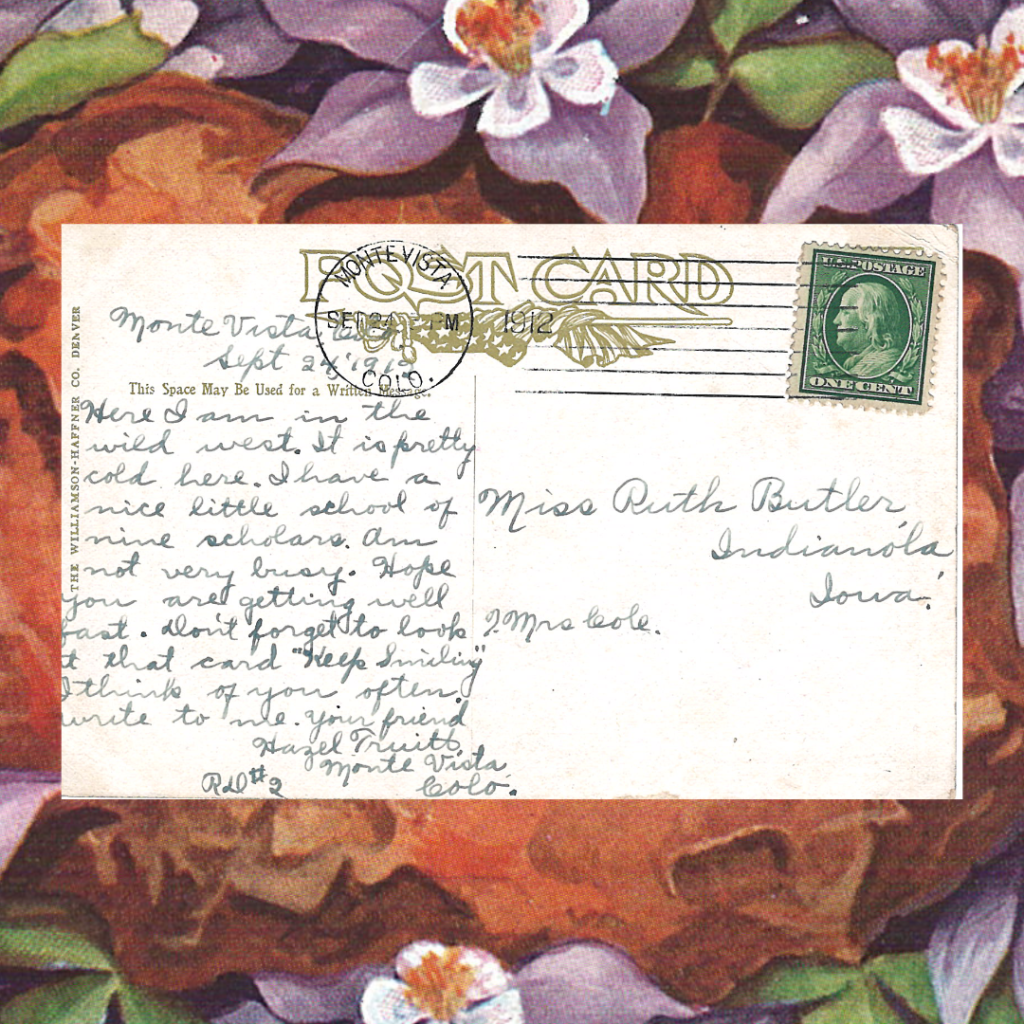
1919: To Miss Ruth Butler, From Hazel Truitt

Monte Vista, Colo.

Sept. 24, 1919

Here I am in the wild west. It is pretty cold here. I have a nice little school of nine scholars. Am not very busy. Hope you are getting well fast. Don’t forget to look at that card “keep smiling”. I think of you often. Write to me.

Your Friend

Hazel Truitt

R20#2 Monte Vista Colo.

By September of 1919 the world was no longer at war, yet the war’s effects were far reaching — especially in the United States. Soldiers returning home from WWI meant an influx of working age men streaming back into cities. This combined with the Great Migration, or the movement of Black men and women from the South towards the North for both opportunities and as a way to escape Jim Crow laws.

The confluence meant a competition of jobs that intensified and erupted into racial violence that was later dubbed the “Red Summer“. Further South, the Axeman of New Orleans had taken his second to last victim, labor strikes were erupting around the country, along with the first Red Scare, which was a great fear of far left movements. The 19th Amendment – which gave women the right to vote, was in the process of ratification, and finally the 18th Amendment, or Prohibition, was months away from taking effect.

This is the context in which Hazel Truitt wrote to her friend Ruth. Monte Vista, Colorado, was a typical western town (or as Hazel said, the Wild West. It sits in the southern part of the state, and in 1919 received it’s first library.

As a school teacher in 1919, it was likely that Hazel boarded with a family, or perhaps another teacher. She would have been paid a pittance, as part of her payment was a room (and some board). Her nine “scholars” would have ranged in age from 5 to possibly 20, and she would have instructed them in one room.

Being in a new city, and a rural one at that, was probably lonely for Hazel, and I think we can see that loneliness creep in to her writing. She makes sure to tell Ruth that she “thinks of her often” and also to “keep smiling.” Perhaps a move to the “wild west” screamed adventure and opportunity, but was a much harsher reality.

Unfortunately I was able to find nothing on Hazel or Ruth. I assume they both married, and I hope they had the chance to reunite at some point in their lifetimes.

As a teacher myself, I feel a kinship with Hazel and hope she found joy in her nine scholars.

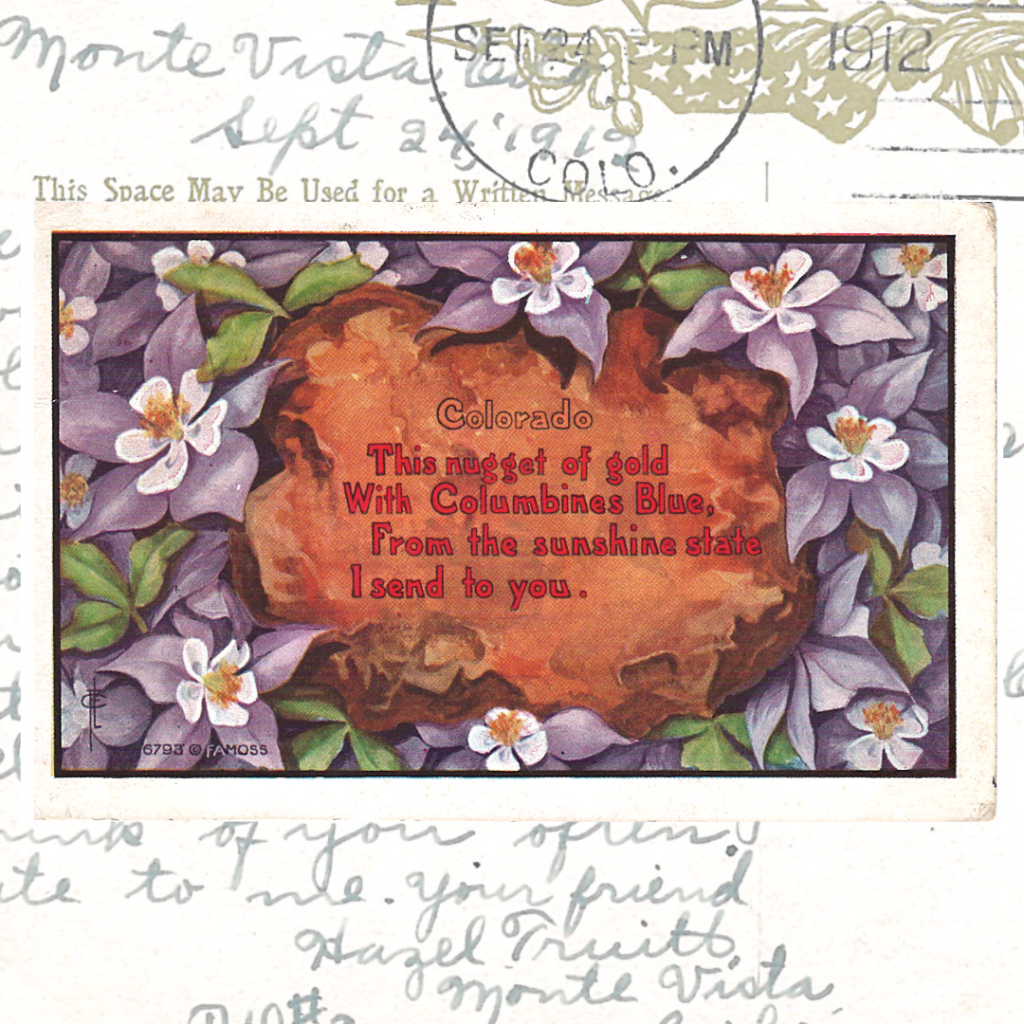
Front of postcard

Colorado

This nugget of gold

With Columbine blue

From the sunshine state

I send to you

Categories
Education History Postcards Vintage writing

Miss Ada Moll: Mama’s Spider Bite & Doctor’s Visits in the 1920’s

Mrs. J.A. Taylor: Circa early 1920’s

My Dear Beryl:

Received your (unclear) card and little note and glad to get both. Hope both of you are well and enjoying yourselves. Will be glad to hear more from you at anytime you’re not busy. We are all well except mama. She was bitten on the left eye Sunday by a poisoned spider and it was swelled up so tight she couldn’t see. Much better now. Have had Dr. Field 4 times. Can open eye a little now. Sorry you forgot the minte. Lots of love,

Ada C. Moll

Post Script: Do you remember ever seeing the view on the other side? Come over and we will take a ride. A.C.M

The date on this card is unclear, the ink lost to the ravages of time. However, I was able to find a Miss Ada C. Moll mentioned in an Indianapolis newspaper in 1925. I suspect this card pre-dates the mention, however since phone lines and wires were becoming more widespread by the 1920’s, I’d wager a guess that it’s within that time frame.

The 1920’s conjures up images of flappers, lipstick, dancing, cars, movies, progress, and fun. This card certainly has some of those aspects. In the 21st century, a postcard that exhibits nothing but a dirt road and telephone wires seems…bland. However, it’s no different than a postcard that features an image of modern wind turbines, or even a plane. That indicates progress. The postscript on the bottom of the card indicates fun and leisure. The Great War has ended, and the depression hasn’t hit yet, so times aren’t quite as rough as they’ve been.

Yet, in the midst of a changing century, we have a world in which doctors make house calls. It’s difficult to imagine the cost of a modern day doctor coming to your house not once, or twice, but FOUR times. However, apparently that’s what the case was. I suspect mama may have been in danger (or fearful) of losing her sight, hence why the doctor had been out so much. I know that if home visits for a doctor were within my price range, I’d probably do the same if my eye was swollen shut.

I’m sure that Ada was a sister of Beryl, or perhaps even writing to her sister and her niece. That being said, Beryl may have been an older sister in the employ or care of Mrs. J.A. Taylor — I’ve been able to find very little. As I’ve said often times before, women are often obscured in history since they married and took on their husbands name. For me, an amateur genealogist with limited time on my hands, it’s difficult to track down the real people. But I invite your suggestions, or even thoughts on Miss Ada C. Moll and her dear friend Beryl.

Front of Postcard, Evansville, Ind.

Categories
Education History Photographs Postcards Vintage Writing Prompt

1936: TB Patients in Arizona and Mrs. Kenneth Brentlinger’s Story

Mrs. Kenneth Brentlinger, 1936

Fri Eve:

We are at Hotel Kimball for nite, cheaper than tourist cottage. Everything here at Phoenix is filled up. The roads are full of tourists. Then, this is where the T.B. patients come. We are going to Grand Canyon and Boulder Dam Sat. then on to Helena Sun. but don’t know what time. Getting along just fine. Mrs. B came through the operation just fine. Had a good nights rest last night.

— Mother

I was able to find Mrs. Kenneth Brentlinger’s name: Helen, and her grave (see the link above), but I wasn’t able to easily find the name of her mother. A lack of information means that I can’t pick apart the intricate lives of these two women, but we can at least drop them into the historical context of wider world events.

In 1936, FDR was re-elected President, Labor Unions protested, and Germany hosted the Summer Olympics, where Jesse Owens won four gold medals. Hitler’s Nuremberg Laws had been enacted in 1935, the United States was in the midst of the Great Depression, and we were still five years away from joining World War II.

Additionally, in 1936, Mrs. Kenneth (Helen) Brentlinger’s mother visited the Grand Canyon and Boulder Dam. A reminder that amidst the grand events of the world stage, our individual lives march on as best we know how. There are so many questions I have about this postcard, the first of which being who is Mrs. B, and what operation did she have?

But what struck me most was a fact that I had never heard before: that TB patients flocked to Arizona for treatment believing that the dry, hot air of the desert would serve as a place where they could rest, recuperate, and unfortunately pass away, from Tuberculosis.

For the patients with money, there were a variety of posh hospitals with beautiful views and state of the art luxuries. These sanatoriums held upward of 100-150 patients, and did their best to treat the disease.

However, there were many more who suffered in poverty. That did not dissuade them from seeking treatment. Called “lungers” as a pejorative, tent cities of patients popped up in Pheonix and Tucson, and though funding and services had improved by 1936, based on this postcard we can see that the influx of patients hadn’t ceased due to the depression. In fact it only increased in the 20s and 30s.

Treatment for TB included the dry air and rest, as well as invasive surgery that included collapsing a lung through the removal of a rib. Is it possible this is the surgery Mrs. B went through? I rather hope not, though perhaps a visit to a sick friend created a sort of impromptu vacation for Helen Brentlinger’s mother.

There’s an inscription around the edge of the front: Seen hundreds of these today. Sure pretty. The sun was sure wonderful and make my toes burn up in places.

There’s something about this that is so human. I love it.

Categories
Education History Photographs Postcards Vintage writing

Teenage Flirtation in 1908, A Call to War, and The Mystery Sender A.N.

Mr. Earl Poush, 1908

Hello Earl,

I received your card and was glad to hear from you. I went to the party Saturday night and had a nice time. Vera and I went over to Dallas Sunday afternoon and staid till church at night. Maybe you think we didn’t have time. Well I didn’t have to ask Bertha who the card was from. Did you go to town Saturday. I will have to close for this time.

Answer Soon

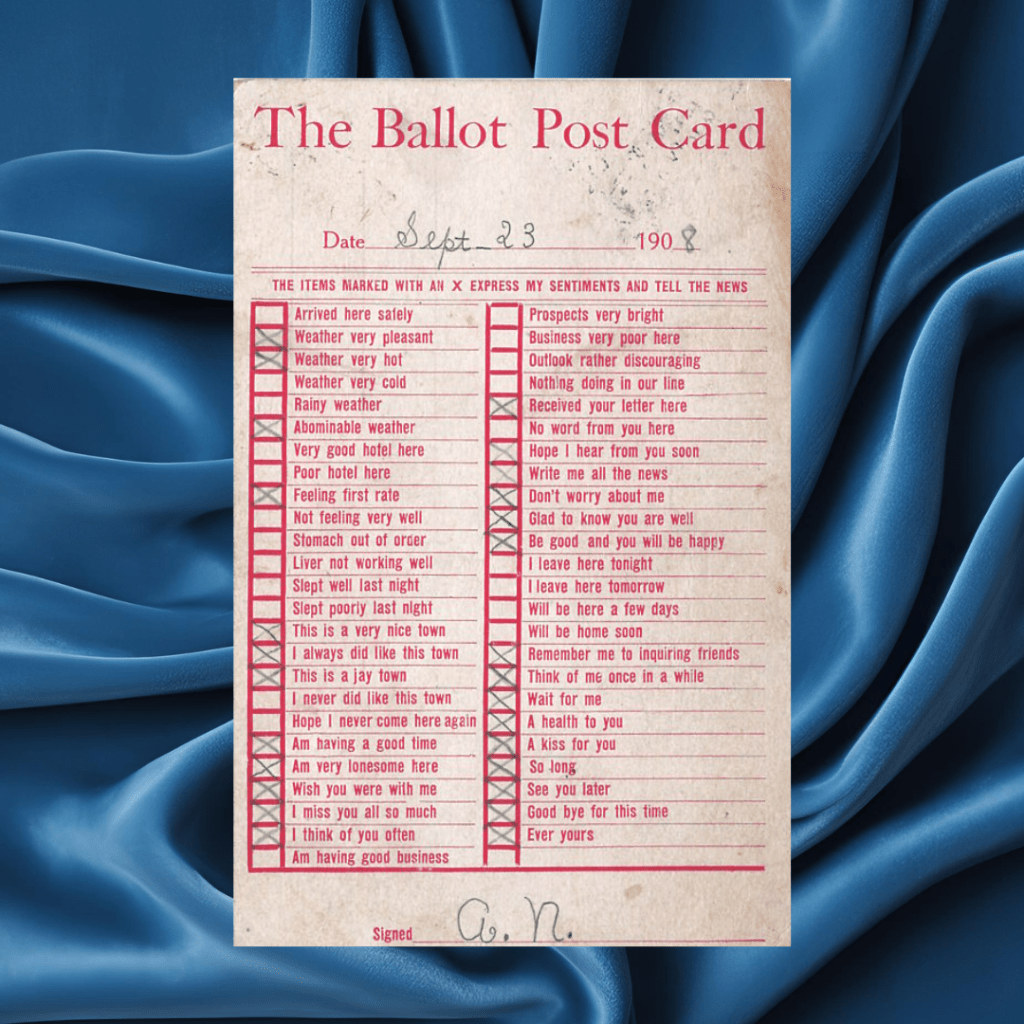
The front of this postcard is just as informative as the back, so rather than post it at the end, I wanted to post it here. Take a gander, then read on:

The Ballot Post Card: September 23, 1908

1908 was a leap year, and saw a variety of notable events that live on within the American zeitgeist. Wilbur Wright completed a 2 1/2 hour flight, Henry Ford debuted his Model T, and the Chicago Cubs won the world series.

But all of that, perhaps, pales in comparison to the light flirtation of teenagers. Again, we have a bit of a mystery sender. There’s no way for me to ascertain who “A.N.” was, or what (I assume her) relationship was to Earl, but I think it’s rather clear that the two of them may have been sweet on each other. Especially since Miss “A.N” checked off “I think of you often”, “Wait for me”, “A kiss for you”, and “Ever yours.”

Additionally, I’m guessing that when “A.N.” says “I didn’t have to ask Bertha who the card was from”, she means she knew the card she received was from Earl before even seeing it. I love that A.N seems to be surrounded by some girl friends, and I wonder if Vera, Bertha, and A.N. were on a little girls trip together.

Although I couldn’t find the identity of A.N., I do believe I found a little bit about Mr. Earl Poush. If I’m correct, it appears that he was born in 1892, which would put him at the tender age of 17 in September of 1908 — the perfect time for an early flirtation. It seems that he fought as a Corporal in World War I, and was injured in 1918. In 1919, he married Hope Lita Hicks (Poush) — not our elusive A.N. The world both teens grew up in must have been very different from the one they sent innocent cards in during the waning summer of 1908.

Categories
History Photographs Postcards Vintage Writing Prompt

Unveiling the Enigma of Mrs. N. in 1913 Los Angeles Through a Vintage Postcard

Miss Louise M. Simmons(?)

Box 13-87 Los. Angeles CA

Dear Friend Louise,

I am writing you a long letter but am to sleepy to finish up tonight so send this card instead. With Love. From your old friend,

Mrs. N.

What a stunning card from an exciting time in the history of the west. By 1913, Los Angeles was the 17th largest city in the nation, with upwards of 319,198 people. 1913 was also a momentous year for the city. The Los Angeles Aqueduct was completed, which because the city could not sell it’s water to other areas, meant that LA grew significantly over the course of the next decades as smaller areas annexed themselves into LA.

Cecil B. de Mille shot the first “Hollywood” movie, the Natural History Museum of Los Angeles County opened, and Georgia, “Tiny” Broadwick became the first woman to parachute out of a plane, landing safely in Griffith Park.

Mrs. N, being in Los Angeles in January, perhaps didn’t know much of what was in store for the city that year. But, this postcard does give us a tantalizing peek into the history of that bright city. Unfortunately, the longer letter is lost to time, or perhaps someones attic, so we can’t know for certain why Mrs. N. was in Los Angeles. Was her family there to work on the aqueduct? Was she part of the burgeoning movie industry? Had the family moved South after the 1906 San Francisco earthquake? Were they citrus farmers? I’d love to hear what you think.

With very little information on the postcard — including the full name of the elusive Mrs. N, it’s difficult to ascertain how and why she had made it to Los Angeles. However, it’s an exercise in imagination to think of what she must have seen in that important year of 1913.

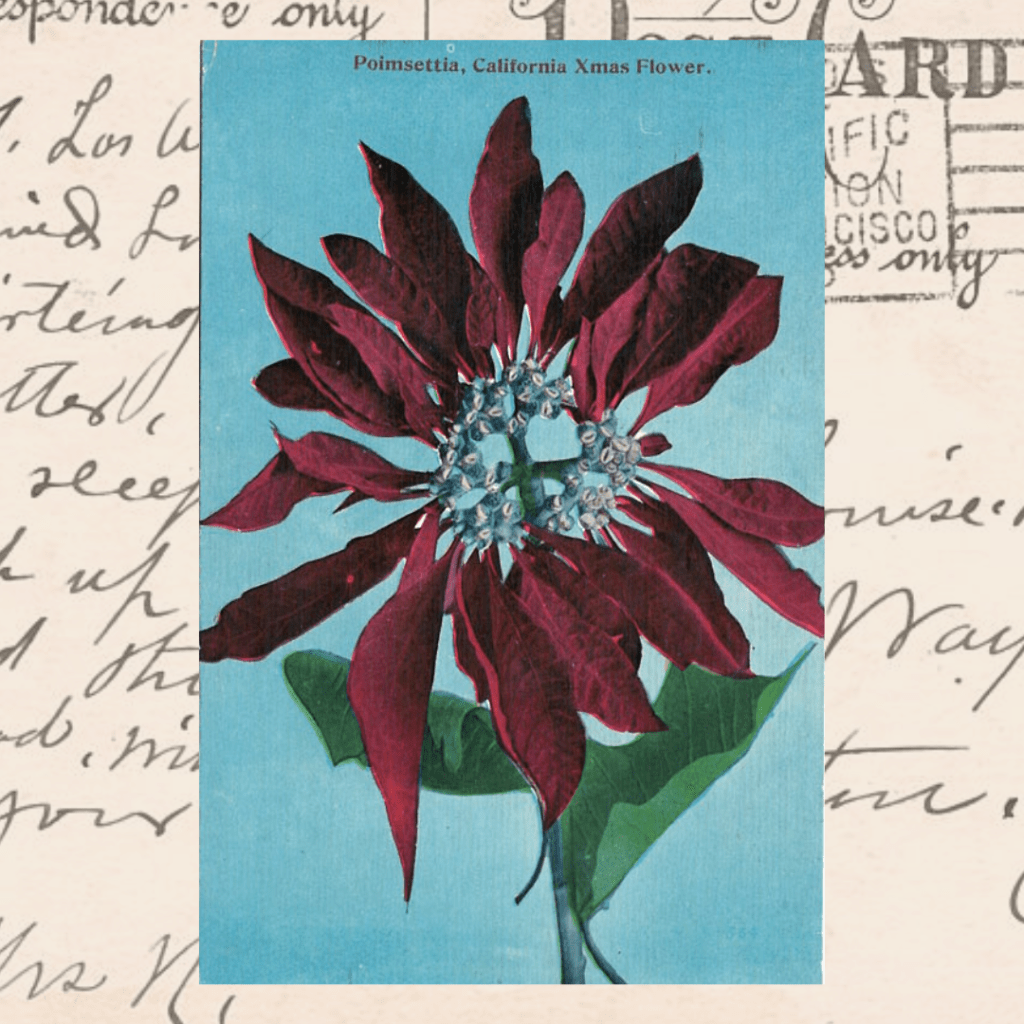
Front of Postcard: “Poimsettia, California Xmas Flower.”

Categories
Education History Photographs Postcards Vintage

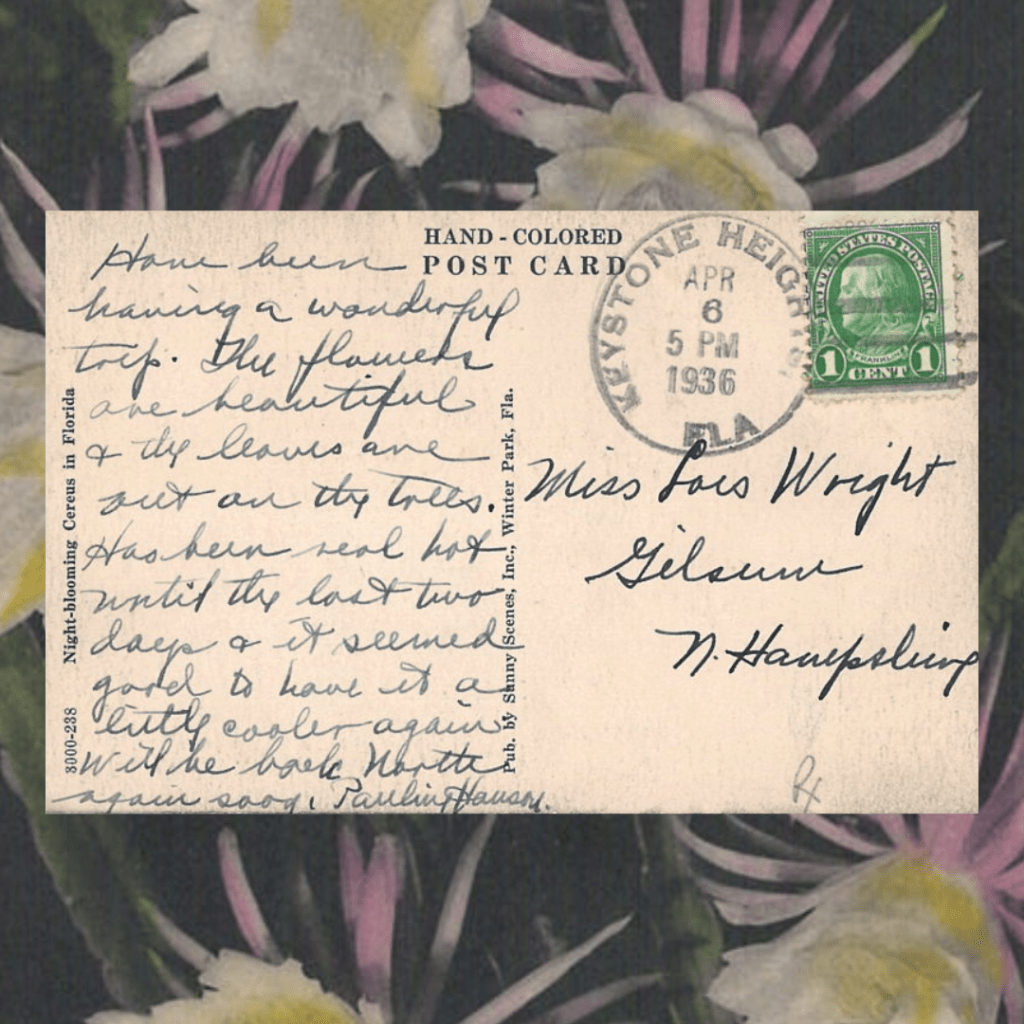
Pauline Howard’s 1936 Postcard to Miss Lois Wright: A Snapshot of Life Amid the Great Depression

Postcard to Miss Lois Wright, 1936

Have been having a wonderful trip. The flowers are beautiufl and the leaves are out on the trees. Has been real hot until the last two days and it seemed good to have it a little cooler again. Will be back North again soon.

— Pauline Howard

First, the context. In 1936 the country was deep into the Great Depression, though the worst hard times were getting slightly better. Black Sunday, the worst storm from the American Dust Bowl, had happened a year prior, on April 14, 1935. By 1936 FDR was elected for a second term, created the Works Progress Administration (WPA) and brought unemployment to 16.9%, down from 20% of the year before. Dorothea Lange also shot her iconic image of “Migrant Mother” in March. So, even if you don’t know a lot about the 30’s, these things probably sound familiar as they exist in the American zeitgeist.

Because the Great Depression exists in our mind as a sort of dark age of American society, it’s difficult to imagine people living their lives outside of hardship. Our minds immediately go to migrants, joblessness, and perhaps even the Grapes of Wrath or Of Mice and Men.

Yes, people were desperate, and yes, these were difficult times. However, the postcard from Pauline to Lois shows that, once again, people were resilient and living the best they knew how. Now, I don’t know how old Pauline and Lois were (though from the moniker “miss” for Lois, I can assume early 20’s), but what’s clear is that despite the country’s turmoil, there was some fun to be had.

Keystone Heights seems as though it was a semi-popular wintering spot which also received assistance from FDR’s alphabet program the Civilian Conservation Corps. April was, perhaps, a tenuous time to visit, as Florida heat in April can get oppressive (indicated in the message of the postcard). But, the country was in for a worse heat wave beginning in June, so hopefully Pauline managed to make her way North before then.

I wonder what the connection between the two women were. Perhaps school friends or room mates? Women are difficult to research since I’m behind a variety of paywalls, and unfortunately I’m not confident I was able to find the correct people. However, there was a Lois Wright who lived in New Hampshire and, despite marriage, did not change her last name (it seems). She lived to be 104, and fits the timeline. Though, of course I can’t guarantee this is our Lois, I’d like to believe it could be.

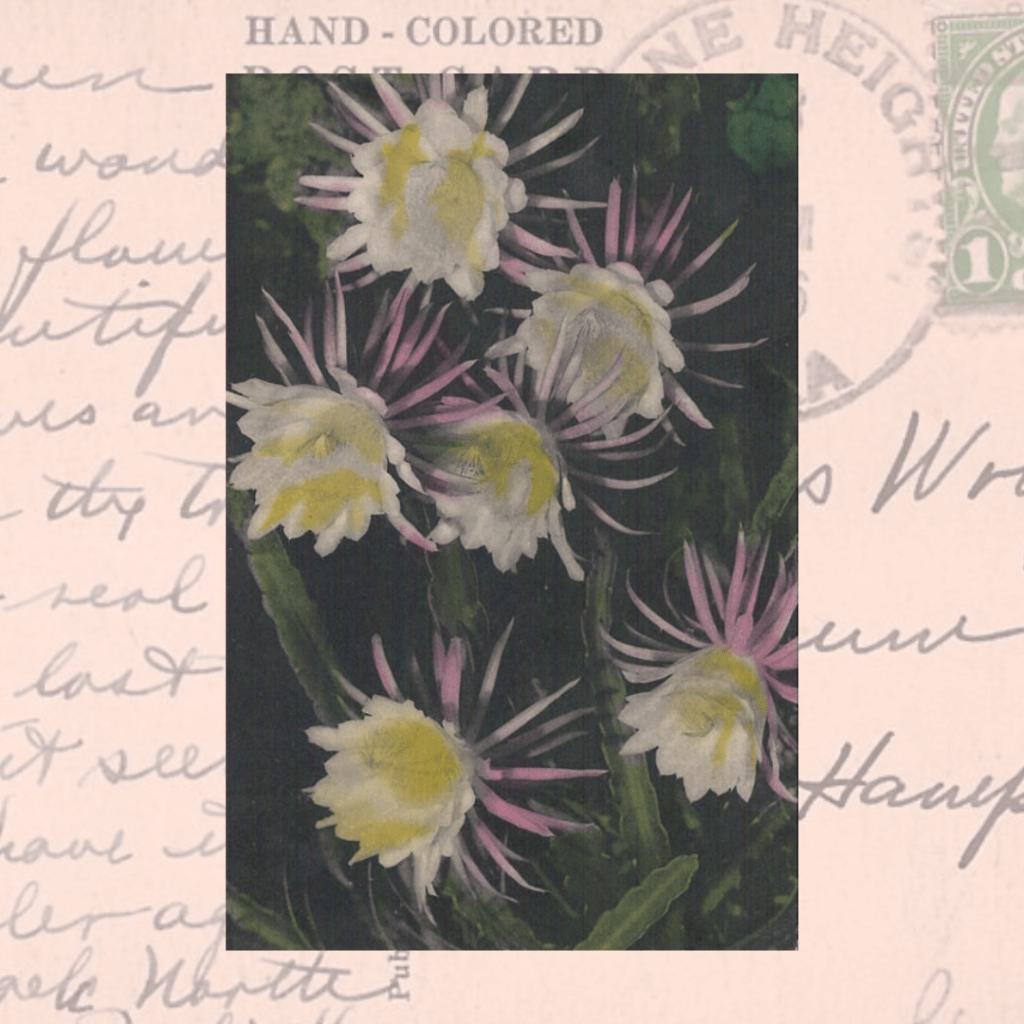
The postcard is also beautifully hand colored, and is stunning in person.

Night Blooming Cereus: Front of Postcard