Categories
Education family History parenting Photographs Poems Postcards Vintage Writing Prompt

Promises, Procrastination, and Postcards: Unraveling a 1912 Tease to Frank Van Gordon

To: Mr. Frank Van Gordon. From, Chuck(?) 1912

Dear Old Friend:

How are you. I am fine and dandy. Marie said she was saving her daughter for you so don’t get married. “Ha Ha”. I never got your letter until the other day and will just send you a card. Haven’t seen tasel(?) for a long time. Well so long and soon.

Yours,

Chuck

542 N. Elder Ave, Indpls

In 1912, William Howard Taft was the president, New Mexico and Arizona were admitted as the 47th and 48th U.S. State (respectively), and in the early hours of April 15, the RMS Titanic sank in the chilly waters of the Atlantic Ocean. Suffragettes paraded in New York City, and Theodore Roosevelt was shot in Milwaukee, Wisconsin, proceeds to give a speech, then goes to the hospital.

It was a crazy year.

This card is one of the first postcards I put on this blog, though I felt like I never quite did it justice. There is just so, so much going on. First, there’s the innuendo that “marie” is “saving” her daughter for Frank. Which…I guess the jibe is fun but it gives me a bit of the ick. I also wonder why Chuck “never got” Frank’s letter. As a professional procrastinator, I wonder if Chuck did in fact get the letter, forgot about it until he saw Marie, then remembered to send a card.

Much to my chagrin, I couldn’t find Frank at all. There were a few decent candidates, but none of them fit the timeline well. I have to assume that in 1912 Frank was somewhere between 20-30 (I’d guess 22), especially seeing as his friend is teasing him about getting married. Also, Antigo is a relatively small town, though it’s part of the lumber industry. It’s possible that Frank was a lumber worker.

Which might be why he’s hidden from us in the archives. If he only worked in Antigo as a seasonal worker, or for a year or two, then there would have been no reason for the census to record him living in that city. Also, I wonder if he’s listed in the archives as simply “Frank Gordon”. It’d be strange, since “Van Gordon” isn’t that crazy of a last name, but it’s still possible I suppose.

Well, I revisited this card in the hopes that I could shed a little more light on Frank and his friend. I’m sorry that I couldn’t find them! At least I feel like I’ve given the card it’s due — especially since so much happened during 1912! I do wonder what happened to Frank. I hope he lived a good life, and managed to sit down to dinner with Chuck at some point.

As an aside, the postcard front is so silly when you connect it to the message on the back. Chuck is teasing Frank about a wife, then sends a card that reads “I found a Queen in Indianapolis. If you’re wise, you’ll hurry here.” That’s more than a hint, it’s a smack across the head with a trowel.
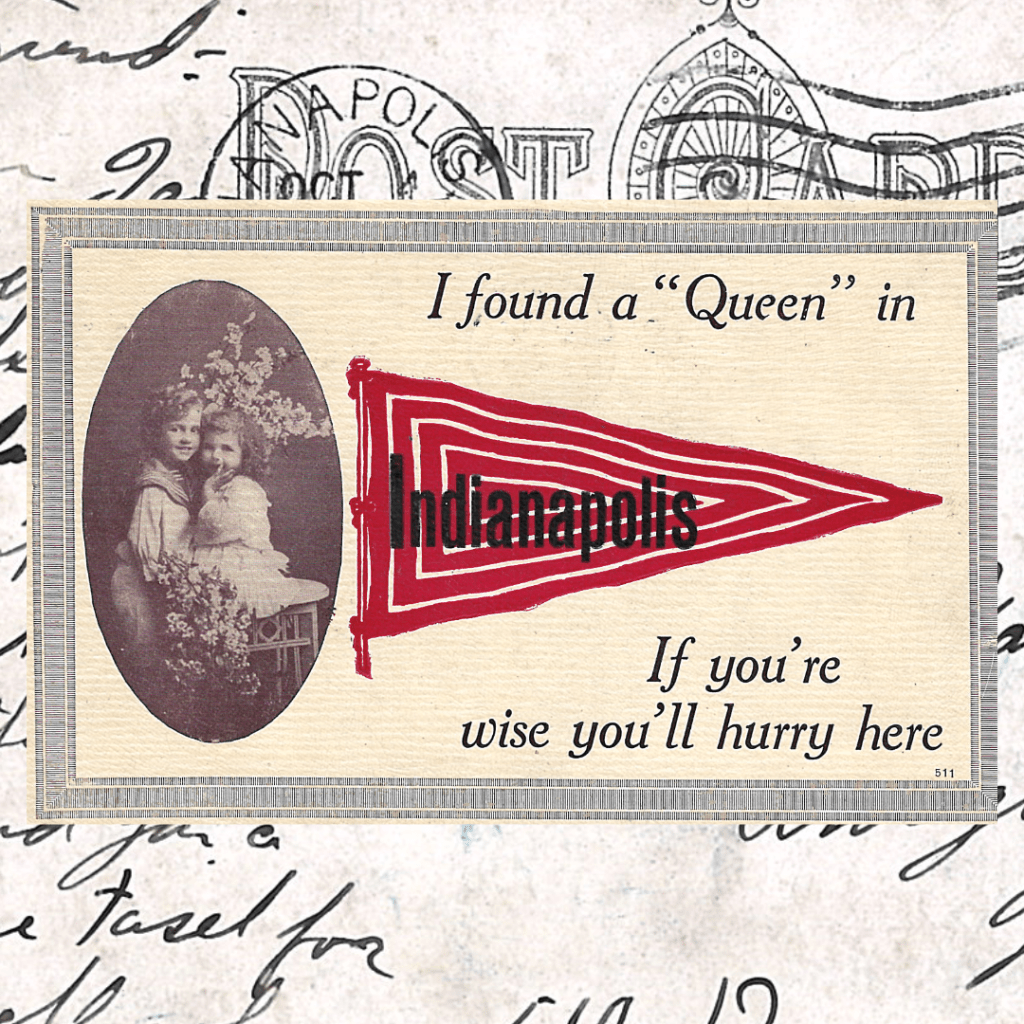
Front of Postcard. “I found a Queen in Indianapolis If you’re wise you’ll hurry here.”

Categories
Education family History parenting Photographs Postcards Teaching Vintage World War II writing

Two Wives, a Botanist, and a Ghost Ship…Oh My! (The Lawrence’s Part II)

From: Ida To Mrs. Dana Lawrence

If you haven’t read my blog post from yesterday, I’d recommend going back and taking a gander. Though part 1 is not entirely necessary, you’ll have more context for this post because I’m going to basically jump right in.

Yesterday, I explored the story of Ida’s postcard and the complicated legacy of the dropping of the Atomic Bombs as well as Victory over Japan day (known as VJ day). As the world entered the Nuclear Age…Ida went on vacation to Natural Bridge.

But what about Mrs. Dana Lawrence, the recipient of the postcard? The more I searched, the more I found, and honestly the stranger it got. So, I’ll go in chronological order and start at the beginning: with Dana Lawrence.

Dana is the patriarch of the family. Born in 1875, he married his first wife, Helen Ethelwyn Briggs in 1897. Their marriage lasted until Helen’s death in 1906. She was 18 when she married, and only 27 when she died. Their union produced three children; Marion Louise, Robert Parker, and Leonard.

With three young children at home, I imagine Dana may have been looking for help. In 1908, Dana married Anna Maria Mathewson. THIS is our “Mrs. Dana Lawrence.” I’ve talked before about how women are often obscured in the historical record because they are referred to by their husband’s full name. This is one of the many times I’ve had to trace the man first and hope to uncover the woman.

Anna was 25 when she married Dana and bore two children: Lucy and George, and THIS is where it got interesting!

George Hill Mathewson Lawrence was actually the first member of the family I found, because apparently he was a somewhat famous and well thought of botanist! This is the first “famous” connection I’ve run across with one of my postcards and while it’s only niche famous, it’s still a pretty cool find — at least I think so.

I know for sure that George entered the military during World War II, serving as a Lieutenant in the Navy. I don’t know where he served, but seeing as Ida specifically asks if Anna had heard anything from the “boys since August 14,” I suspect it was in the Pacific. If you remember yesterdays post, Japan informally surrendered on August 15. So, the greeting makes sense.

Now, I’ve also promised you the Queen Mary, and don’t worry, I’ll deliver! Leonard Lawrence (youngest son of Helen) has an interesting attachment to his record. It’s the passenger list of the RMS Queen Mary. He took the liner from Southampton to New York City between April 25-April 29 of 1951. Apparently he traveled first class as well. The ship now anchors in LA as a popular tourist attraction, and is considered one of the most haunted places in America. But probably not with any of the Lawrence clan.

There are plenty of other tidbits I found, but not as interesting as the ones I’ve shared. Anna died in 1959, at which point I assume this postcard was boxed, shuffled around, sold, sold again, and so on and so forth until it made it into my hands. Once again, it’s the friendship between two women that uncovers a part of family history.

Thanks for reading!

Categories
Education family History Photographs Postcards Vintage World War II writing

“First Holiday in Four Years”: The Complicated Legacy of VJ Day and the Strange History of the Lawrence Clan, Part I

From: Ida To: Mrs. Dana Lawrence 1945

VJ Day 1945

Any good news of the boys since Aug. 14th?

Yesterday we drove thru (sic) Shenandoah Valley, Luray, New Market, Staunton to Natural Bridge — First holiday in 4 years except Xmas day — Return by way of Charlotteville tomorrow.

Love to all,

Ida

I’ve been waiting to post this card until September 2, which in 1945 was celebrated as “VJ” day, or “victory over Japan” day. I planned to do a post that discussed the complicated legacy of the United States’ victory over Japan which resulted in utter destruction and death in Nagasaki and Hiroshima. That message is still at the heart of this post. However, the research into this postcard took twists and turns that brought me to a second wife, a famous botanist, and even the illustrious RMS Queen Mary.

Therefore, this post will be part one of two. To honor those men and women who fought and died in World War II, as well as the bombings of Hiroshima and Nagasaki, I will discuss VJ day in today’s post. Tomorrow, I will discuss the strange and winding tale of the Lawrence clan.

September of 1945 finally brought an end to the brutality of World War II. The war remains the bloodiest conflict in human history, with the deaths of an estimated 15 million military personnel and 38 million civilians.

Although Hitler met his demise on April 30, and by May 8 of 1945, the war in Europe was over, the US and her allies were still fighting the war in the Pacific against Japan. That war continued through the Summer and in weighing the death estimates of a full land invasion, President Truman made the decision instead to drop two atomic bombs. The United States dropped “Little Boy” on Hiroshima on August 6, 1945, and “Fat Man” on Nagasaki on August 9, 1945. These two bombs laid waste to the cities, and resulted in upwards of 200,000 deaths. More, if you count those who’ve died in the years since the bombings.

By August 15, Emperor Hirohito announced the unconditional surrender of Japan to the Allies. This agreement was formally signed on September 2, 1945 — hence the term “VJ Day.” This is likely the history you know, or at least partially know.

There are many conflicting opinions on whether or not the bombs should have been dropped. I, personally, am in the “should not have dropped it” camp. However, I am a cultural historian and I primarily studied the colonial United States. I can give you in depth information about the color “Haint Blue“, but if you ask me about military history I often come up short. All this to say, I’m not here to argue for or against one side. I think Truman’s decision was wrong, but I understand others may vehemently agree with me.

What’s clear is the atomic bombs not only quickly brought an end to the final stages of World War II, they also leapfrogged us into the nuclear age, cold war, and mutual assured destruction. History was forever and irrevocably changed in the few moments that it took to release those bombs on a civilian population. Humans of the world must live with those consequences, and we can’t ever go back.

The thing that strikes me about this postcard is the disconnect between Ida’s tone and the immense world changing events that are happening around her. Yes, she acknowledges that the war is over. Yes, she asks about the “boys” (at least one of whom was deployed and I will talk about tomorrow!), but then she goes straight into a discussion of her vacation. She even sends the postcard from the Natural Bridge landmark. It’s so scarily mundane.

I chose postcards for this little project specifically because they provide a small snippet of information about the life of a person. It’s like peeking into a half-lit window while you’re passing a house at 60 miles an hour. You get a small sense of their surroundings, but not intimate details. I understand that we can’t, and often don’t, get the true feelings or fears or hopes of the sender. However, it seems to me as though the atomic bombings loom much larger for us in 2024 than they did for Ida in 1945.

Instant access to news and information was not an option for Ida. Wartime propaganda and bias would have also influenced what she knew, how much she knew, and even what she thought. News of the bombings and the Manhattan Project was tightly controlled and in the aftermath of the bombings, 85% of Americans responded favorably and believed we should have dropped the bombs. They vividly remembered those lost in the storming of the Normandy beaches, and were glad the war would not claim any more American lives.

So the fact that Ida and her husband chose to take a vacation after 4 years of war was probably not that strange. They were celebrating victory, celebrating life, celebrating the end of the war and reveling in American patriotism. However, I can’t help but get the ick from it. I know this is because I have the benefit of history. But the dropping of the bombs was one thing I truly thought made the world stand still.

But it seems that some Americans went on vacation.

It’s a lot to think about, and I have to wonder what events will be momentous to our ancestors that aren’t truly hitting us yet. Or, perhaps it was too much for Ida to take in, or she felt powerless, so chose to spend time with those she loved? That, I can understand. So many things have happened in the last five years that made me feel powerless to the press of history. But, we keep living and doing what we can to maintain normalcy.

Maybe that’s all Ida wanted.

Stay tuned for part two!

Natural Bridge Virginia

Categories
Education History parenting Photographs Postcards Vintage World War II writing

The Untold Story of Lizzie J. Dearwechter: A Postcard Journey

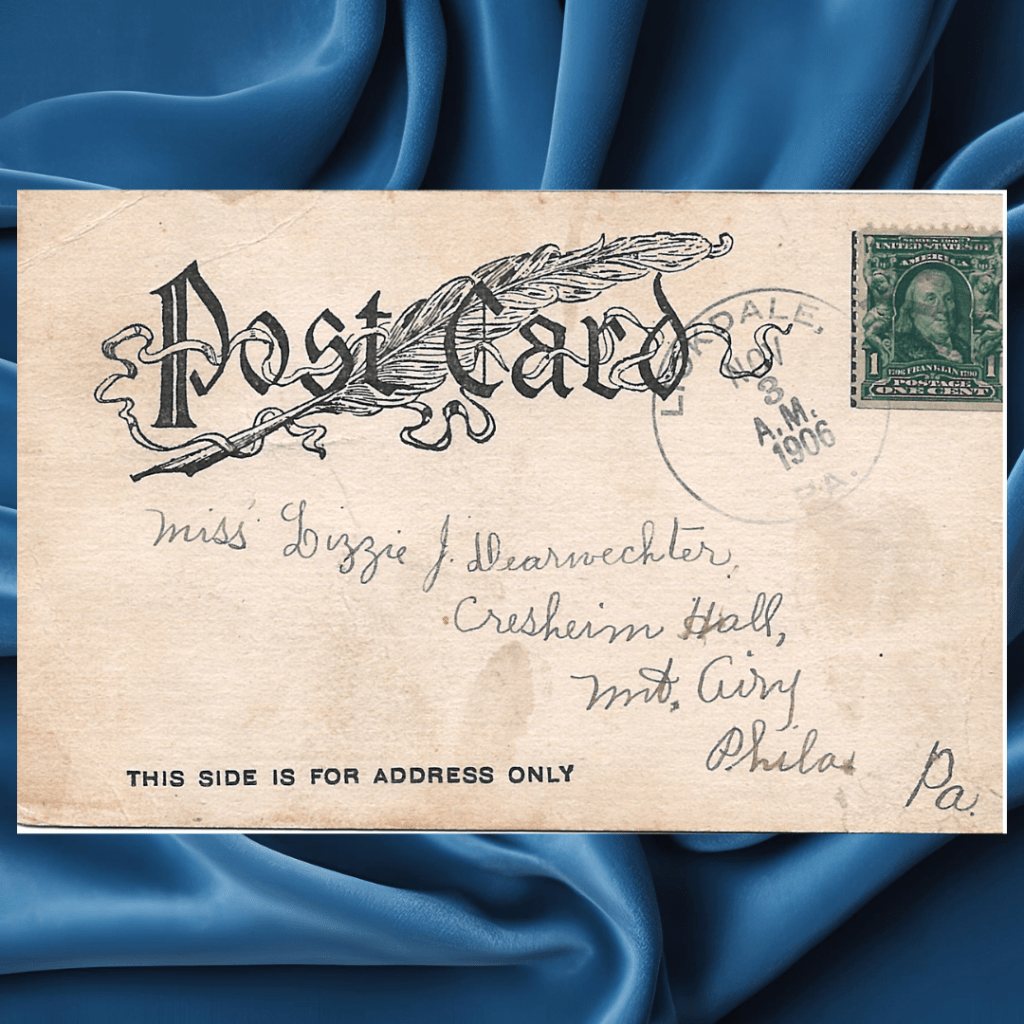
To: Miss Lizzie J. Dearwechter From: E.W.A 1906

I’ll write you next week. I am having a fine time on the cornfield.

From a friend,

E.W.A

In 1906, Theodore Roosevelt was President, Upton Sinclair published The Jungle, and Oklahoma was still a territory, and not yet a state. By November, San Francisco had been devastated by a 7.8 magnitude earthquake, and in what the newspapers called the “crime of the century” Harry K. Thaw shot Stanford White in Madison Square Garden. The Progressives were making their mark on the American landscape…in whatever way possible.

And, as we know a little bit about postcard history, 1906 was an undivided back period. This is a time where postcards favored the front image and had very little space for any sort of message as the entire back was to be utilized only for the address. Although undivided back postcards often lack details for research, they are beautiful. Even the printed word “postcard” with a feather in the background is luxurious and hints at a fancier, more formal time.

This postcard is funny to me, largely because the sender has chosen a postcard of a “typical California home,” but sends the card from Lickdale, PA. Lickdale is a small, unincorporated town in the south east of Pennsylvania that shares a zipcode with a few other cities. The total population for the zip is upwards of 8,000 people.

Pretty far from California if you ask me. As a historian, I understand the magnetic pull that the west coast has on the American psyche. I have to believe that the image of curated palm trees in front of a Victorian/Gothic-esque house was a bit of wishful longing. Perhaps the two friends had dreams to move west, or loved the idea of California. Perhaps E.W.A just liked the postcard.

As for Lizzie J. Dearwechter, with a little bit of luck, and a lot of elbow grease, I managed to find her in the records. I had to follow a few lines of Dearwechters, but I did it! Lizze was born October 13, 1888, so by November of 1906, she was 18 years old. I was curious about Cresheim Hall, so I looked it up. It seems that it was a School for the Deaf in Mt. Airy, Pennsylvania. The only real problem that I’ve run into is that –other than this postcard — I can’t place her at this address with the sources available.

Miraculously, Find a Grave included more than a picture of the tombstone, it included Lizzie’s obituary! It’s a rarity, especially since she passed in 1976. I had hoped that maybe the obituary might allude to her time at the hall, or perhaps indicate whether or not she may have been Deaf. However, it provided no further insights. What we do know is that she was single in 1906, but had met and married her husband by 1908. She went on to have 13 children, and upon her death she was survived by 31 grandchildren and 42 great-grandchildren. A legacy indeed.

As for E.W.A…well they are impossible to track down. However, their quick note about enjoying the cornfields spawned a 118 year journey that led us to unravel snippets of Lizzie’s life. A life that saw the sinking of the Titanic, the Spanish Flu outbreak, both World Wars, the assassination of J.F.K, the moon landing, Civil Rights, and Woodstock…amongst other things.

Thank you, E.W.A, for the postcard.

Close-ups of both sides of the postcard

Categories
Education History Photographs Postcards Vintage World War II Writing Prompt

Blackouts and Friendship: A World War II Connection

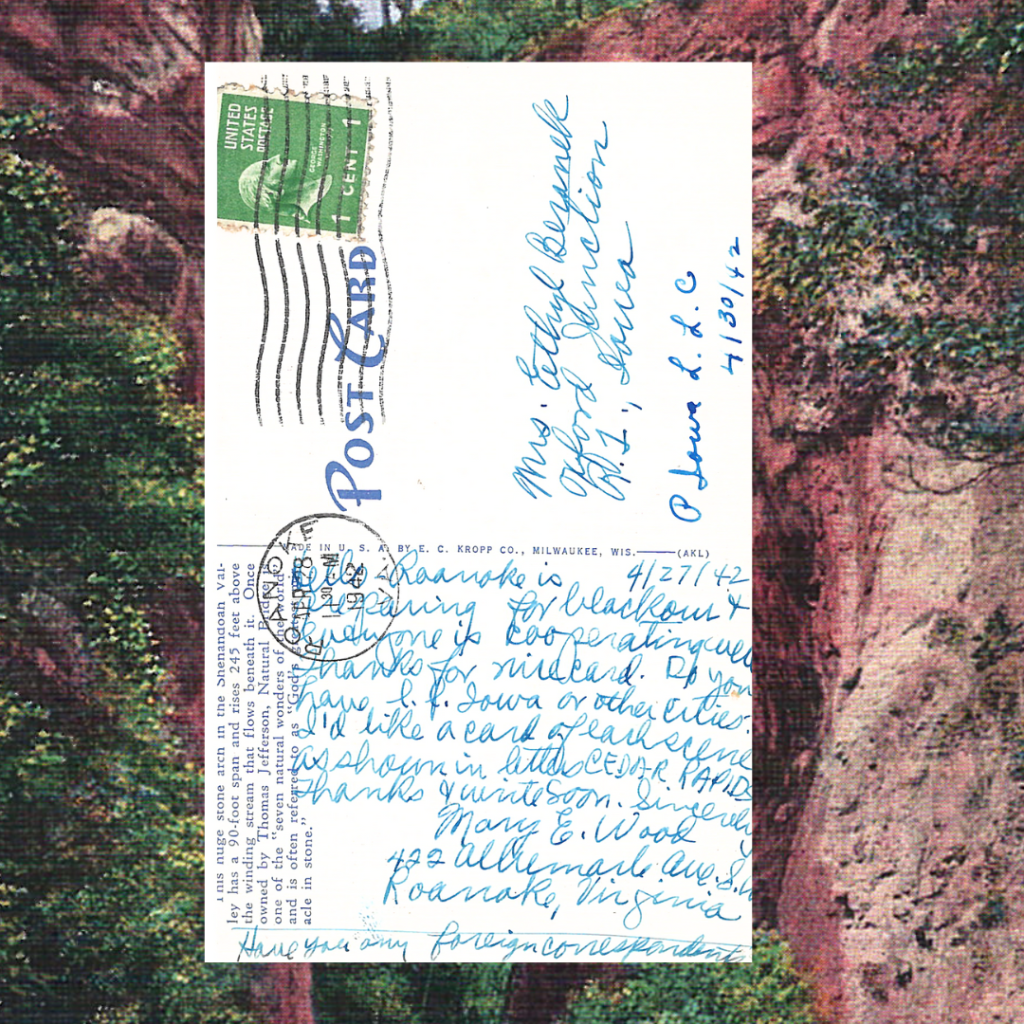
From: Mary E. Wood, To: Mrs. Ethyl Beranek 1942

4/27/42

Hello.

Roanoke is preparing for blackouts and everyone is cooperating well. Thanks for the card. Do you have L.L. Iowa or other cities? I’d like a card of each scene as shown in little’s CEDAR RAPIDS. Thanks and write soon.

Sincerely,

Mary E. Wood

422 Albemarle Ave S.W.

Roanoke, Virginia

Have you any foreign correspondents?

By the time Mary wrote this letter, the United States had newly entered World War II. A few months earlier, in February, a Japanese submarine had attacked an oil refinery in Santa Barbara, California. Though the attack didn’t cause much damage, fears and tensions in the United States were high. Shortly after the attack on California, FDR signed Executive Order 9066 which led to the internment of 125,000 people, two thirds of which were American Citizens.

In April, the country was already well on its way to mobilizing for war. In preparation, many cities — including Roanoke — were practicing blackouts. The city had practiced at least two blackouts by the time Mary sent her letter to Ethyl. Families bought blackout curtains for their windows and hoods for their headlights. At some point during the blackout, air raid sirens blared and people extinguished lights, pulled over and listened for the test to be over.

The fear of invasion is a type of fear I hope I never have to experience, and to see it documented in this letter is so interesting. Mary expresses prepping for an invasion first, which tells me it was probably at the top of her mind.

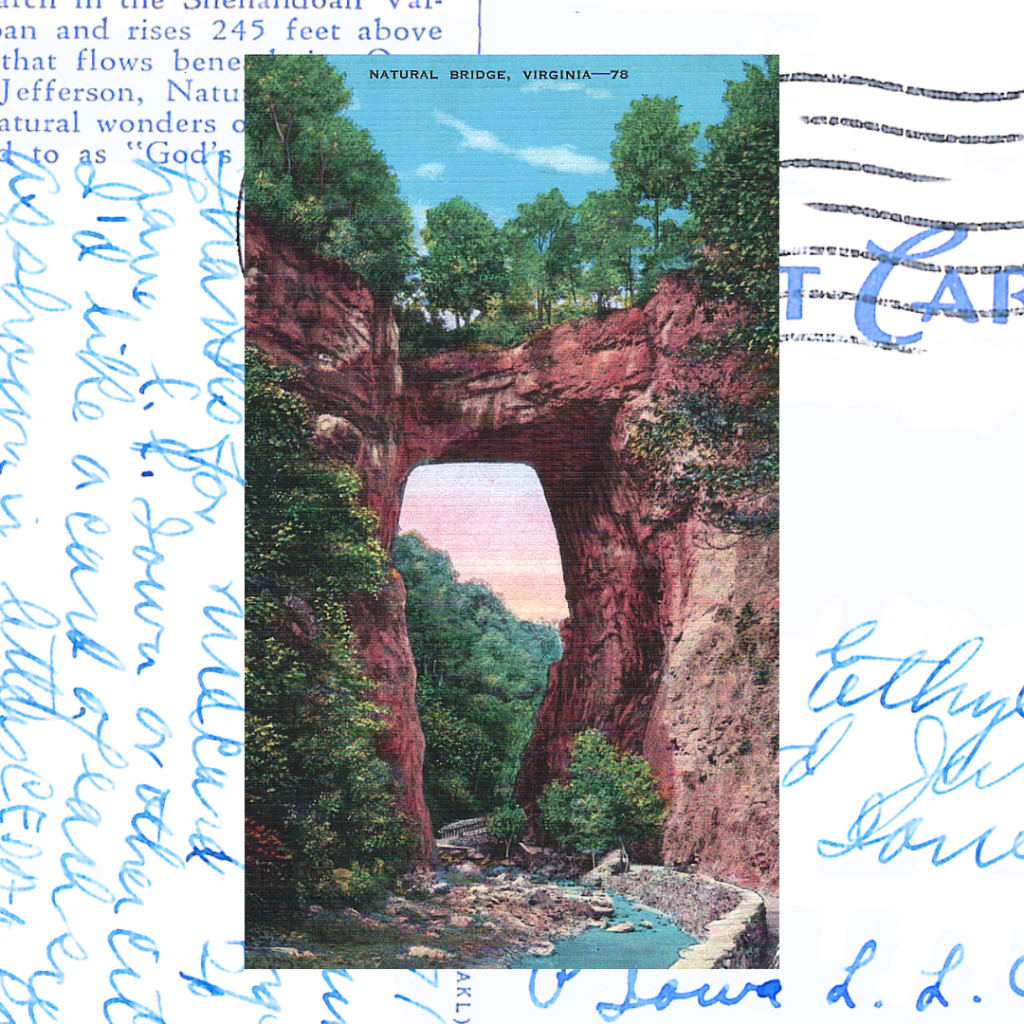
However, the wartime blackout conditions are juxtaposed by Mary’s request for different types of postcards. It almost seems like she’s part of some sort of post crossing program before post crossing existed! Or, as we elder millennials remember it as: pen pals. I do wonder if Mary personally knew Ethyl and the two of them were simply card collectors, or if it was a type of pen pal program. Very interesting.

As for Mary Wood, I think I found her. She was born as Mary Ellen Thurston, but her first husband had the last name Wood. She later divorced and remarried, becoming Mary Ellen Truslow. What’s strange is that I found her second marriage certificate, which listed her birthday year as 1927, but her grave and all other documentation lists 1921.

As for Ethyl, funnily enough the first thing that popped up when I searched was another postcard to her. Same address, though a different sender. Wouldn’t that have been the bee’s knees? After a little more digging on Family Search, I managed to ascertain that she probably passed away shortly after World War II — 1953 to be exact.

The obituary states that she had suffered from an “illness for the past year.” Two of her sons died shortly after, one in 1955 and another in 1958. An overall sad end to an interesting postcard.

I hope that the two women remained in correspondence until Ethyl’s untimely death. Perhaps this small blog post can help keep the memory of their connection alive.

Front of Postcard. One of a few Natural Bridge postcards that I own

Categories
History Postcards Writing Prompt

Red Cross War Fund and Soldier’s Postcard: Private Charles P. Kerchner 1943

Mrs. William Kerchner: 1943

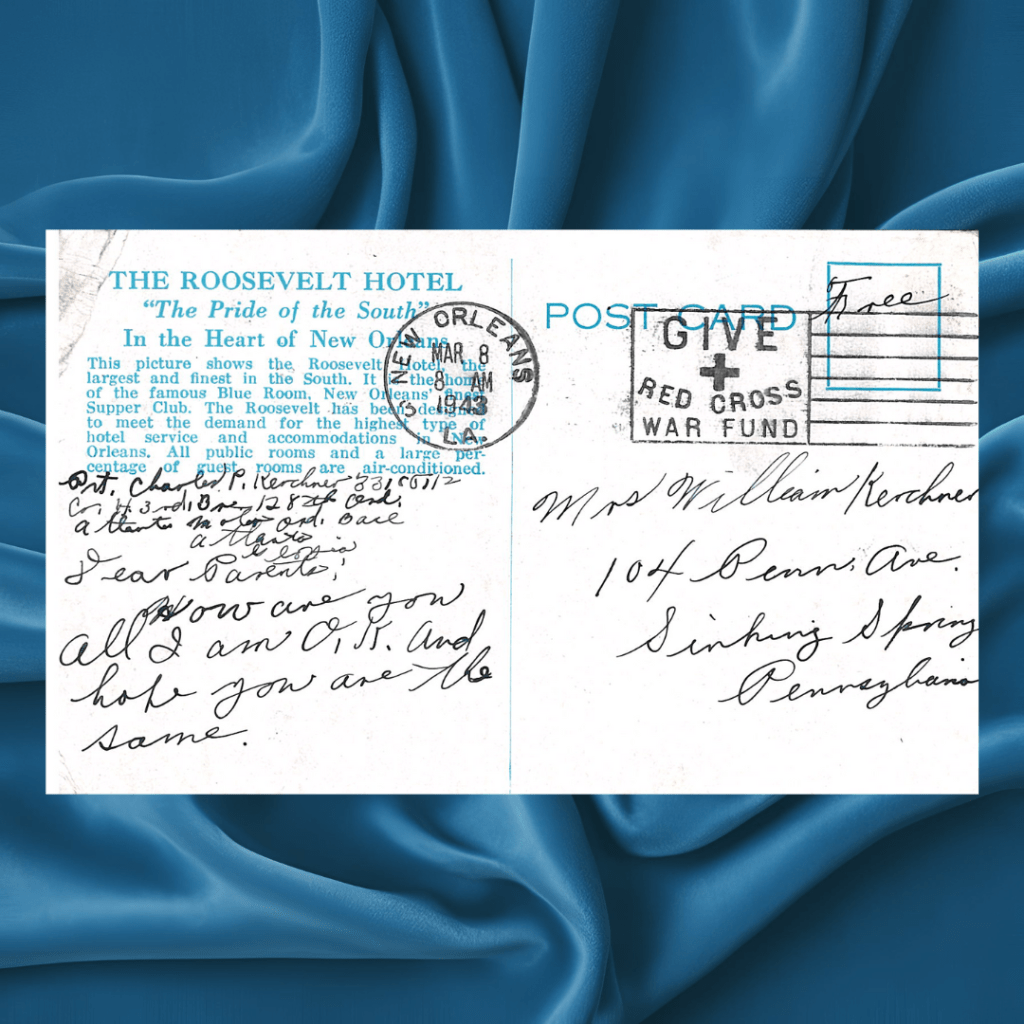
Pvt. Charles P. Kerchner

Dear Parents:

How are you all. I am O.K. and hope you are the same.

A simple message scrawled quickly in pen on the back of a beautiful postcard opens a door for us to understand a little more about postcard history, as well as World War II history.

When I began this project I knew nothing about the history of postcards in the United States or abroad. I’m still lacking in my historical knowledge, but I’m also learning with each post I create. One simple piece of information I’ve recently stumbled upon are the different “eras” of postcards.

By roughly 1930, “linen” type postcards had begun to circulate. These postcards have a different look and texture than the early 1900’s postcards. In fact, it may suprise you to find out that they look like they are printed on linen (shocking I know). The colors on these postcards also tend to be more vibrant and saturated. This postcard is no different. While the back is somewhat nondescript and not quite as pretty as some of the earlier postcards in my collection, the front is so beautiful it could be framed as a watercolor painting.

I assumed the “free” written in the stamp section had something to do with the fact that this is a soldier sending a postcard home to his family. A brief google search revealed that by World War II, if the soldier wrote his outfit and camp (along with the word “free” in the stamp box), then the postage was comped for him.

Another notable aspect of this postcard is the stamped “GIVE: Red Cross War Fund.” I have a few of these from postcards sent during WWII, but I find them fascinating reminders of a different time.

This is also the first postcard where I feel confident I’ve found some information on the original sender. Private Charles P. Kerchner survived the war, married, raised a family, and died in 2008 at the age of 87.

A lovely piece of history from a bygone era.

Front of postcard. Note the blues and yellows and pinks that serve as the masquerade of a sunset.