Categories
Education family History Photographs Poems Postcards Teaching Vintage Work In Progress writing

“Did You Get a Man Yet?”: A 1915 Tease and the Mystery of Single Susie

To: Miss Susie Miller. From: Bill. 1915

Well did you get a man yet, if not if I would know I would bring up a duch-man(sic). Love and kisses.

From,

Bill

In 1915, Woodrow Wilson was president, “Typhoid Mary” infected 25 people and was put in quarantine for life, Babe Ruth hit his first career home run, the film Birth of a Nation was released — a precursor to the second iteration of the Ku Klux Klan (also established in 1915), and the R.M.S Lusitania was sunk on it’s way to Britain by a German U-Boat.

And apparently, Bill was trying to hook Susie up with a “duch-man”.

I first have to say, I really love this card. Like, more than love…I adore this card. It’s playful, flippant, goading — everything I need for a little drama in my life. Written in pencil that’s faded only slightly over the 100 years it’s been in circulation, this card feels familial. Like something a brother might write to a sister. So, when I began to research the card, that’s where I started.

I’ll be honest, there were so many Susie and Susan Miller’s of various ages in 1915, that I can’t be sure I found the right one. I will say, I only found one with a brother named “William”, which can be shortened to “Bill.” Is this confirmation bias? Probably, since that’s what I was looking for. However, the card tells me that this is one of two situations:

First, a family member (brother) is teasing Susie. Second, Bill is actually sweet on Susie and is also teasing her (lol I found someone else for you lol). I lean toward the first scenario, so I’ll describe the people I found. You can make your best guess as well.

Susan G. Miller was born in Pennsylvania on May 26, 1895. She had two other siblings: Edward W Miller (1890) and William B. Miller (1892). It seems Edward died young, in 1918. Based on the date and his grave, I think he was probably killed in World War I, though whether he died from gas, bullets, or Spanish Flu is unclear.

The two remaining children, William and Susan, lived with their mother Maude until at least 1940. That’s where the records for both William and Susan end. I’m unsure when William died, but Susan lived until April of 1986, and passed away at the age of 91. I can’t find a grave for her, nor could I find additional information about her past 1940.

For some reason, it always makes me a little sad when I find a person who seems to have lived a life alone with no spouse and no children. It makes me wonder why. I understand that now, in 2024, it’s often a choice to remain unattached. For man (especially women) this is a form of freedom we’ve never been historically afforded.

But typically, a 20 year old girl in the early 1900’s would have been expected to marry. Though, Susan did live out her formative years under the shadow of World War I, the riotous 1920’s, and the crushing 1930’s. It’s possible that social change combined with the economic struggle of the Great Depression prevented her from finding “the one.”

It’s also possible that she wanted to remain with her mother and brother (perhaps one or both were ill?), or she simply wanted to make her own path. For a woman in the 20’s, 30’s, and 40’s, this would have been difficult — but not impossible. Susan lived through a vast expansion of rights for Americans. She may have seized her opportunity and marched to the beat of her own drum.

And that, my friends, is true freedom.

Until next time!

Mineral Spring Park, Reading, PA

Categories
Education family History parenting Photographs Poems Postcards Vintage Writing Prompt

Secrets in a 1908 Postcard: A Mysterious Message, a Tragic Twist, and a Family’s Forgotten Past

To: Mrs. HM. Maurey From: Roy 1908

Drive safe and in good condition

Roy

In 1908, Teddy Roosevelt was president, the Converse Rubber Shoe Company is formed, and Thomas Selfridge is the first person to pass away from an airplane crash. For those who follow my blog, you’ll know that 1908 is one of my favorite years to collect from. You’ll also know I love the Progressive Era and all the changes that were taking place at the start of the 20th Century. I think it was my late 90’s obsession with the musical Ragtime.

Although this card doesn’t give us too much, a simple “drive safe and in good condition,” implicitly it says a lot about the changing laws and norms that surrounded postcards. In 1907, it became legal to place a message on the back of postcards. This is known as the “divided back” period. Prior to 1907, postcards had to be addressed on the back, and any message was squished onto the front. This often caused problems, as the front of the postcard could smear, or there was very little room to write anything.

What’s unique about this card is that it looks like it’s from the “undivided back period” (historians aren’t great at making fancy names for eras). During this period, the address would take up the entirety of the back of the card, and any message had to be squished in to what little blank space was on the front. In fact, if you look at this particular card, you can see that there’s a tiny bit of space on the left. Certainly not enough to write more than a passing phrase.

However, our friend Roy divided his own back. It was legal, after all, to write the message on the back of the card along with the address, so Roy went ahead and took advantage of that fact. Maybe he had an old postcard lying around, or a set of them. Or perhaps stores still sold the undivided back sets. Whatever the case, Roy drew a stark line down the card and wrote his message.

Except he didn’t really say much. “Drive safe and in good condition” would have easily fit on the front of the card, and there were no laws saying you couldn’t write on the front after 1907. It seems to me that the collective habit of writing out a short note on a postcard took longer to fade from the zeitgeist. Roy divided his back, but kept the message clipped. He said all he needed to say.

As for the Maurey’s…I’m not 100% sure I found them. Honestly, I’m only about 70% sure I have the right family, but I’ll explain what I found and let you make your best guess.

As you know, it’s incredibly difficult to find anyone with just initials. If you add to the fact that this card is written to a woman…now you have her obscured by both her husband’s name AND his initials. Which can be doubly frustrating. Nonetheless, I searched up the name and plugged in a few dates.

The first promising hit was a Roy Maurey. Thinking maybe this is the writer, I decided to check out Roy’s family tree. Turns out, he had a father named…drumroll please…Henry M. Maurey. That takes care of the HM. But these are all men’s names. Who is the woman behind them? Henry was married to Emma Fritz. Could she be our HM Maurey? I think it’s possible. Let me break the family down.

Henry M. Maurey was born on May 7, 1856 in Lebanon Pennsylvania. Unfortunately, the record doesn’t show when he married Emma Fritz, but the two of them had three children together. Henry died the day before his birthday, May 6 of 1932 at the age of 76. And, I can’t stress this enough, he would have been roughly 4 years old at the beginning of the American Civil War. His wife, Emma, was born in November of 1859. Unfortunately, I don’t have a death date for her, and I couldn’t find grave information for either of them.

Their son, Roy, was born on December 26 of 1888. At some point, he married Florence Edna Wilbur (can’t find out when). I have to imagine that the card, then was sent to his mother, Mrs. HM Maurey, because they were coming out to visit. Roy would have been 20 by this time and perhaps working in Maryland. Though, and this is the kicker, I can’t place him there in the records.

Here’s where the story takes a bit of a sad turn. Roy died on March 6, 1913 at the age of 25. He had one son with Florence. Roy Jr. was born 7 months later, on October 6, 1913. Which, is honestly tragic. Even worse, Florence passed away on October 13, 1916, when Roy Jr. was only 3 years old. By the census of 1920, Roy Jr. was living with our very own Henry M Maurey in Sunbury, PA. He lived a long life, passing away at the age of 80 in Illinois.

Because of this postcard, I was able to attach a variety of documents to his family tree, and I found his gravesite. Perhaps…perhaps these are not the original people involved in our postcard. But, I have to believe that the story was asking to be told and that led me to this family.

I hope you enjoyed reading this twisted tale. What do you think? Did I find the right people?

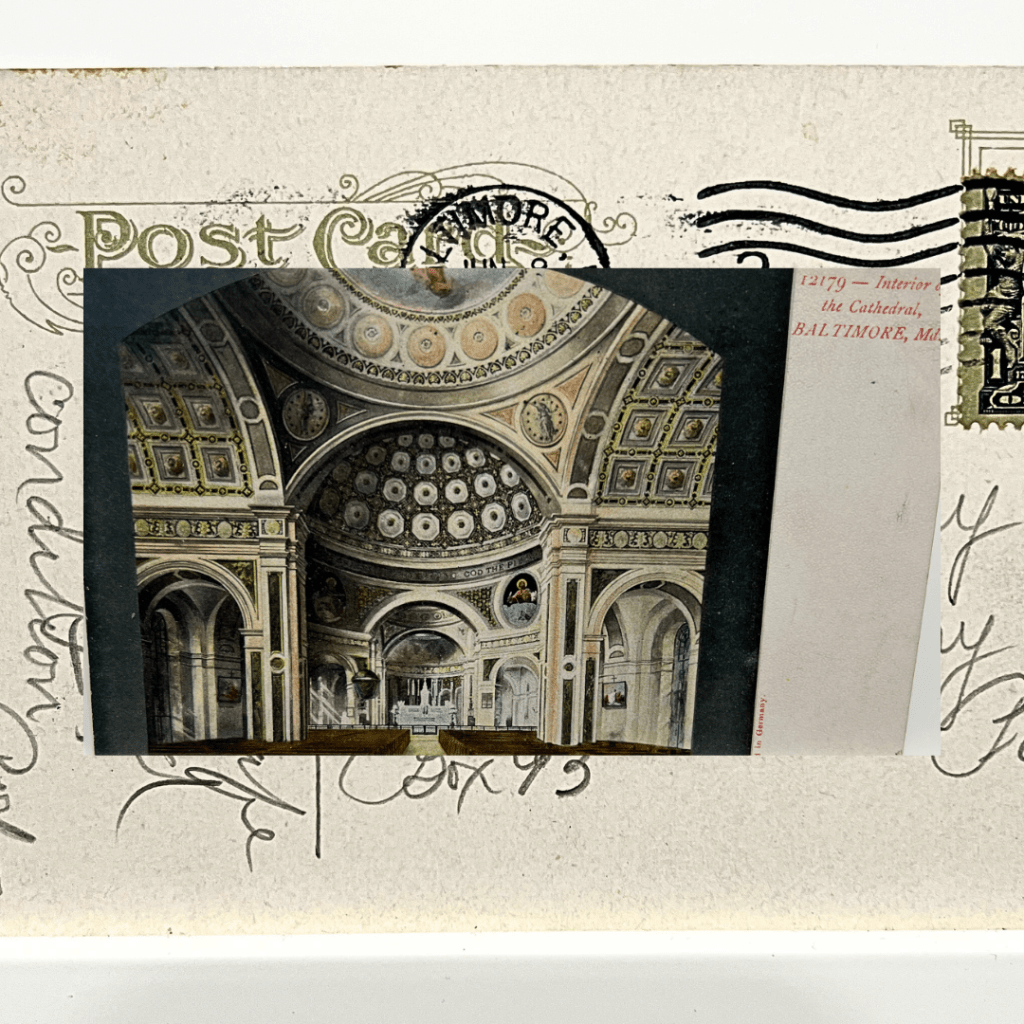
Front of Postcard, Interior of Cathedral, Baltimore, MD

Categories
Education Flash Fiction History parenting Photographs Postcards Vintage Work In Progress writing Writing Prompt

Unanswered Letters: A 1914 Postcard and Ruth Kenison’s “Secret” Marriage

To: Miss Ruth Kenison, From: F.R. La Barre 1914

Am on my way to Winona Minn. to see my kid brother.

F.R. La Barre

In 1914, Woodrow Wilson was president, the Ford Motor Company instituted the 8 hour shift and $5 per day wage, Babe Ruth made his major league debut with the Boston Red Sox, and World War I began in Europe. Great social upheavals pervaded the world.

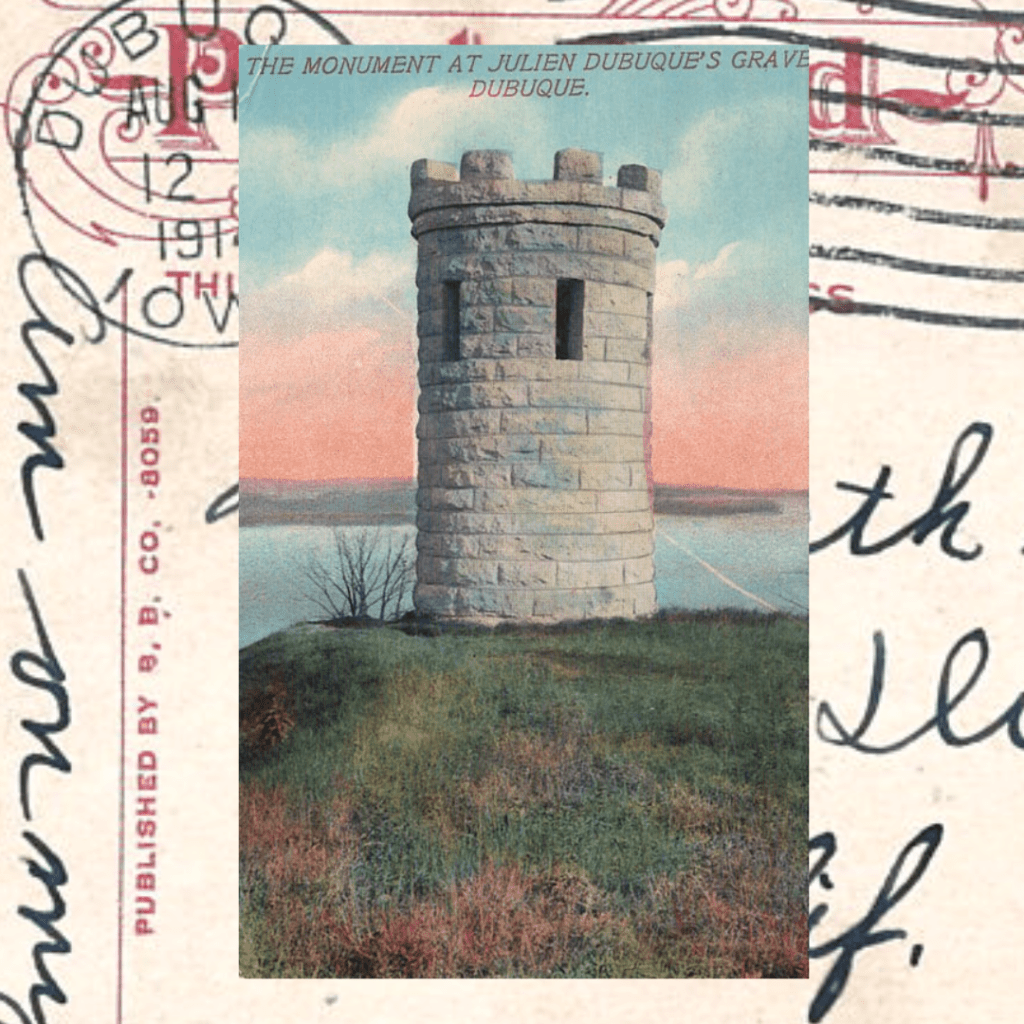
In 1914, Winona, Minnesota was a decent sized town that grew up due to the steam boat and railroad industry. As of 2020, there were 25,000 people living. Dubuque, Iowa is an even larger town, and what’s fun is Julien Dubuque’s Grave really looks a lot like the image on the postcard. I assume our friend F.R. traveled through Dubuque on his way to Iowa. Though what’s interesting is that the postcard was addressed to San Diego…quite a long way from where he was.

As for Ruth, I think I found her. I found a Ruth Kenison living in San Diego in 1914, but here’s the kicker…she lived in Iowa as a child. In fact, she was there in 1910 at the age of 14! This is the type of connection that really clinches an identification for me. By the census of 1920, Ruth’s parents were living in San Diego, California. So, I have to assume that at some point between 1910 and 1914, the family made the move west. F.R. easily could have been a childhood friend sending a quick note because they thought of Ruth.

What I did find interesting is that in June of 1914, Ruth Belle Kenison married Hugh Adams Haffley in San Diego. She was 18 at the time. This postcard was mailed in August, but still used the title “Miss”, so it makes me think that F.R. wasn’t aware of the marriage. She was awfully young, even for the early 1900’s, and I have to wonder…was it a secret marriage? Was it rushed? or was it simply kids making choices?

Ruth ended up on Coronado — a “tied island” in San Diego County. You may know it from the beach scenes in Top Gun, but it was initially settled specifically for tourism. It’s known for sparkling beaches and the Hotel Del Coronado. She marBy 1929 Ruth lived in Oklahoma, but she moved back to California by way of Sacramento. Born August 2, 1895, she died on Christmas day in 1971 at the age of 76. I have to wonder what she did in Coronado. Was she a worker, or did her husband have money and own land out there? I wish I could find more information.

As for F.R…as so often happens, without a full first name, I wasn’t able to find them. I feel like it was probably a man, based on handwriting alone. But just because I think everything revolves around love, doesn’t mean that it does. This could be a cousin or family friend. Either way, what’s clear is that F.R did not know about Ruth’s marriage. I hope the message found Ruth, and she was able to write back to F.R.

Front of Postcard: “The Monument at Julien Dubuque’s Grave”