Categories
Education History Photographs Poems Poetry Postcards Teaching World War II Writing Prompt

No Rest for the Wicked: The Life of a Teacher in 1945

To: Mrs. J. Clarkson, From: Ruth. 1945

Monday Evening

10:30 PM

Sept. 3, 1945

Dearest Mother,

Haven’t seen this yet, but there’s a view for you. (unclear) badly put in our first work day and it wasn’t too bad. Spent the morning registering and signing forms. Had a picnic lunch out on the lawn and back to lectures and instructions until 5 p.m. Came back to hotel, changed, and (unclear) to a place called “Treasure Island” for dinner. Did some window shopping on the way back and here I am. Have to be Johnny-on-the-spot tomorrow at 9 a.m. Howe’s everything?

All my love,

your, Ruth.

September 3, 1945 was “Victory over Japan” day, or V-J Day, as that’s when Japan officially signed documents of surrender. Though, you wouldn’t know it from this particular postcard. In fact, there’s no mention of the war at all, not even a passing relief that it was finally over. As a historian, I find this fascinating.

In 1945, citizens of the United States had borne witness to the horrors that came out of the end of World War II. Liberated concentration camps, sunken faces of POW’s, and Nuclear Bombs pervaded newspapers for months. It’s no wonder, then, that Ruth simply tried to lead a normal life. As we know so well, when everything around you feels like it’s tumbling down, you cling to what you can control. Perhaps that’s what Ruth was doing, leaning into the mundane because she could control it.

When I started out, I wasn’t sure I would find Ruth or her family. I did have her first and last name, but I didn’t have the name of her mother, or father. However, after digging a bit on the internet, I found that in 1938, Ruth was teaching high school. The entry is as follows:

Miss Ruth Barbara CLARKSON
Who has taught at the Lincoln School for several years and is completing her first year at Manistee High School, received her A.B. degree from the University of Michigan. She teaches civics (12), economics (12), sociology (12), and English (11). Miss CLARKSON was born in Highland Park, Illinois, and is a graduate of Manistee High School. She assisted the Junior Class sponsor with the J-Hop.
(“Most Popular” female faculty member)

Since Manistee is a relatively small town, and since the time-frame sits right, I figured I had our Ruth. More digging, and I confirmed that Miss Ruth Barbara Clarkson, the most popular female faculty member at Manistee High School in 1938 is very likely our Ruth. I managed to find her grave, which lists her father as Joseph W. Clarkson. Hence, “Mrs. J. Clarkson.”

Ruth was born on October 9, 1910 to Joseph and Bessie Clarkson. Because of that wonderful yearbook blurb, we know that she earned a degree at the University of Michigan, and taught high school for several years. She died on April 13, 1963 at only 52. Unfortunately, I wasn’t able to find an obituary.

Why was she in Washington D.C? The tone of the card indicates she was doing some sort of work, and that she planned on going to Mount Vernon. And, I have to wonder, did she take students on a trip out there? Was it some sort of Civics convention? I myself will be taking the 8th graders I teach to Washington D.C. this Spring. It’s possible that she was on some sort of school trip. Perhaps that’s why she went through a list of everything they did. And maybe that’s why she had to be “Johnny-on-the-spot” in the morning. She had a bunch of students to wrangle!

It’s only conjecture, of course. The postcard gives us a lot of detail, but very little actual knowledge. What is apparent, however, is that she must have been close to her mother.

I do love this postcard. I hope Ruth had a wonderful time, and I hope she spent more lovely days in Washington D.C. seeing the sights, and taking picnics on the last days of summer.
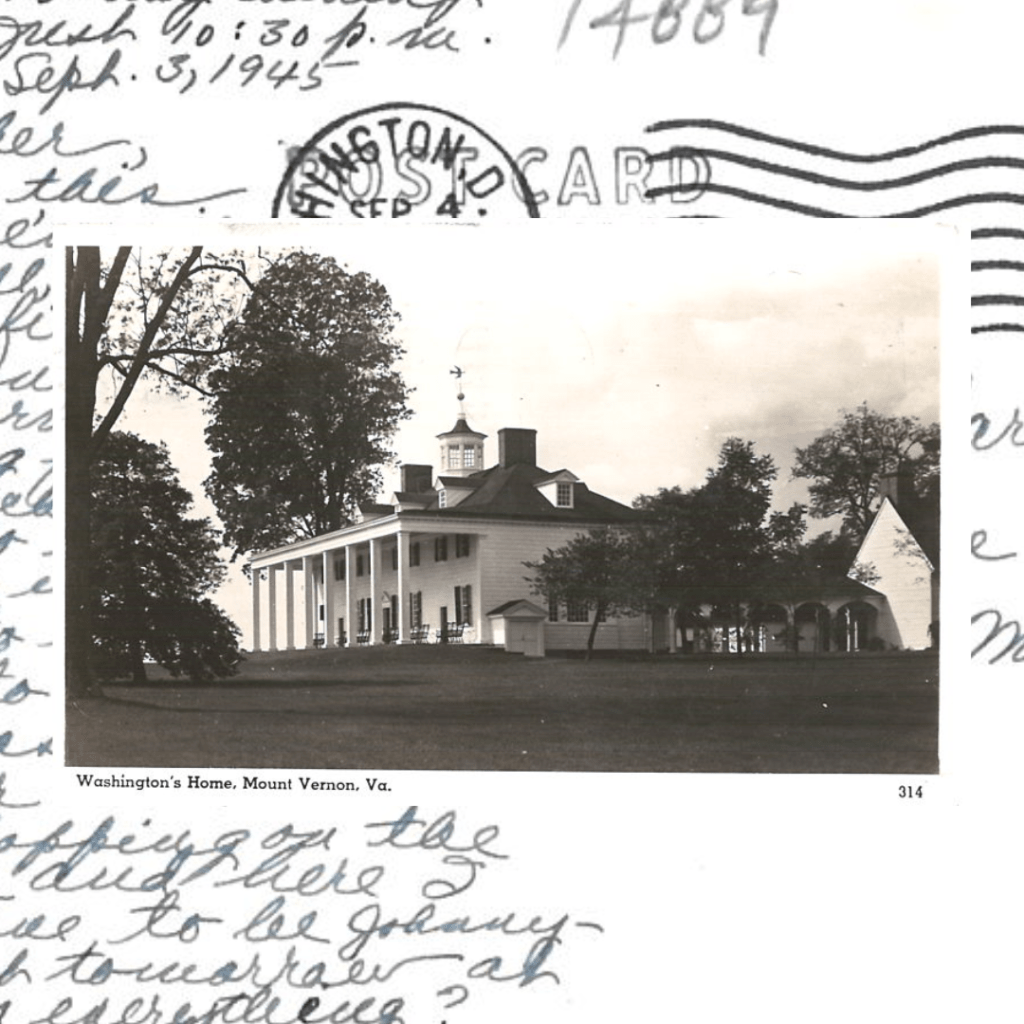
“Washington’s Home” Mount Vernon, VA.

Categories
Education family History parenting Photographs Postcards Vintage World War II writing

Tripping the Light Fantastic: Exploring Chicago Through a 1942 Postcard

To: Mr. Jim Henry From: Private Shorty Martin, 1942

Taken in the big city of Chicago. We would like to have sleepy here. I am having the time of my life with all the trimmings. Just got here, budies are waiting , tell all hello, will see you all later.

Pvt. Shorty Martin

By November of 1942, the United States had entered into World War II with fists swinging. Although the US had instituted a peacetime draft in 1940 — which required all able bodied men ages 18-45 to register, many of the enlistees were volunteers. Chicago, a city bustling with industry, was a vital crossroads for war preparation.

Not only was Chicago a major industrial city, producing parachutes, bombs, metal sheeting, and airplane engines (among many other things), but was also within easy reach of various military training facilities like Fort Sheridan, Glenview Naval Air Station, and Great Lakes Naval Training Station. It’s no wonder, then that Pvt. Shorty Martin tripped the light fantastic in the bustling streets of Chicago.

Unfortunately, I couldn’t find Jim or Shorty. There were a few decent contenders, but none that I could link to Waco definitively. Though, there were more than two “Shorty’s” running around Texas before and after the war. Although I couldn’t find our sender or recipient, it’s fairly easy to imagine a young soldier experiencing a big city for the (maybe) first time in his life.

I do love that he’s meeting up with some of his buddies. I wonder if these are military friends, or simply connections he has in Chicago. It’s feasible that Shorty was African American. As industrialization boomed in the United States — and racism spread after the fall of Reconstruction — Black men and women left the south in waves and traveled north, many of them landing in cities like Chicago. Perhaps Shorty had friends or connections already who had made the move?

I also puzzled over the “would like to have sleepy here.” I couldn’t figure out if he wanted to spend the night, but couldn’t, or if it was a misspelled word (or a mistake in transcription). But, after a minute, I came to the conclusion that I think “sleepy” is a person. He would have “liked to have sleepy here” seems like it’s too bad another friend couldn’t join. I assume Jim knew who sleepy was but nothing is certain in the postcard game.

The card itself is a linen postcard published by Curteich with a vibrant and stunning image of the Chicago skyline. While the scan did bring out many of the colors — it’s even prettier in person.

I do hope Shorty had a fabulous time exploring Chicago. Cheers to him and Jim.

Curteich Postcard: Michigan Avenue North from River, Chicago

Categories
Education History Photographs Postcards Vintage World War II Writing Prompt

Blackouts and Friendship: A World War II Connection

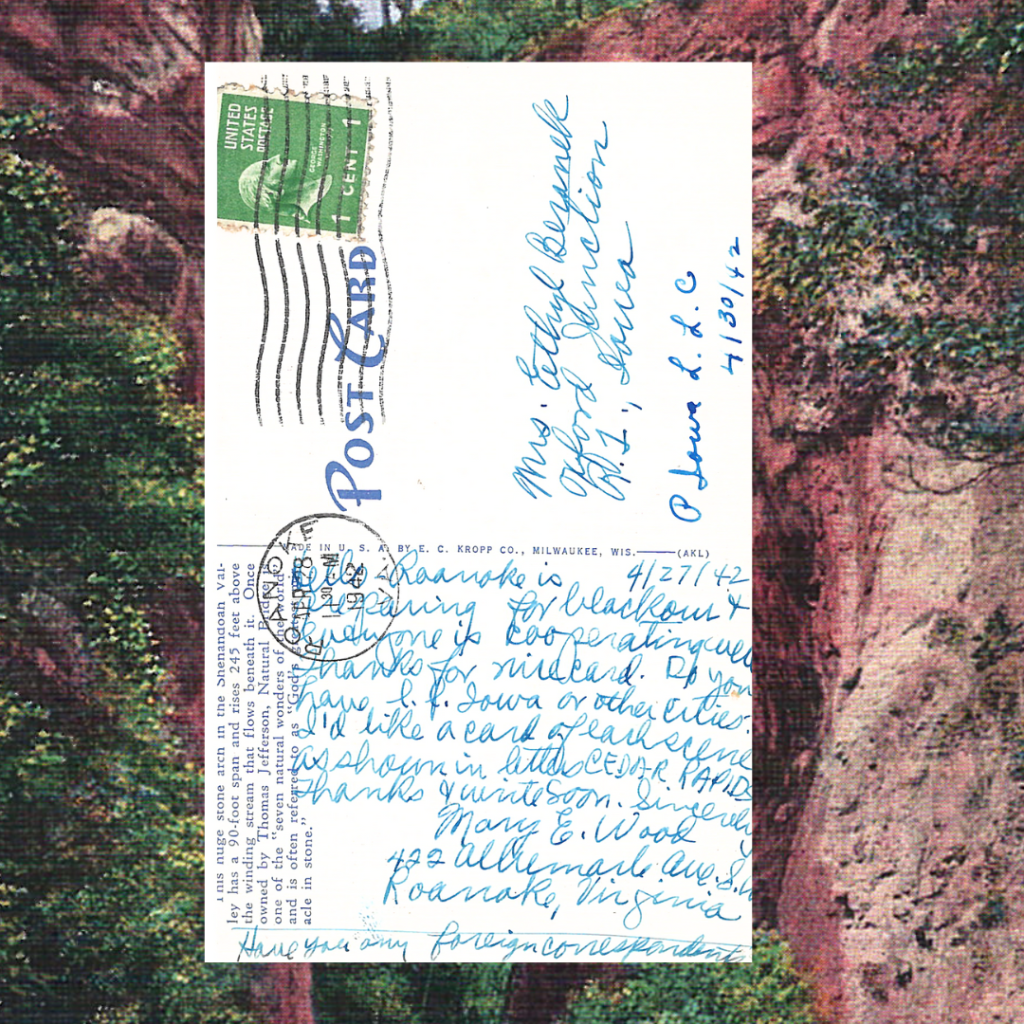
From: Mary E. Wood, To: Mrs. Ethyl Beranek 1942

4/27/42

Hello.

Roanoke is preparing for blackouts and everyone is cooperating well. Thanks for the card. Do you have L.L. Iowa or other cities? I’d like a card of each scene as shown in little’s CEDAR RAPIDS. Thanks and write soon.

Sincerely,

Mary E. Wood

422 Albemarle Ave S.W.

Roanoke, Virginia

Have you any foreign correspondents?

By the time Mary wrote this letter, the United States had newly entered World War II. A few months earlier, in February, a Japanese submarine had attacked an oil refinery in Santa Barbara, California. Though the attack didn’t cause much damage, fears and tensions in the United States were high. Shortly after the attack on California, FDR signed Executive Order 9066 which led to the internment of 125,000 people, two thirds of which were American Citizens.

In April, the country was already well on its way to mobilizing for war. In preparation, many cities — including Roanoke — were practicing blackouts. The city had practiced at least two blackouts by the time Mary sent her letter to Ethyl. Families bought blackout curtains for their windows and hoods for their headlights. At some point during the blackout, air raid sirens blared and people extinguished lights, pulled over and listened for the test to be over.

The fear of invasion is a type of fear I hope I never have to experience, and to see it documented in this letter is so interesting. Mary expresses prepping for an invasion first, which tells me it was probably at the top of her mind.

However, the wartime blackout conditions are juxtaposed by Mary’s request for different types of postcards. It almost seems like she’s part of some sort of post crossing program before post crossing existed! Or, as we elder millennials remember it as: pen pals. I do wonder if Mary personally knew Ethyl and the two of them were simply card collectors, or if it was a type of pen pal program. Very interesting.

As for Mary Wood, I think I found her. She was born as Mary Ellen Thurston, but her first husband had the last name Wood. She later divorced and remarried, becoming Mary Ellen Truslow. What’s strange is that I found her second marriage certificate, which listed her birthday year as 1927, but her grave and all other documentation lists 1921.

As for Ethyl, funnily enough the first thing that popped up when I searched was another postcard to her. Same address, though a different sender. Wouldn’t that have been the bee’s knees? After a little more digging on Family Search, I managed to ascertain that she probably passed away shortly after World War II — 1953 to be exact.

The obituary states that she had suffered from an “illness for the past year.” Two of her sons died shortly after, one in 1955 and another in 1958. An overall sad end to an interesting postcard.

I hope that the two women remained in correspondence until Ethyl’s untimely death. Perhaps this small blog post can help keep the memory of their connection alive.

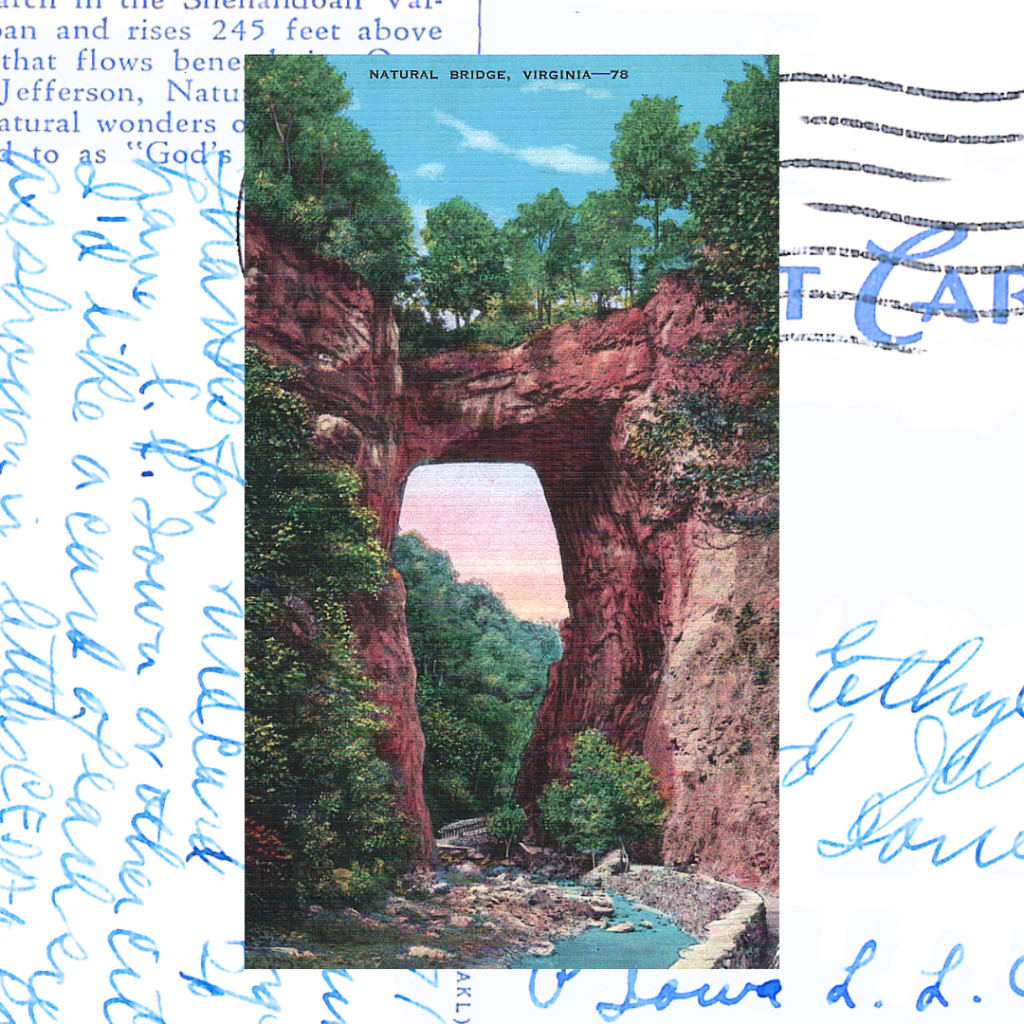
Front of Postcard. One of a few Natural Bridge postcards that I own