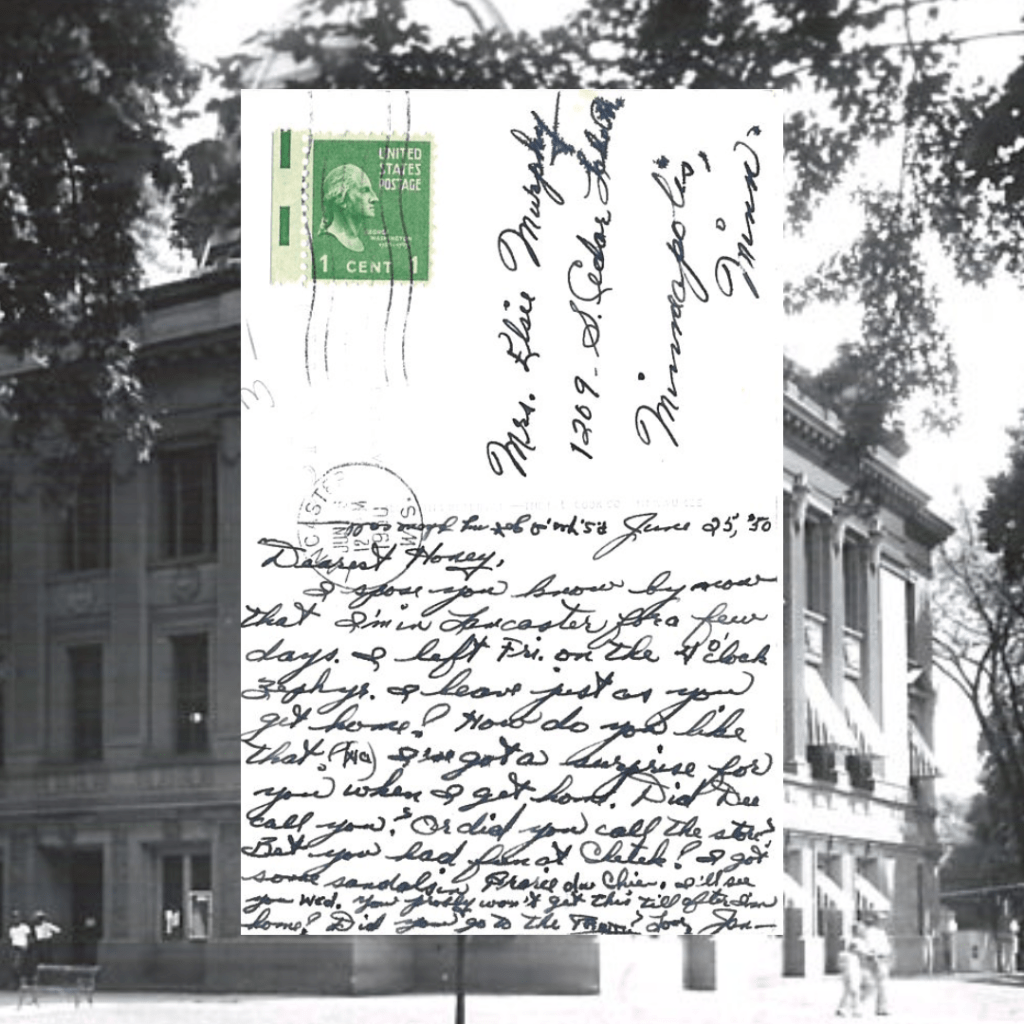
To: Mrs. Elsie Murphy. From: Jan, 1950
June 25, 1950
Dearest Honey,
I spose you know by now that I’m in Lancaster for a few days. I left Fri. on the 4 o’clock Zephyr. I leave just as you get home! How do you like that (ha). I’ve got a surprise for you when I get home. Did Dee call you? Or did you call the store? Bet you had fun at Cletek!(?) I got some sandals in Prairie du Chien. I’ll see you Wed. You probably won’t get this till after I’m home! did you go to the prom?
Love,
Jan
P.S. I got my phone call.
In 1950, World War II still loomed large in the proverbial rear view mirror of the United States. Harry Truman was President, the Korean War was just beginning, Joseph McCarthy — a Senator from Wisconsin — believed that Communists were everywhere, and Albert Einstein warned that nuclear war would lead to mutual destruction. It was somehow both a time of great change and stagnation. Technology was advancing at a frenzied pace, but Americans were frightened of the monsters they so eagerly created and sought ultimate control.
When I read this postcard I was positive it was a letter from a husband to a wife. From the salutation (Dearest Honey) to the squished signature — which I thought was “Jon”. At first glance, it was innocuous. A man sharing somewhat mundane stories and promising a surprise.
But under close examination the signature I thought read “Jon” was in fact “Jan.” Things clicked for me after that. The tone of the card is what I would call “gushing“. There’s a tumbling array of thoughts spilled out over the white space of the card as though Jan had so many things to tell Elsie that she needed to make sure to spill a little tidbit of everything while frustratingly sparing all the details.
Once I ascertained that the card was from Jan, I started looking for Elsie. I found quite a few Elsie Murphy’s floating around. There was even a promising obituary of an Elsie Murphy with a daughter named Dee, but she lived her whole life in Maine — so couldn’t be our Elsie. Finally, I decided to try Elsie’s name and address, and immediately got a hit on a newspaper article from the Library of Congress. It states:
Shown receiving the Bronze Star Medal awarded to her husband, Cpl Robert V. Murphy, is Mrs. Elsie E.Murphy, 1209 South Cedar Lake Road.
This is, unquestionably, our Elsie. This record is amazing for a variety of reasons, not least of which is that it includes an image of Elsie as she probably looked around the time she received the postcard. A little bit more digging uncovered the 1950 census reports from Minneapolis. It seems after her husband passed away, or perhaps even while he had been in war, Elsie lived with her parents in the Cedar Lake Road house. In 1950, she was listed as 31, widowed, and working full time as a typist at a publishing company.
Now that I had Elsie and her husband’s name, I started searching for him. It seems Robert V. Murphy was killed in action in Germany during WWII. He was born in North Dakota and only went to Minneapolis in May of 1942. Did he meet Elsie there? How long did they have together before he deployed? Like so many other young couples, did they have a heated romance and marry quickly because of the threat of war?
And who was Jan? A friend Elsie met at her job as a typist? A school friend? A cousin? What was the surprise Jan had for Elsie? What was Jan’s phone call? Had she gotten a job, a date, a scholarship? We won’t ever know, because without a last name I couldn’t find Jan.
The story is fascinating, and even though I found Elsie, I simply couldn’t find much more about her, including her grave or obituary. This tells me she likely remarried and was not buried under the Murphy name. I have to wonder how she managed to press on in her grief. Especially because Robert’s body was never recovered. She’d become a blushing bride only to become a grief stricken widow. I know I’ll be thinking about Elsie, her life after the war, and Jan’s sandals for a long time to come.

“Grant County Court House” Lancaster, Wisconsin

Leave a comment