Categories
Education family History parenting Photographs Poems Postcards Vintage Writing Prompt

Secrets in a 1908 Postcard: A Mysterious Message, a Tragic Twist, and a Family’s Forgotten Past

To: Mrs. HM. Maurey From: Roy 1908

Drive safe and in good condition

Roy

In 1908, Teddy Roosevelt was president, the Converse Rubber Shoe Company is formed, and Thomas Selfridge is the first person to pass away from an airplane crash. For those who follow my blog, you’ll know that 1908 is one of my favorite years to collect from. You’ll also know I love the Progressive Era and all the changes that were taking place at the start of the 20th Century. I think it was my late 90’s obsession with the musical Ragtime.

Although this card doesn’t give us too much, a simple “drive safe and in good condition,” implicitly it says a lot about the changing laws and norms that surrounded postcards. In 1907, it became legal to place a message on the back of postcards. This is known as the “divided back” period. Prior to 1907, postcards had to be addressed on the back, and any message was squished onto the front. This often caused problems, as the front of the postcard could smear, or there was very little room to write anything.

What’s unique about this card is that it looks like it’s from the “undivided back period” (historians aren’t great at making fancy names for eras). During this period, the address would take up the entirety of the back of the card, and any message had to be squished in to what little blank space was on the front. In fact, if you look at this particular card, you can see that there’s a tiny bit of space on the left. Certainly not enough to write more than a passing phrase.

However, our friend Roy divided his own back. It was legal, after all, to write the message on the back of the card along with the address, so Roy went ahead and took advantage of that fact. Maybe he had an old postcard lying around, or a set of them. Or perhaps stores still sold the undivided back sets. Whatever the case, Roy drew a stark line down the card and wrote his message.

Except he didn’t really say much. “Drive safe and in good condition” would have easily fit on the front of the card, and there were no laws saying you couldn’t write on the front after 1907. It seems to me that the collective habit of writing out a short note on a postcard took longer to fade from the zeitgeist. Roy divided his back, but kept the message clipped. He said all he needed to say.

As for the Maurey’s…I’m not 100% sure I found them. Honestly, I’m only about 70% sure I have the right family, but I’ll explain what I found and let you make your best guess.

As you know, it’s incredibly difficult to find anyone with just initials. If you add to the fact that this card is written to a woman…now you have her obscured by both her husband’s name AND his initials. Which can be doubly frustrating. Nonetheless, I searched up the name and plugged in a few dates.

The first promising hit was a Roy Maurey. Thinking maybe this is the writer, I decided to check out Roy’s family tree. Turns out, he had a father named…drumroll please…Henry M. Maurey. That takes care of the HM. But these are all men’s names. Who is the woman behind them? Henry was married to Emma Fritz. Could she be our HM Maurey? I think it’s possible. Let me break the family down.

Henry M. Maurey was born on May 7, 1856 in Lebanon Pennsylvania. Unfortunately, the record doesn’t show when he married Emma Fritz, but the two of them had three children together. Henry died the day before his birthday, May 6 of 1932 at the age of 76. And, I can’t stress this enough, he would have been roughly 4 years old at the beginning of the American Civil War. His wife, Emma, was born in November of 1859. Unfortunately, I don’t have a death date for her, and I couldn’t find grave information for either of them.

Their son, Roy, was born on December 26 of 1888. At some point, he married Florence Edna Wilbur (can’t find out when). I have to imagine that the card, then was sent to his mother, Mrs. HM Maurey, because they were coming out to visit. Roy would have been 20 by this time and perhaps working in Maryland. Though, and this is the kicker, I can’t place him there in the records.

Here’s where the story takes a bit of a sad turn. Roy died on March 6, 1913 at the age of 25. He had one son with Florence. Roy Jr. was born 7 months later, on October 6, 1913. Which, is honestly tragic. Even worse, Florence passed away on October 13, 1916, when Roy Jr. was only 3 years old. By the census of 1920, Roy Jr. was living with our very own Henry M Maurey in Sunbury, PA. He lived a long life, passing away at the age of 80 in Illinois.

Because of this postcard, I was able to attach a variety of documents to his family tree, and I found his gravesite. Perhaps…perhaps these are not the original people involved in our postcard. But, I have to believe that the story was asking to be told and that led me to this family.

I hope you enjoyed reading this twisted tale. What do you think? Did I find the right people?
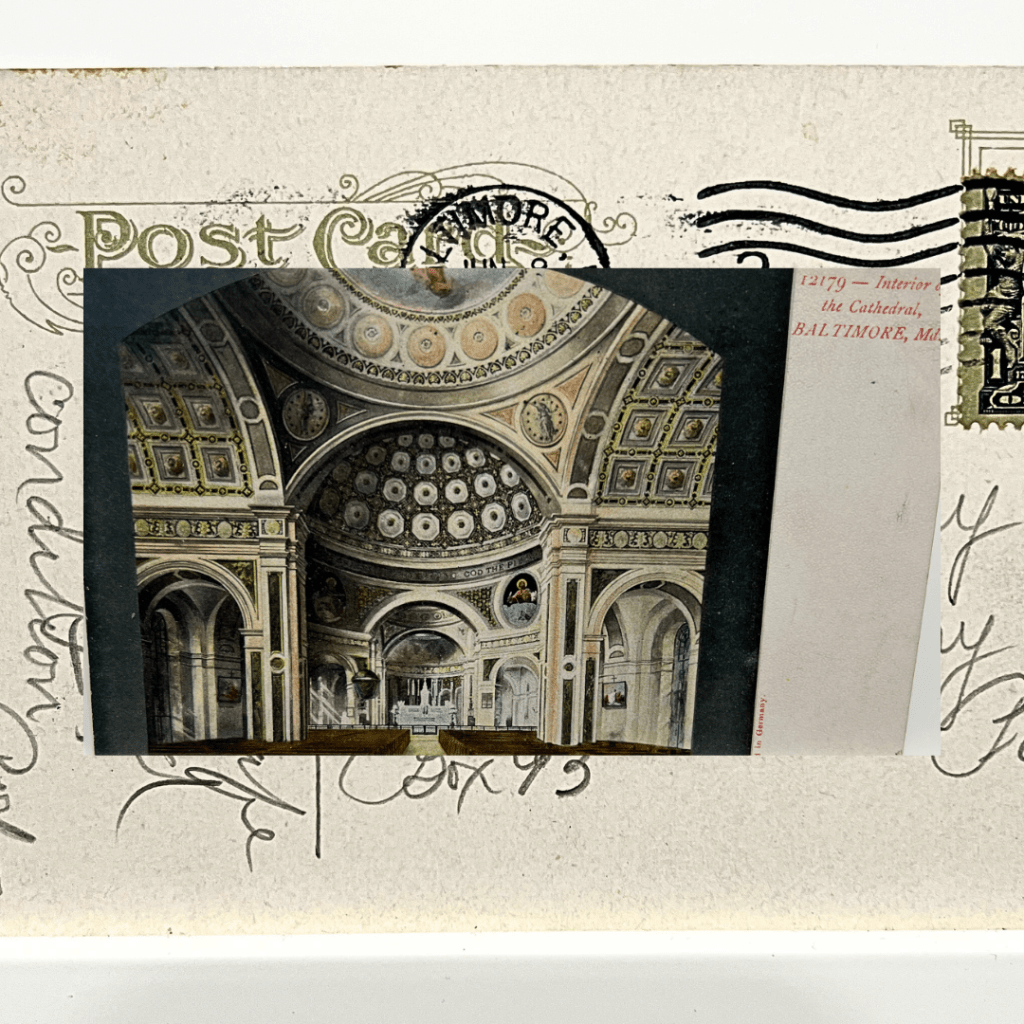
Front of Postcard, Interior of Cathedral, Baltimore, MD

Categories
Education History Photographs Postcards Vintage writing Writing Prompt

Secrets, Slices, and Scandals from Seattle Day 1909: A Postcard’s Peek into the Alaska-Yukon-Pacific Exposition

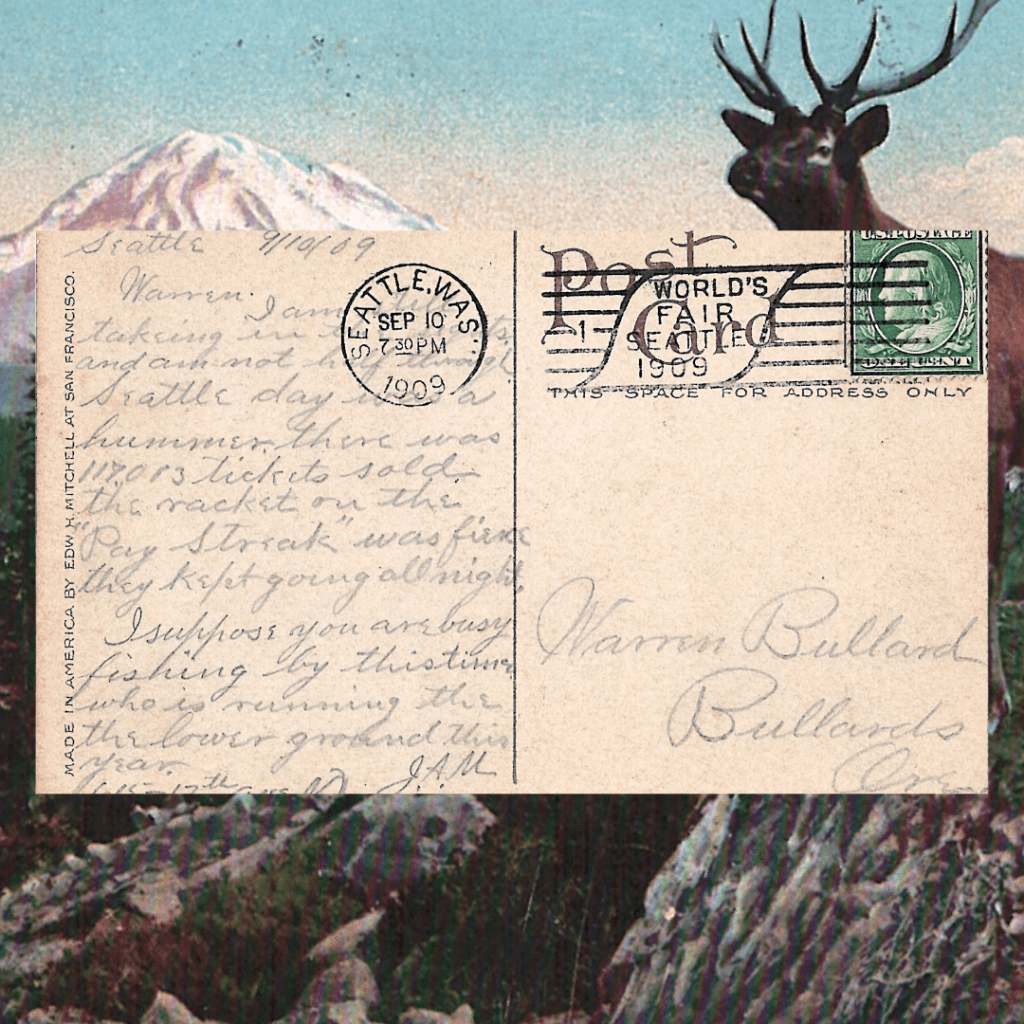
From: J.A.M To: Warren Bullard 1909

Seattle 9/10/09

Warren,

I am still taking in the sights and am not half through. Seattle day was a hummer. There was 117,013 tickets sold the racket on the “Pay Streak” was fiene(sic), they kept going all night.

I suppose you are busy fishing by this time. Who is running the the lower ground this year.

(615-12th ave N.)

J.A.M

In 1909, William Howard Taft was president, the NAACP was founded, Alice Huyler Ramsey became the first woman to drive across the United States, and the Alaska-Yukon-Pacific Exposition opened on June 1 — running until October 16.

And J.A.M was there.

This is one of my favorite postcards, partially because it provides so much information on such a small canvas. I’ve posted this card before, but I didn’t feel like I did it justice, so I wanted to re-post now that I’m a little better at this blog thing.

First, I want to talk about the Seattle World’s Fair — or the Alaska-Yukon-Pacific-Exposition. The exposition was huge, and on opening day attracted 80,000 people. However, “Seattle Day” brought in a crowd of 117,013. I’m amazed that this piece of information is immortalized in JAMs letter. I’m also thrilled about it. As a historian, it’s amazing when you can get real data from a source. And this source provides a ton of information.

The “Pay Streak” was sort of the fair’s answer to a midway. There were a variety of things that one could do on the “pay streak”. There were babies in incubators, machines that could slice a salmon in half, and even an orphaned baby that was “auctioned” off. Yes. That was a thing that happened. However, the winner never collected their prize. Apparently, historians are still trying to figure out what happened to the child. Suffice it to say, just because technology was progressing, doesn’t mean humans were.

And what of Warren Bullard and JAM? Well, I found Warren almost immediately. Warren Bullard was born January 20, 1884, which made him 25 at the time the postcard was written. A year later, in 1910, he married a woman with the best name possible, Leafy May Kendall. They had three children, and remained together until Warren’s early death in 1940. Warren registered for WWI, but I can’t find records that he fought. Leafy lived another 38 years after his death. She taught school and lived to be 90. She’s buried next to her husband.

And as for JAM? As you know, without a full name it’s almost impossible to find the person, unless they happen to be a relative of the recipient of the postcard. Unfortunately, I couldn’t find JAM. He’s not a cousin or brother that I can see — which must make him a friend or school mate. Alas, thems the breaks sometimes.

This postcard is more than just a connection, it’s a true primary source that chronicles the Seattle World’s Fair. It’s an exceptional find and I’m thrilled to at least have found Warren. I hope he took as much pleasure in reading the card as I have taken in talking about it.

Front of Postcard, Mt. Rainier, Washington

Categories
Education family History Photographs Postcards Teaching Vintage Writing Prompt

Vacation Vibes and Weigh-Ins: A 1946 Postcard with Hidden Stories

To: Mr. and Mrs. Melvin Else From: Alas(?) 1946

Hi!!

Came up here Sun. for our second week. Herb stepped on the scales last nite — but not me! I can walk right past them. Temp. was 101 yesterday 0n the mainland but in our “no.12” it wasn’t so bad. Is Waterloo still only nine miles from Lake?

Alas(?)

In 1946, Harry S. Truman was president, the Philippines is granted independence by the United States (lest we forget that we for sure held territories and still do), the first underwater test on a nuclear bomb is conducted at Bikini Atoll, Dr. Spock released The Common Sense Book of Baby and Childcare, and It’s a Wonderful Life is released in theaters. Civil and social strife are still rampant, with a variety of lynchings that take place in the south, but the government is (slowly) moving toward civil rights laws.

In 1946, World War II was over, and the age of the United States had begun. The US had escaped from the war almost unscathed, and although this was a time of prosperity (for some), values began to move further and further right as the US struggled against Russia. Although it would be another 8 years before “under God” was added to the Pledge of Allegiance (1954), the US still felt the need to “prove” our superiority. This began the age of the baby boom.

When researching this postcard, the first thing that struck me was Alas’ mention of “Herb stepped on the scales.” I don’t know enough about vacationing in the 40’s to know if that was something that people regularly did (weigh themselves on vacation…) or if the “stepped on the scales” phrase means something different than what my modern mind understands. But, I did find a pamphlet for the lodge for sale on Ebay, and it looks nice! Horseback riding, tennis, shuffleboard, golf nearby, a pool and a lake. There’s also winter sports apparently. So, it seems that perhaps if you’re being active you might want to see if you’ve lost weight. But not Alas. I love a queen who knows how to protect her peace.

As for Mr. and Mrs. Melvin Else, I believe I found them. Though, I do think this postcard was written from a woman to a woman, so let’s begin by uncovering Mrs. Melvin Else. Mable Setz was born in 1907 in Waterloo, Wisconsin and lived nearly a full century, passing away on March 29, 2004. She and Melvin married August 28, 1936 when they were both 29 years old. Melvin died relatively early, in 1984 at the age of 76. Mable, however, kept on, living her whole life in Waterloo. No children are listed on the family search, so I’m unclear if they did have children, or if the children just aren’t listed.

What was their tie to Alas and Herb? I had hoped that either Melvin or Mable had a brother or sister that would help me find the other couple, but neither had siblings that even remotely matched with the names. I’m thinking perhaps cousins, or even old friends from Melvin’s military days (he served in WWII)? It would explain the question of “Is Waterloo still only 9 miles away from Lakes” Which…is a strange question since I can’t imagine a lake or a city are going to move.

Either way, the connection was strong enough that Mable and/or Melvin kept the postcard. Now, I have the pleasure of recounting Alas and Herb’s adventure to you, my dear readers. May we all have the strength of Alas to “walk by” those proverbial scales.

Deer Trail Lodge, Lake Nokomis, Heafford JCT., Wisconsin

Categories
Current Events Education History parenting Photographs Postcards Vintage Writing Prompt

Postcards and Progress: Etta’s Excitement, Ethel’s Mystery, and a Glimpse into 1900s Life

To Mrs. W. Beals, From: Etta J P (unclear). 1907-1915

I suppose you are home and “hard at it” as I have been. I am on the verge of getting some new bedroom furniture so I am all excitement. I will write you a letter some time soon. Hope you and Dorothy. We were greatly recovered(?) all wish to be (unclear)

Etta J. P(unclear)

On flipped side: write me a letter and tell me bout your stay at the beach

Although I can’t be certain when this particular postcard was written, there are some clues. It’s a divided back, which means it has to be 1907 or after. The handwriting exhibits the cursive style script that was typical of the early 1900’s, and many of the Acegraph company postcards were printed and sent between 1910-1912. So, I think it’s safe to say that this postcard is somewhere in-between 1907-1915. Which, if you’ve followed along with me for a while, you’ll know is my personal favorite time-period for a postcard. I do love those wily progressives.

I’ve been re-visiting some of the postcards I posted back when I started this blog, and this is one of them. It’s actually one of my favorite messages I’ve seen on a postcard because Etta is simply dripping with excitement about her bedroom furniture. It makes me wonder if she was a new wife, or perhaps she and her husband recently moved, or maybe they had been saving for some time. Especially since she says she’s on the “verge” of getting new furniture and she is “all excitement.” I love the imagery of it.

As for Mrs. W. Beals, I’m 87% sure I found her. And, when I say she fell in my lap by chance, I mean it. I’ve talked before about how difficult it is to find women when they are obscured by their husbands name. It’s even more difficult when the sender of a postcard abbreviates the name (like “w” for example). As a historian, it presents a fun, challenging mystery. But it’s also super frustrating sometimes! Nonetheless, I figured that Bluefield was small enough that I might get a hit. I found some “Beals” and started following the family trees.

Wouldn’t you know it, a few clicks later and I had found William Jacob Beals, and his wife Ethel Julia Cross. They were married in 1908 (which fits the timeline) and had a daughter…wait for it…named Dorothy born in 1909! In the census of 1910 and 1920, they also lived in Bluefield West Virginia.

Ethel Julia Cross was born on April 2, 1888 in Minnesota. At the age of 20, she married William Jacob Beals in Pennsylvania. From there, they moved to Bluefield, West Virginia. The couple had two children, Dorothy and William. I’m not sure why they lived in Bluefield, but the city boomed because of it’s coal mines. At one point in the late 19th century, it was also considered the “city of millionaires” because there was so much wealth fixated in such a small spot.

At some point, she and her husband made it out to sunny California, because her grave is located in Los Angeles. Ethel died on September 7 of 1973, about 20 years after her husband.

I had hoped that I’d be able to find Etta, because I feel confident she’s related to Ethel in some way. However, no luck. Ethel’s grandparents aren’t listed in her tree, so any search for cousins or family connections runs dry. Nonetheless, the archival Gods aren’t usually this kind, and I must remember to present them with an offering later tonight.

I do hope Ethel lived a wonderful life, and I hope she enjoyed her time in the sun in California. I also hope that Etta’s furniture was exactly as she hoped it would be!

Front of Postcard: Randolph Macon Women’s College, Lynchburg, VA

Categories
Education family History parenting Photographs Poems Postcards Vintage Writing Prompt

Promises, Procrastination, and Postcards: Unraveling a 1912 Tease to Frank Van Gordon

To: Mr. Frank Van Gordon. From, Chuck(?) 1912

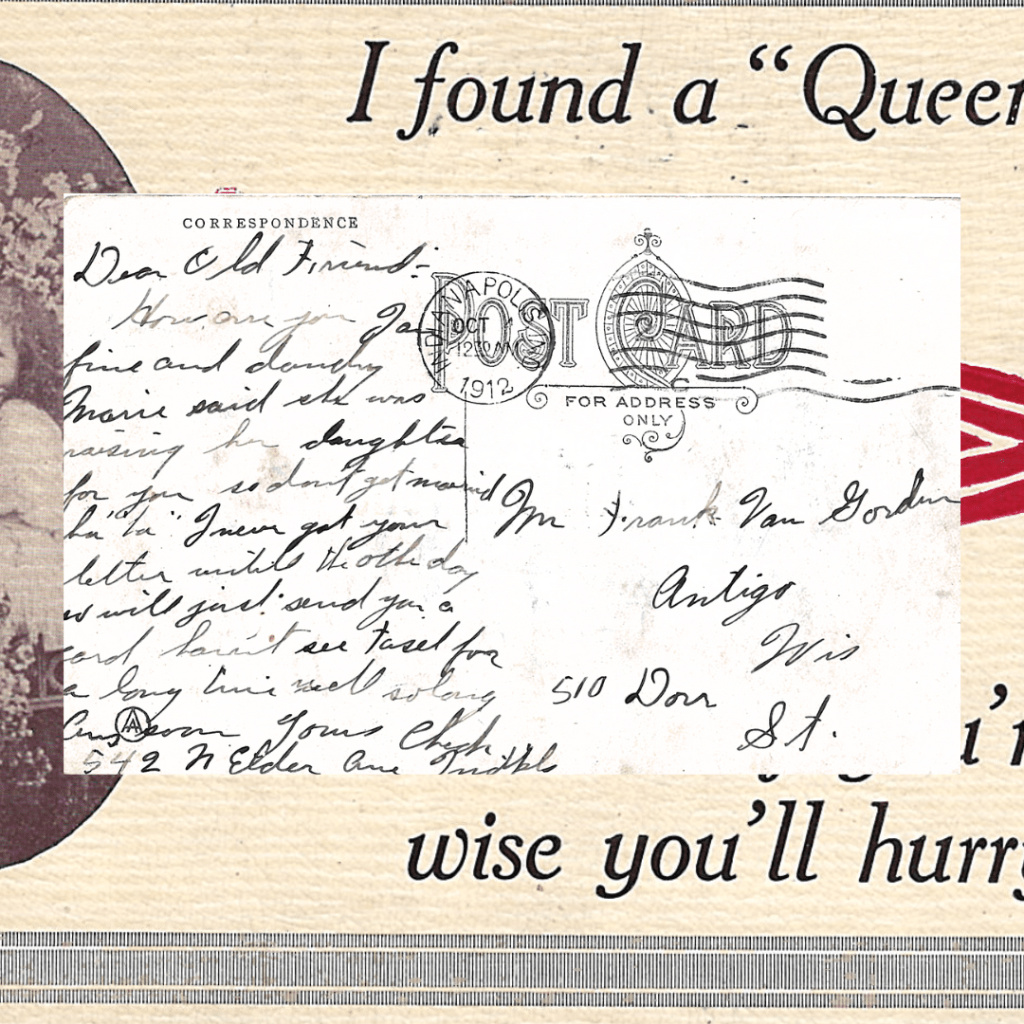
Dear Old Friend:

How are you. I am fine and dandy. Marie said she was saving her daughter for you so don’t get married. “Ha Ha”. I never got your letter until the other day and will just send you a card. Haven’t seen tasel(?) for a long time. Well so long and soon.

Yours,

Chuck

542 N. Elder Ave, Indpls

In 1912, William Howard Taft was the president, New Mexico and Arizona were admitted as the 47th and 48th U.S. State (respectively), and in the early hours of April 15, the RMS Titanic sank in the chilly waters of the Atlantic Ocean. Suffragettes paraded in New York City, and Theodore Roosevelt was shot in Milwaukee, Wisconsin, proceeds to give a speech, then goes to the hospital.

It was a crazy year.

This card is one of the first postcards I put on this blog, though I felt like I never quite did it justice. There is just so, so much going on. First, there’s the innuendo that “marie” is “saving” her daughter for Frank. Which…I guess the jibe is fun but it gives me a bit of the ick. I also wonder why Chuck “never got” Frank’s letter. As a professional procrastinator, I wonder if Chuck did in fact get the letter, forgot about it until he saw Marie, then remembered to send a card.

Much to my chagrin, I couldn’t find Frank at all. There were a few decent candidates, but none of them fit the timeline well. I have to assume that in 1912 Frank was somewhere between 20-30 (I’d guess 22), especially seeing as his friend is teasing him about getting married. Also, Antigo is a relatively small town, though it’s part of the lumber industry. It’s possible that Frank was a lumber worker.

Which might be why he’s hidden from us in the archives. If he only worked in Antigo as a seasonal worker, or for a year or two, then there would have been no reason for the census to record him living in that city. Also, I wonder if he’s listed in the archives as simply “Frank Gordon”. It’d be strange, since “Van Gordon” isn’t that crazy of a last name, but it’s still possible I suppose.

Well, I revisited this card in the hopes that I could shed a little more light on Frank and his friend. I’m sorry that I couldn’t find them! At least I feel like I’ve given the card it’s due — especially since so much happened during 1912! I do wonder what happened to Frank. I hope he lived a good life, and managed to sit down to dinner with Chuck at some point.

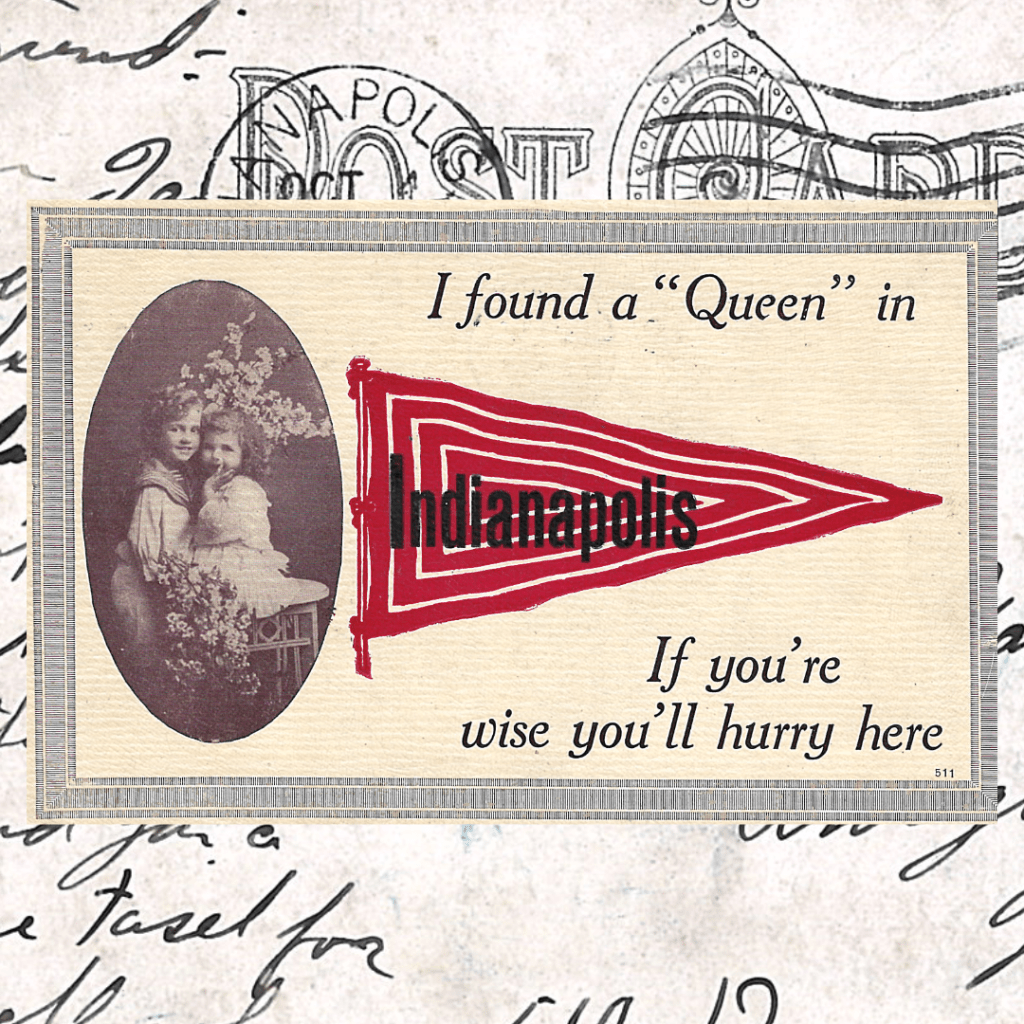
As an aside, the postcard front is so silly when you connect it to the message on the back. Chuck is teasing Frank about a wife, then sends a card that reads “I found a Queen in Indianapolis. If you’re wise, you’ll hurry here.” That’s more than a hint, it’s a smack across the head with a trowel.

Front of Postcard. “I found a Queen in Indianapolis If you’re wise you’ll hurry here.”

Categories
Education History parenting Poems Postcards Vintage Work In Progress writing

The Scarlet Letter: Women’s Names and Identity in 1908

To: Mrs. Oscar Lee Masters, From: Anna 1908

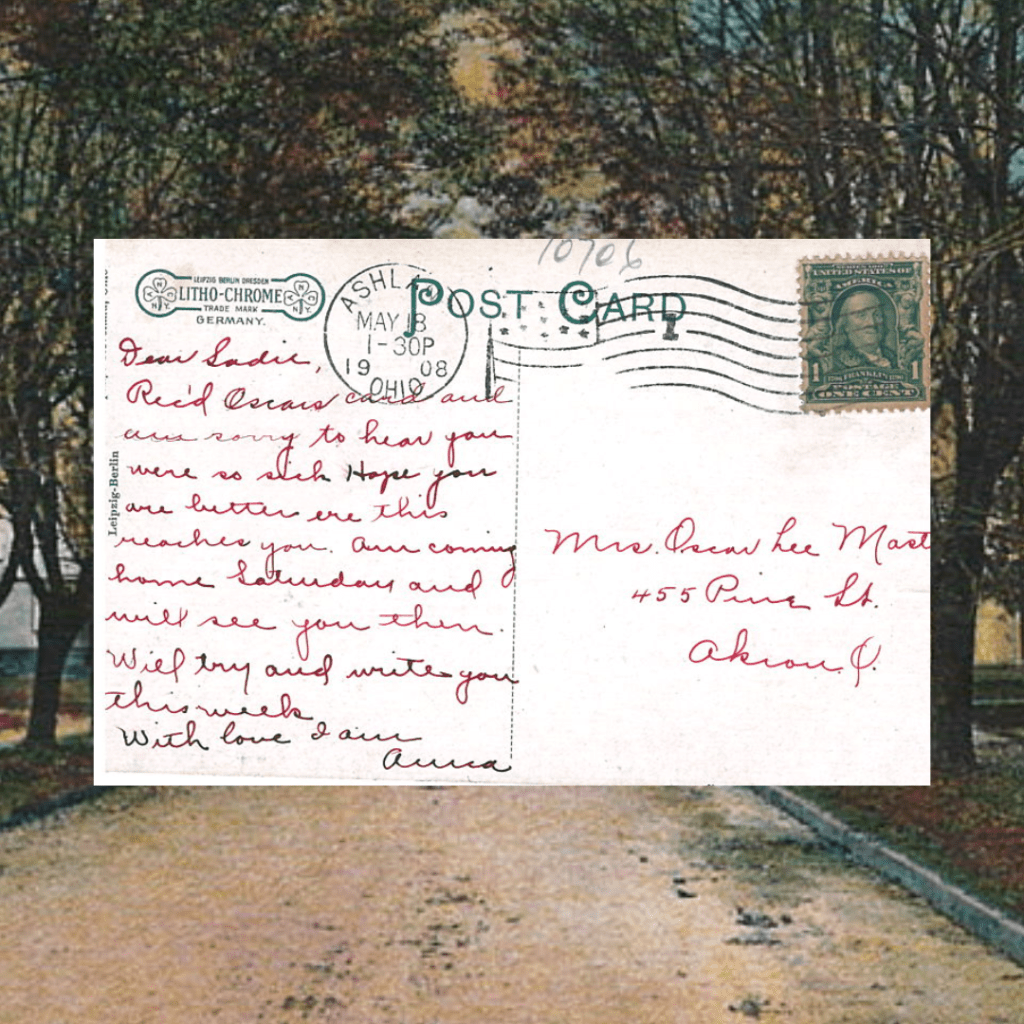
Dear Sadie,

Rec’d Oscars card and am sorry to hear you were so sick. Hope you are better ere this reaches you. Am coming home Saturday and will see you then. Weill try and write you this week. With love,

I am,

Anna

In 1908, Teddy Roosevelt was president, the ball dropped in Times Square for the first time, and Henry Ford launched the Model T, pricing the car at $850. The Progressives were in power, and despite their work dismantling monopolies and establishing national parks — they also came from a strict moral backdrop. “Reform” often came from religious motivations.

There are two things I find especially unique about this postcard. The first is that it seems to have been written in red ink. Now, I did not expect my research to lead me down an ink-enthusiast rabbit hole…but this did. Why? Because I wasn’t sure if the ink used started out black, and dried red over the century+ it’s been exposed to air, or, if it could have been written in actual red ink. Spoiler…I still don’t know. I found an advertisement in 1908 for a red inked fountain pen…perhaps that’s what Anna had? On the physical postcard the ink is a vibrant red–not rusted or brown. So, I lean toward the thought that it was written in red ink. If this is the case…it’s a style choice by Anna that I sort of love.

The second think I find unique about this postcard is that Anna uses Sadie’s name. In a time where so many women’s names hid underneath their husbands, here we have a situation where Anna specifically addresses the letter as “Dear Sadie.” If you’ve followed along with me for a while, you’ll know this actually rarely happens. Once a woman is married, it’s almost like her name totally disappears from the record. This is from the laws of “coverture” in which a woman is literally “covered” by her husband. So, not only did Anna defy convention by using black ink, she provided us with Sadie’s name.

So, starting out my research I felt I was already in a good position. I had a date, a place, and two names: Oscar Lee Masters (or master) and Sadie Master(s). It felt easy.

That was my first mistake.

I got lucky with my postcard yesterday, but today I had no luck at all. There were a few hits on Oscar Masters, but none that showed me his wife or family. I had nearly nothing on Sadie Masters…this tells me Sadie was probably a nickname for something (maybe Saundra?).

Here’s what I suspect: Anna was likely a sister or maybe a close cousin, and a flamboyant one at that. I’d like to think she was like one of the Aunt’s in Practical Magic. Of course, I don’t know for sure. But her use of the red pen has me thinking that she was definitely someone who stood out in a crowd. As for Sadie, I hope she felt better by the time Anna arrived. I imagine the two of them strolling down a spring street arm and arm catching up on life.

Center Street, Ashland, Ohio

Categories
Education History Photographs Poems Poetry Postcards Teaching World War II Writing Prompt

No Rest for the Wicked: The Life of a Teacher in 1945

To: Mrs. J. Clarkson, From: Ruth. 1945

Monday Evening

10:30 PM

Sept. 3, 1945

Dearest Mother,

Haven’t seen this yet, but there’s a view for you. (unclear) badly put in our first work day and it wasn’t too bad. Spent the morning registering and signing forms. Had a picnic lunch out on the lawn and back to lectures and instructions until 5 p.m. Came back to hotel, changed, and (unclear) to a place called “Treasure Island” for dinner. Did some window shopping on the way back and here I am. Have to be Johnny-on-the-spot tomorrow at 9 a.m. Howe’s everything?

All my love,

your, Ruth.

September 3, 1945 was “Victory over Japan” day, or V-J Day, as that’s when Japan officially signed documents of surrender. Though, you wouldn’t know it from this particular postcard. In fact, there’s no mention of the war at all, not even a passing relief that it was finally over. As a historian, I find this fascinating.

In 1945, citizens of the United States had borne witness to the horrors that came out of the end of World War II. Liberated concentration camps, sunken faces of POW’s, and Nuclear Bombs pervaded newspapers for months. It’s no wonder, then, that Ruth simply tried to lead a normal life. As we know so well, when everything around you feels like it’s tumbling down, you cling to what you can control. Perhaps that’s what Ruth was doing, leaning into the mundane because she could control it.

When I started out, I wasn’t sure I would find Ruth or her family. I did have her first and last name, but I didn’t have the name of her mother, or father. However, after digging a bit on the internet, I found that in 1938, Ruth was teaching high school. The entry is as follows:

Miss Ruth Barbara CLARKSON
Who has taught at the Lincoln School for several years and is completing her first year at Manistee High School, received her A.B. degree from the University of Michigan. She teaches civics (12), economics (12), sociology (12), and English (11). Miss CLARKSON was born in Highland Park, Illinois, and is a graduate of Manistee High School. She assisted the Junior Class sponsor with the J-Hop.
(“Most Popular” female faculty member)

Since Manistee is a relatively small town, and since the time-frame sits right, I figured I had our Ruth. More digging, and I confirmed that Miss Ruth Barbara Clarkson, the most popular female faculty member at Manistee High School in 1938 is very likely our Ruth. I managed to find her grave, which lists her father as Joseph W. Clarkson. Hence, “Mrs. J. Clarkson.”

Ruth was born on October 9, 1910 to Joseph and Bessie Clarkson. Because of that wonderful yearbook blurb, we know that she earned a degree at the University of Michigan, and taught high school for several years. She died on April 13, 1963 at only 52. Unfortunately, I wasn’t able to find an obituary.

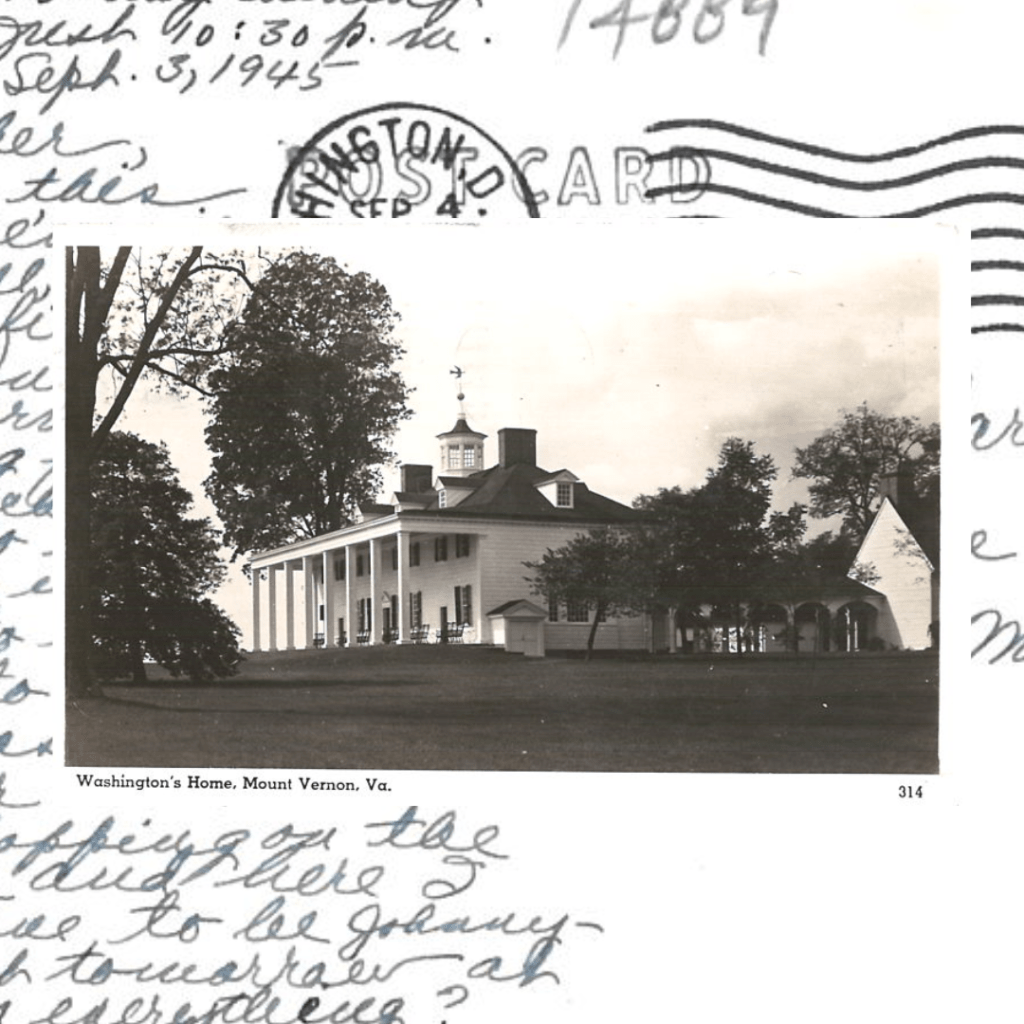
Why was she in Washington D.C? The tone of the card indicates she was doing some sort of work, and that she planned on going to Mount Vernon. And, I have to wonder, did she take students on a trip out there? Was it some sort of Civics convention? I myself will be taking the 8th graders I teach to Washington D.C. this Spring. It’s possible that she was on some sort of school trip. Perhaps that’s why she went through a list of everything they did. And maybe that’s why she had to be “Johnny-on-the-spot” in the morning. She had a bunch of students to wrangle!

It’s only conjecture, of course. The postcard gives us a lot of detail, but very little actual knowledge. What is apparent, however, is that she must have been close to her mother.

I do love this postcard. I hope Ruth had a wonderful time, and I hope she spent more lovely days in Washington D.C. seeing the sights, and taking picnics on the last days of summer.

“Washington’s Home” Mount Vernon, VA.

Categories
Education History parenting Photographs Postcards Teaching Vintage Writing Prompt

“Take Care of Puff and Fluff”: Exploring 1957 Through a Family Postcard.

To: Master David Thomas. From: “Mom” 1957

Tues Eve.

Dear David,

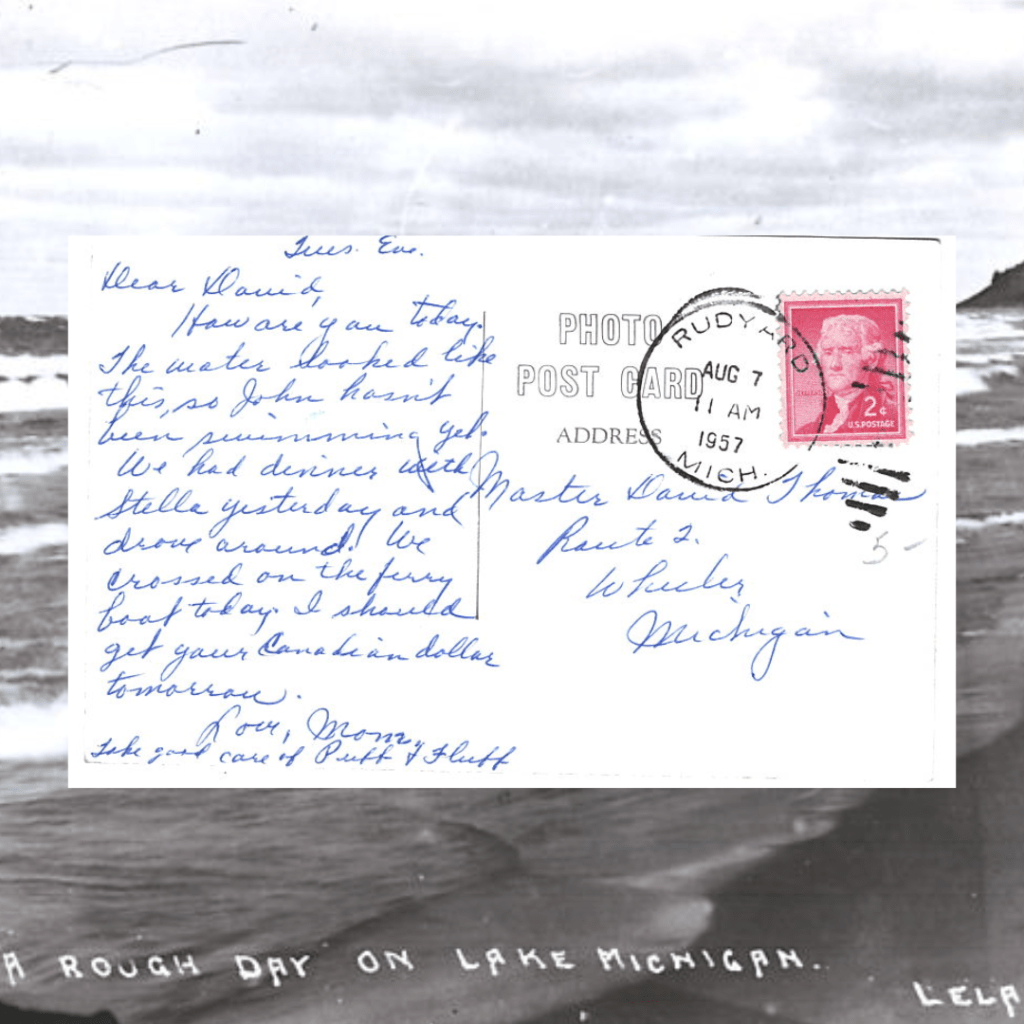
How are you today. The water looked like this, so John hasn’t been swimming yet. We had dinner with Stella yesterday and we drove around. We crossed on the ferry boat today. I should get your Canadian dollar tomorrow.

Love, Mom

Take good care of Puff and Fluff

In 1957, Dwight D. Eisenhower was president (with Nixon has his VP), and despite the attempt at gilded edges, the nation was entering a massive era of change. Elvis Presley moved his family into Graceland, Rodgers and Hammerstein’s Cinderella was shown on television, and West Side Story opened on Broadway. The Little Rock Nine were enrolled in Little Rock Central High School, and eventually the National Guard had to be sent in to allow the students to enter. The 50’s were in full swing, an era of prosperity for some and civil action for others.

For those of you who read my blog daily, you may notice that the front of this postcard is the exact same as the front of my postcard from yesterday. The difference between the two, however, is 30 years. While yesterday’s postcard was written by a young man to his friend, this postcard is much more maternal. Signed only “mom” and filled with family news about the vacation. My favorite part about this particular message is the name of the pets, who I’m guessing are cats? Puff and Fluff are the most adorable names for animal friends. I also love that mom referred to her son as “Master David Thomas” as though he’s lord of the house while they are away. It’s very sweet.

Ironically, I struggled to find “Master David” in the archives. I suspect this is because he’s still alive. I could find record of a David M. Thomas still living in Wheeler, Michigan. This David was born around 1948, which would have put him at 9 years old at the time of the postcard. This feels fitting. It’s possible he stayed home with a grandparent while the parents and older children (or aunts and uncles?) went to Lake Michigan. It’s also possible the parents were doing a college tour with the elder son (John, perhaps?). Anyway, if a person is still alive, they don’t really exist much in the archive except through census records.

If I knew who “mom” was, I’d probably be able to find the family. But, alas, that’s the way it goes sometimes.

Nonetheless, I do hope that puff and fluff were well taken care of, and given lots of extra treats by the man of the house, Master David Thomas.

As an aside, I also tried to research the postcard itself, and it turns out that they were fairly popular! Which, considering I have two of the exact same image 30 years apart, isn’t too surprising. But, I do wonder who sold them. Was the postcard picked up at a local shop? Was this image so popular it was constantly in print? For anything to survive multiple editions over 30 years is quite the feat. If only my endeavors could be so prolific!

“A Rough Day on Lake Michigan” Photo Postcard

Categories
Education family History parenting Poems Postcards Teaching Vintage Writing Prompt

The Mystery of Mabel Setz: A Glimpse into the Roaring Twenties

To: Miss Mabel Setz From: Ernest 1928

Dear Mabel,

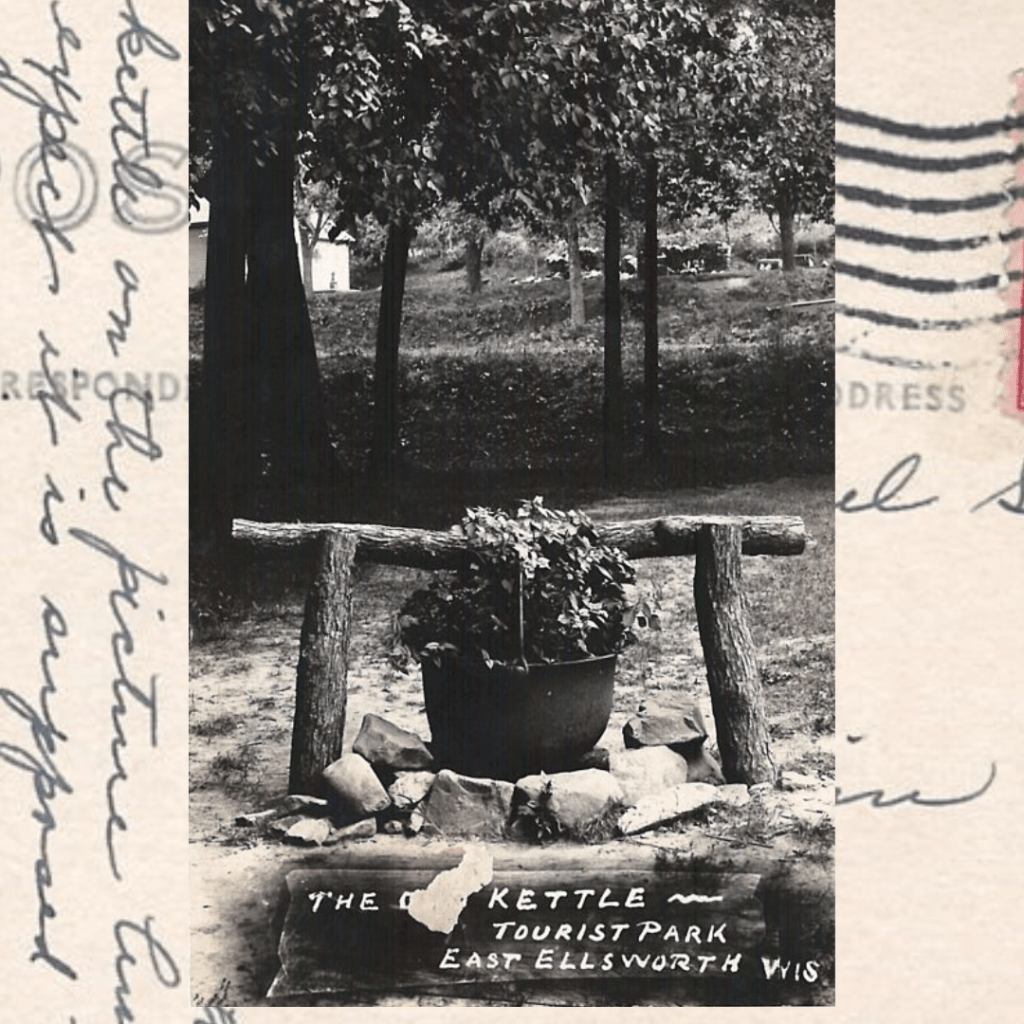
I haven’t seen the kettle on the picture but expect it is supposed to be scenic.

Don’t play too much tennis and give my love to “Bertha”. We’re having a lot of fun.

Ernest

In 1928, Calvin Coolidge was president, alcohol was illegal, and no one knew it quite yet, but the “Roaring Twenties” was coming to a close. Amelia Earhart was still alive, and Mickey Mouse made his debut. The age of entertainment brought to us by screens was beginning. It’s shocking how far it’s come since then.

Perhaps it’s because this postcard comes from 1928, perhaps it’s the joke about tennis and “Bertha,” perhaps it’s simply that there is a full picture postcard of the “Kettle” which appears to be a cauldron decorated by forest loving witches (or if you’re an ACOTAR girlie, by Elaine). BUT, this whole postcard feels like it could be straight out of the Great Gatsby. All that’s missing is a pier with a green light, fancy parties, and the most beautiful shirts you’ve ever seen.

East Ellsworth is a small town located in Pierce County, Wisconsin. Apparently, the train companies couldn’t build in Ellsworth proper, so they set up a depot about one mile away. This became “East Ellsworth.” At least, according to the internet. As far as I can tell, “the old kettle” doesn’t exist any longer, though it certainly looks like it used to sit on a quaint camp/hiking area. Maybe Ernest was there on a camping getaway with family, or maybe hanging with friends? Hard to know, but we know he thought of Mabel.

Mabel Setz was born on January 21, 1907 to Robert Setz and Eda Langlot Setz. At the time of this postcard, she would have been 21, and by the census of 1930, she was working as a book keeper at a local company. I wonder whether she worked by choice or by circumstance, since the stock market tanked in 1929. However, her parents were mid-sixties. Since she was the youngest, and still living with her parents, it makes sense that she might have worked to help with expenses. Mabel married Melvin Henry Else in August of 1936, and passed away in March of 2004 at the dignified age of 97.

As for Ernest, unfortunately I couldn’t find him. Without a last name, it’s fairly difficult unless he happened to be attached to the family in some way. He was neither brother, cousin, or husband. So whatever Ernest’s relationship to Mabel may have been must remain a mystery to us. I won’t lie, whenever I’m researching postcards between young people, I always hope to find out that they ended up married. I suppose it’s the hopeless romantic in me.

Maybe Mabel and Ernest suffered the same romantic fate as Gatsby and Daisy (though hopefully without the murder…), maybe they loved each other, but could never quite find their way to be together. Maybe, they simply remained friends. Whatever the case, I hope Ernest finally got to see the Old Kettle while in Ellsworth.

“The (old?) Kettle” Tourist Park, East Ellsworth, WIS.

Categories
Education History Photographs Poems Postcards Teaching Vintage World War II writing

1945: The Canal Zone’s Unique Postcard History

To: Mr. Scott R. Galbreath From: Robt. (Robert) 1945

Dear Scott —

Hope all the family are ok by now and especially Exa. Scott will you try to get me a set of those 5¢ stamps recently issued on the different nations of the Allied Nations. Mgt (Margaret?) is supposed to do it, but I’m afraid she has slipped up. Also any other recent stamps, just 1¢ mint and send them to Mgt and I’m telling her to send you whatever they cost. I’m trying to get some nice ones here for both of us.

Best Regards,

Robt. (Robert)

I talked about it in a recent post, but in March of 1945, WWII was on it’s way towards being over. Allied troops were pushing Germany ever inward. FDR would be president for just over 30 more days, Americans launched the Battle of Iwo Jima in the Pacific Theater, and the Academy Awards were broadcast over radio for the first time. I don’t know why, but it always seems so strange to have something as incongruous as WWII and Academy Awards happening at the same time. As we know, the world rarely stops moving for big events (except Covid!), but still, it’s strange to see something as normal as the Academy Awards next to the Battle of Iwo Jima.

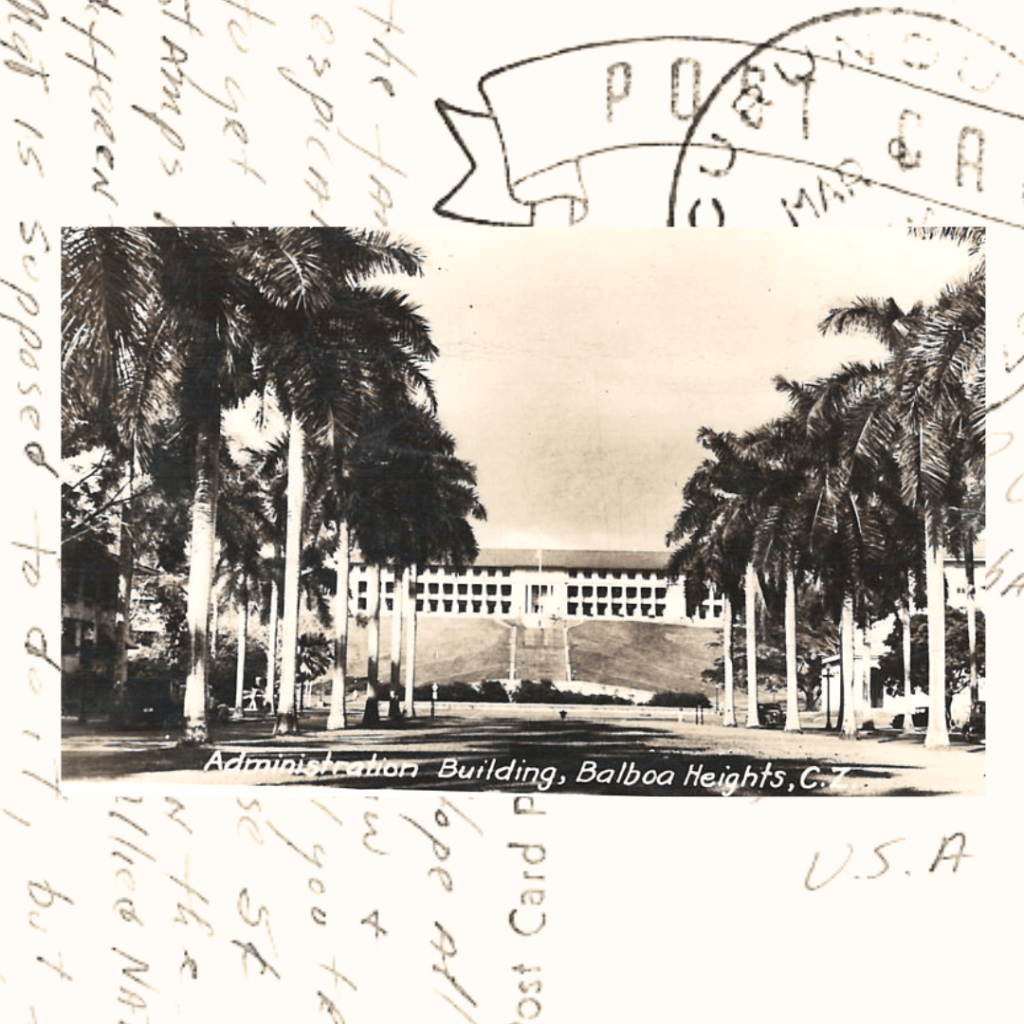
This particular postcard is super interesting, first because it’s postmarked from the Canal Zone (as in Panama Canal). Second, you can’t tell, but the postcard has a sort of metallic sheen to it. I’m unsure if it’s from age or if it was always the nature of the card, but it’s super cool to see in the light. I’ll try and capture it on video and post it to my Instagram account if you’re interested.

Through 1945 (and beyond) the Canal Zone was also deeply segregated by race. The “Gold” roll workers were almost all white US citizens, while “Silver” roll workers were non-white, non-US workers. The titles “gold” and “silver” stems from an earlier practice of literally paying white Americans in gold and non-white, non-Americans in silver.

Interestingly, the Canal Zone also issued their own stamps until 1978. The stamp is on the card, and not super obscured, but I’ve added a picture of it at the bottom as well. Even though the zone had their own stamps, that sort of mundane existence may be exactly what Robert chafed against — hence his request for various other stamps from his friend Scott. Poor Margaret, I wonder what she did to muck up his stamp order so poorly.

And what of Robert and Scott? Surprisingly, I found Scott immediately, largely because the name of his wife is so unique. Though, I’ll admit I thought it was Eva at first. Scott Robert Galbreath Jr. was born in Paris, Texas on September 13, 1908. In 1945, he would have been 36 years old. He lived with his wife, Exa, and his daughter Ammie, who was 7 in the census of 1940. From what I can tell, he was a manager at an insurance company. At least that’s how the census listed him in both 1930 and 1940. I even managed to find Exa in the record, though obscured by her husbands name, attending a silver tea for charity.

Although Family Search does not list any children, I did find his daughter, Ammie’s, obituary, which indicates that Scott had at least one son…yep…you guessed it…Scott Galbreath III. It’s always very rewarding when I’m able to track down snippets of a life from a postcard.

Robert and Margaret, however, remain a mystery. I had hoped that one of them was related to either Scott or Exa, and perhaps they were indirectly related (cousins or something), but they were not direct brothers or sisters of either one of the Galbreath’s. Though, judging by Scotts photo (on Find a Grave), I have to believe that he got poor Robert the Allied Nations stamps he so desired. I hope Robert enjoyed the heck out of them.

Front of Postcard, featuring the Administration Building of the Canal Zone