Categories
Education Flash Fiction parenting Postcards Vintage writing Writing Prompt

Waning Summer Days: Suzie Radley’s 1909 Letter

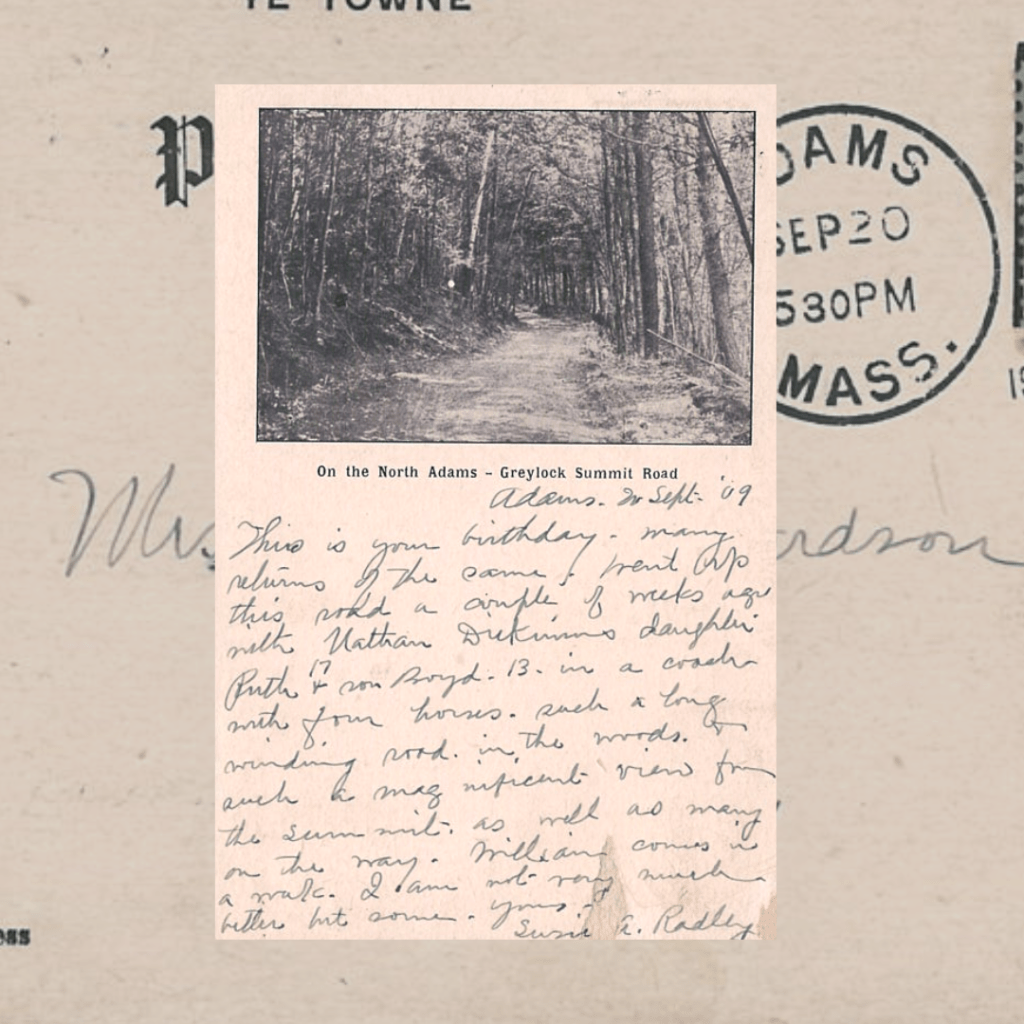
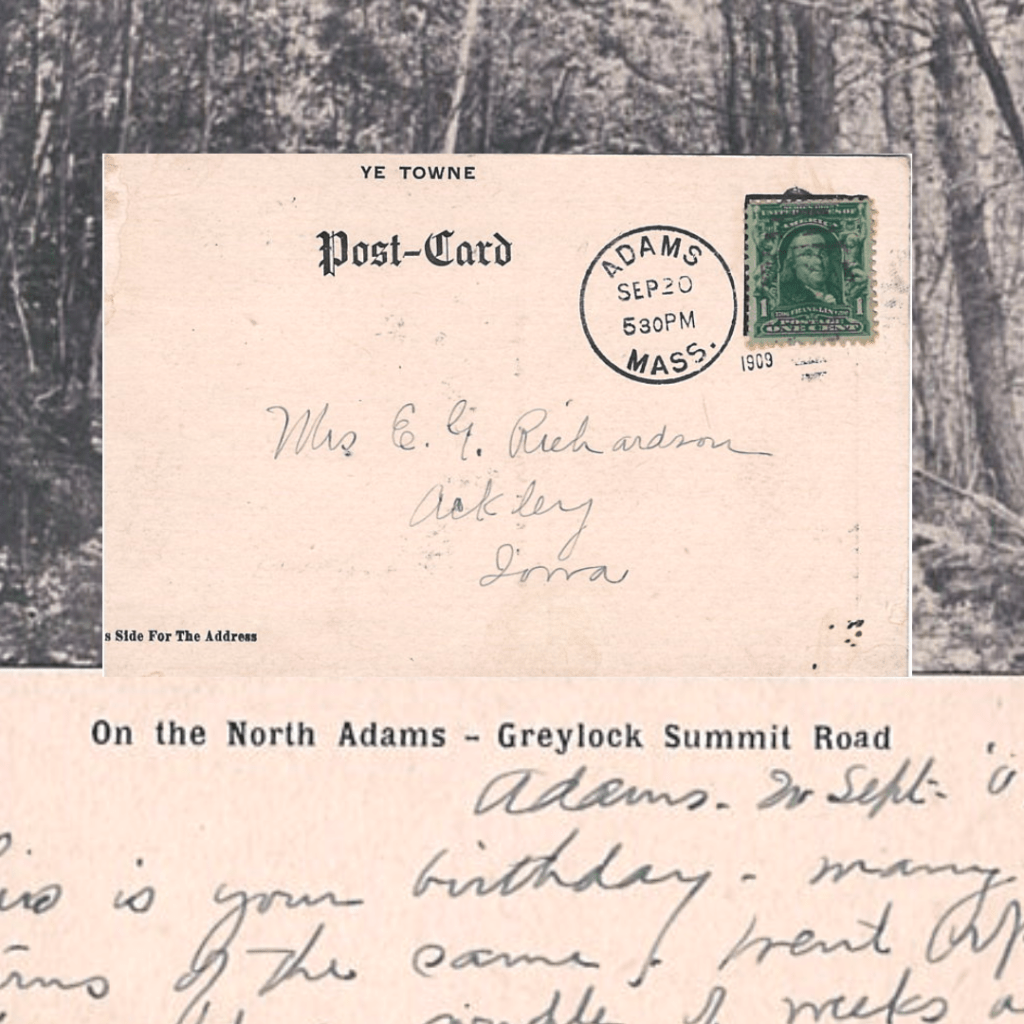
From: Suzie A. Radley To: Mrs. E.G. Richardson, 1909

Adams, MA. Sept. ’09

This is your birthday. Many returns of the same. Went up this road awhile of weeks ago with Nathan Dickinsons daughter Ruth (17) and son Boyd (13) in a cart with four horses. Such a long winding road in the woods and such a magnificent view from the summit as well as many on the way. William comes in a week. I am not very much better but some.

Yours,

Suzie A. Radley

In September of 1909, news reached the world that both Dr. Frederick Cook and Admiral Peary had reached the North Pole, the United States passed a law that allowed postal workers to skip houses with aggressive dogs, and union members were locked out of their jobs at the Triangle Shirtwaist Company.

It was also E’s birthday. How old she was, or what her first name was, I don’t know. I wasn’t able to find her easily in the records. However, we know that Suzie was thinking of her, which I think is sweet.

On my hunt for information to bring to this post, I really ran into a wall. I couldn’t find a Suzie or Susan or Susanna Radley, I couldn’t find E, I couldn’t even find Nathan, Ruth, or Boyd Dickinson. Usually I can find something, but alas, no luck for me.

Although I don’t have biographical information for our main characters in the post-card, the card itself provides quite a bit of personal and life information. As you can see, the writing was on the front of the postcard, not the back. Again, we have an instance of a transition period postcard. It was legal to split the back, but for whatever reason Suzie didn’t use a divided back card.

Because the photo is so small and because Suzie didn’t have to contend with a divided back, we get a lot of details that we can use to infer other information. The fact that she went on a carriage ride through the woods with a 17 and 13 year old tells us she’s probably somewhere between 15-19. I’d guess she’s closer to Ruth’s age — since that’s who she named first.

The ride through the woods probably took place in the waning days of August. The idea of it is lovely. A warm ride through a shaded wood with the crisp scent of fall on the horizon. Perhaps a bag full of bread and apples, and the joyous chatter of fellow teens to keep you company and a “magnificent” view at the end. What a great way to spend the last bright days of summer.

We also know that Suzie was expecting William. I am guessing he’s a brother or cousin, though I couldn’t find him either. My questions linger on the relationship between E and Suzie. Were they friends, cousins, or sisters? Was Suzie visiting Adams for the summer months, or did she live there? It’s the personal histories that fascinate me. The everyday lives of ordinary people that simply tried to do their best with what they had — it’s heroic. I wish I was able to find more.

But I’ll still bask in the thought of Suzie’s perfect summer day, and hope that E’s birthday brought her much joy and happiness.
Categories
Current Events Education Flash Fiction History Photographs Poems Poetry Postcards Vintage writing

Flashback Friday: 1942 Blackouts and Forging Friendships Through Postcards

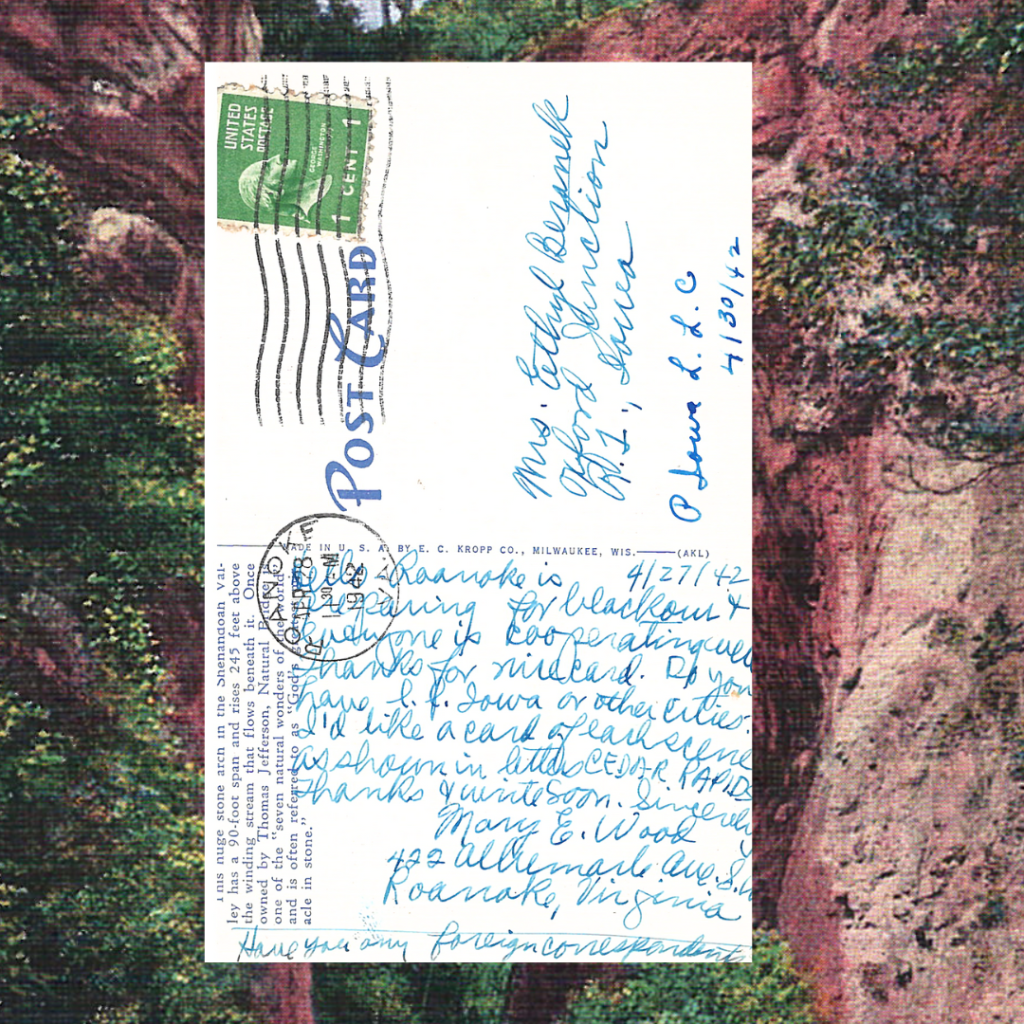
From: Mary E. Wood, To: Mrs. Ethyl Beranek 1942

4/27/42

Hello.

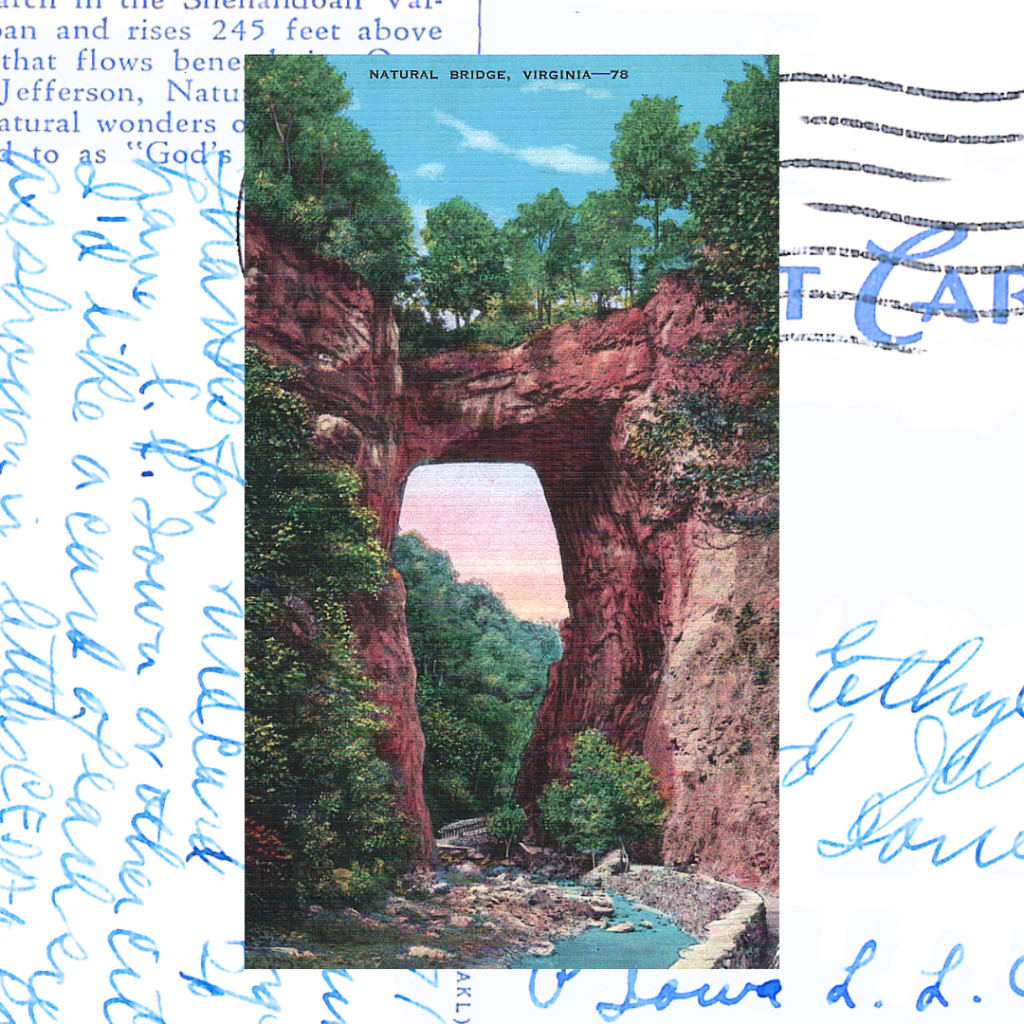
Roanoke is preparing for blackouts and everyone is cooperating well. Thanks for the card. Do you have L.L. Iowa or other cities? I’d like a card of each scene as shown in little’s CEDAR RAPIDS. Thanks and write soon.

Sincerely,

Mary E. Wood

422 Albemarle Ave S.W.

Roanoke, Virginia

Have you any foreign correspondents?

By the time Mary wrote this letter, the United States had newly entered World War II. A few months earlier, in February, a Japanese submarine had attacked an oil refinery in Santa Barbara, California. Though the attack didn’t cause much damage, fears and tensions in the United States were high. Shortly after the attack on California, FDR signed Executive Order 9066 which led to the internment of 125,000 people, two thirds of which were American Citizens.

In April, the country was already well on its way to mobilizing for war. In preparation, many cities — including Roanoke — were practicing blackouts. The city had practiced at least two blackouts by the time Mary sent her letter to Ethyl. Families bought blackout curtains for their windows and hoods for their headlights. At some point during the blackout, air raid sirens blared and people extinguished lights, pulled over and listened for the test to be over.

The fear of invasion is a type of fear I hope I never have to experience, and to see it documented in this letter is so interesting. Mary expresses prepping for an invasion first, which tells me it was probably at the top of her mind.

However, the wartime blackout conditions are juxtaposed by Mary’s request for different types of postcards. It almost seems like she’s part of some sort of post crossing program before post crossing existed! Or, as we elder millennials remember it as: pen pals. I do wonder if Mary personally knew Ethyl and the two of them were simply card collectors, or if it was a type of pen pal program. Very interesting.

As for Mary Wood, I think I found her. She was born as Mary Ellen Thurston, but her first husband had the last name Wood. She later divorced and remarried, becoming Mary Ellen Truslow. What’s strange is that I found her second marriage certificate, which listed her birthday year as 1927, but her grave and all other documentation lists 1921.

As for Ethyl, funnily enough the first thing that popped up when I searched was another postcard to her. Same address, though a different sender. Wouldn’t that have been the bee’s knees? After a little more digging on Family Search, I managed to ascertain that she probably passed away shortly after World War II — 1953 to be exact.

The obituary states that she had suffered from an “illness for the past year.” Two of her sons died shortly after, one in 1955 and another in 1958. An overall sad end to an interesting postcard.

I hope that the two women remained in correspondence until Ethyl’s untimely death. Perhaps this small blog post can help keep the memory of their connection alive.

Front of Postcard. One of a few Natural Bridge postcards that I own

Categories
Climate Education Flash Fiction History Photographs Poems Poetry Postcards Teaching Vintage writing Writing Prompt

Mysteries from the Boardwalk: A 1915 Postcard from Atlantic City

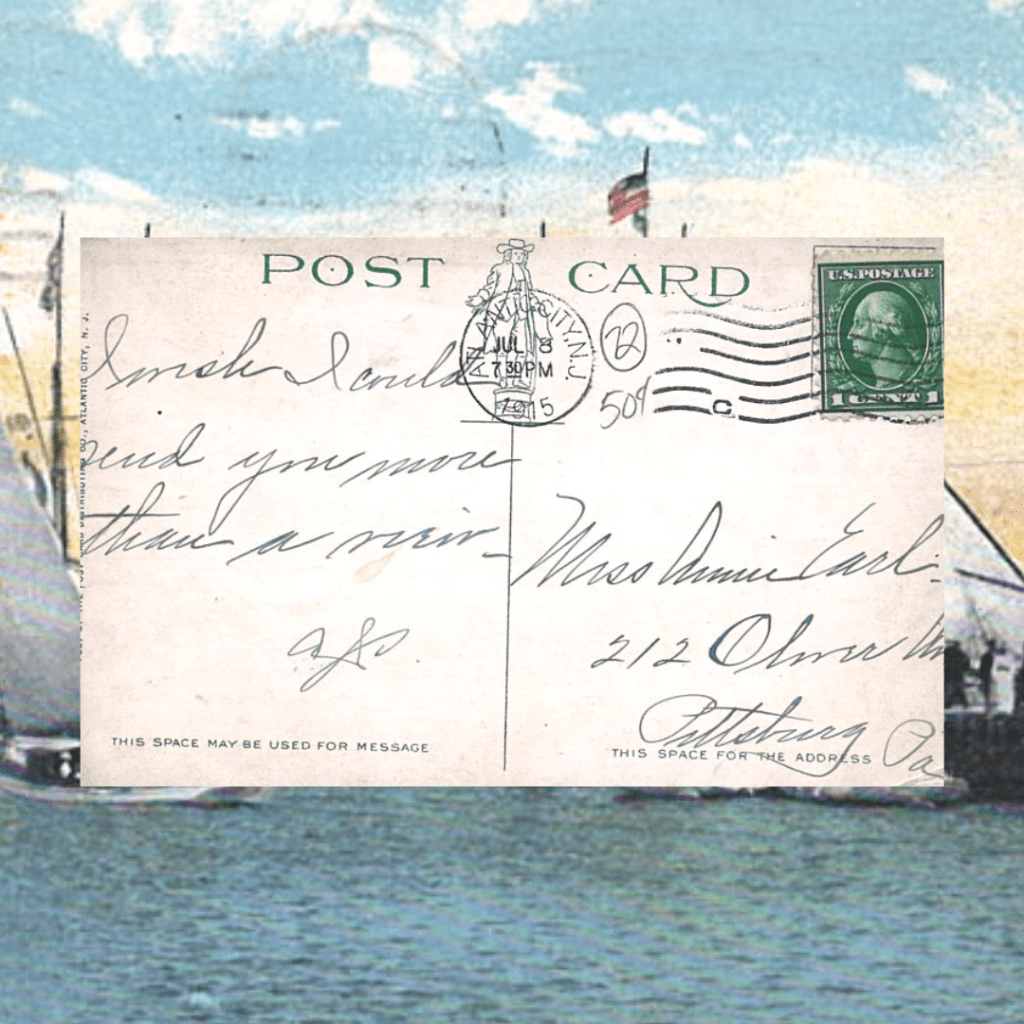
To: Miss Annie Earl. From: AS(?) 1915

I wish I could send you more than a (unreadable)

In 1915, Woodrow Wilson was president, the United States began it’s occupation of Haiti, the Lusitania was sunk by a German U-Boat, and the United States recognized the new Mexican Government as a de-facto government.

This is one of the few cards I have that’s from a true resort town, and I love the vibes of it all. By 1915, Atlantic City was already a destination city, bringing in over 500,000 people by rail every year. At this time, the boardwalk was over 7 miles long, and an array of large hotels sprawled along the ocean, some capable of holding up to 2,000 guests. I have to assume that the sender of this card was in Atlantic City on vacation, though, of course, they could have been a seasonal worker.

As beautiful as the card is, it’s a tad frustrating because there’s simply not much information. The last word is illegible (for me), and even the sender’s signature is nothing more than scrawled initials. I do have the name “Annie Earl”, but even that led to a dead end. There were many, many, Ann’s, Anna’s, and Annie’s that fit the time frame — and while I have a suspicion of which one or two might be correct, I don’t feel confident enough to write about them. So, I’ll leave you with some theories.

My first guess is that this is one of two types of card. Either, from one sibling to another, or from one friend to another (with a possible romantic entanglement since that’s how I role). My gut feeling tells me this is probably an older sibling writing to a younger one. Maybe they were working in Atlantic City but couldn’t send money, or maybe they simply didn’t have enough time to send a full letter.

My less prominent theory — but perhaps more fun one — is that this is a beau writing to his girl. Maybe he was down on his luck and had gone to Atlantic City to earn some dough and that didn’t go through. Maybe he wanted to get enough money to marry. I genuinely don’t think this is the case, but since I’m left with little information, it’s fun to think about the possibilities.

Either way, it’s a beautiful card with elegant and sweeping handwriting. It feels like there’s a cool breeze drifting in from the ocean, and I envision the sender quickly writing out the letter on the boardwalk, squinting their eyes against the sun. What a lovely memorial to a July day.

“Scene at the Inlet”

Categories
family History parenting Poems Postcards Teaching Vintage writing Writing Prompt

A 1907 Postcard and the Short Life of Tillie Seedorf

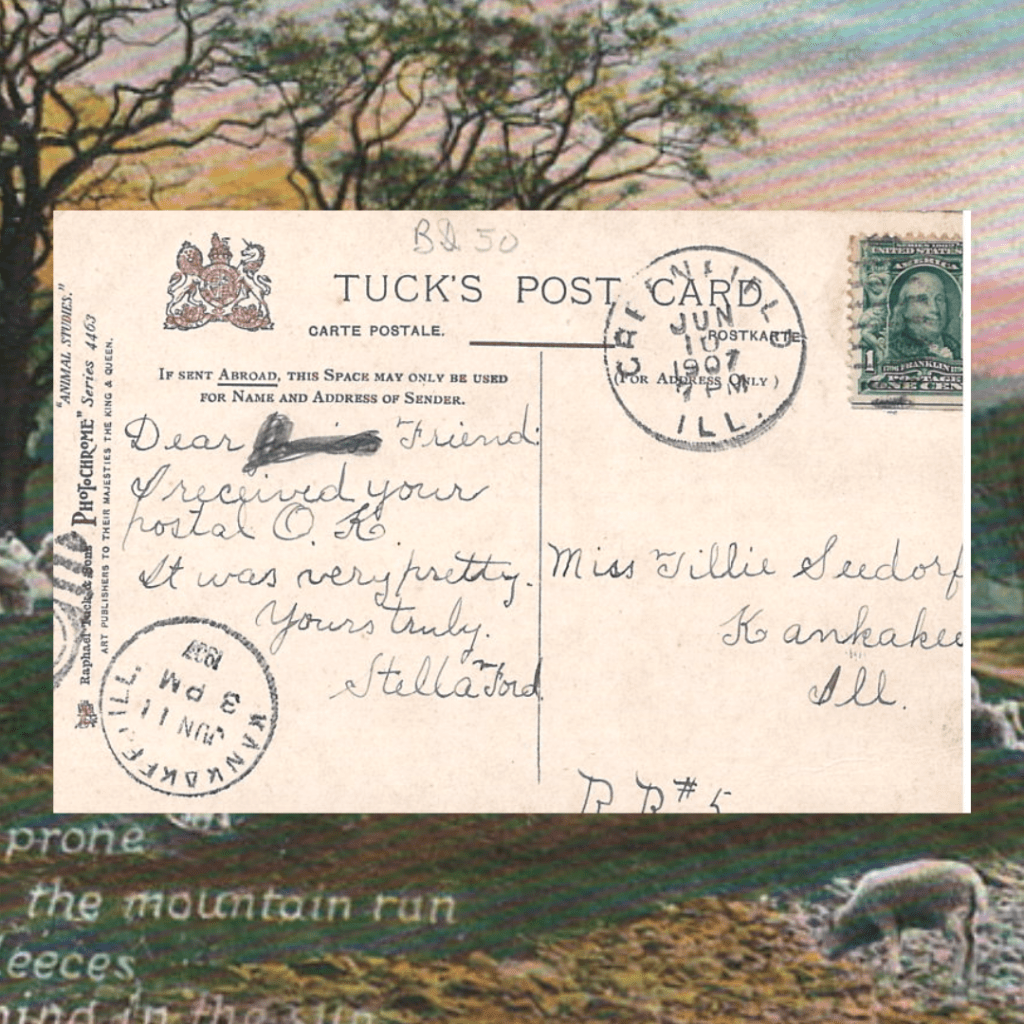
To: Miss Tillie Seedorf. From: Stella Ford. 1907

Dear Friend.

I received your postal O.K. It was very pretty.

Yours truly,

Stella Ford

As you know, 1907 and 1908 are some of my favorite years to collect postcards. I’m particularly drawn to period in history that are transition years — where rules are not yet fully written on how to deal with a changing landscape. It’s small, but the switch from un-divided back postcards to divided-back postcards feels like a space where rules aren’t quite clear yet. This particular card notes that if it’s to be sent abroad, it can only be used as the address to the sender. Even though a place like England got rid of the divided back earlier than the United States.

The theme for this week seems to be “young friends,” which I’m perfectly content with. I think so many of us forget that young children and teens have ALWAYS been young children and teens throughout history. Their brains developed roughly the same as ours (not accounting for environment). They struggled with adults and loved their friends, even when those friends were far away.

In something that’s close to a miracle, I’m pretty sure I found both girls, though I’m a little dicey on Tillie. I don’t have a lot of information for either of them, though. It’s one of those situations where the trail runs cold because I won’t pay my way past an information wall. But, allow me to introduce them to you.

Stella Ford was born on June 10, 1892, the third child of four children born to Benjamin Ford and Hulda Wells. When she sent her postcard, she would have been 15 years old. In 1916, she married Charles Kinney. I don’t have record of children between the two, so I’m unsure if the record is true, or if the children simply aren’t attached.

Tillie was a bit of a more difficult find. There were Seedorf’s living in Kanakee in 1907 and beyond, and I had to do some family tree digging. However, I finally found (what I think is) a match.

Mathilda S. Seedorf was born on March 25, 1885 to Friedrich Seedorf and Mary Mueller. She was the third child, but first daughter to the couple, and one of 8 children. She doesn’t appear to have married, and died relatively young: October of 1931 at the age of 46.

What’s interesting about her record, is that there’s a probate document attached. When her father died in 1920, she received an $8000 inheritance. The inheritance is one of those cold, black and white facts that carries a lot of weight. I can’t possibly know exactly what was going through her mind, but we can know that there was grief, possibly loneliness, and maybe even anger.

What is clear, however, is that Stella Ford and Tillie Seedorf cared for each other. This card is beautiful, with colors that are vibrant and descriptive over a hundred years later. I hope Tillie and Stella maintained a friendship for the rest of their lives.

“Strengthening rows prone from the mountain run. The flocks–their fleeces glistening in the sun.”

Categories
Education family History parenting Photographs Poems Postcards Teaching Vintage writing

Unraveling a 1910 Mystery: Who Were Eddie R. and Anna Mathes? A Postcard’s Clues to Friendship, Family, or Courtship…

To: Anna Mathes. From Eddie R. 1910

Hello Annie.

How are they coming. Fine I suppose. We are all very good down here. We are making the mission now and have to be good. I suppose you are having a fine time up there.

Eddie R.

In 1910, William Howard Taft was president, Joyce Hall founded Hallmark Cards, the first unofficial Father’s Day was observed, and although aviation is getting off the ground (see what I did there?), the first American pilot dies in a crash in front of 5,000 spectators. America had lived in the 20th century for a decade, and it was already looking to be a doozy.

The more I read this card, the more questions I seem to have. Eddie and Annie seem to be young…perhaps what we would deem upper elementary or middle school age (between 10-14). But, based on the context of the card, I can’t tell if the two are related, friends, or if this was some sort of project or pen-pal scheme.

Both Annie and Eddie were a little difficult to track down in the records. Anna because I’m not sure if her name is spelled incorrectly on the card. It could be Mathes, but it could also actually be Mathis. Especially if Eddie wasn’t sure. But, I only found one Anna Mathis born in Chaska — so I’m thinking I found a match.

Anna Mathis was born in June of 1893 to a German father and Dutch mother. She was the oldest of two children and lived in Chaska (a suburb of Minnesota) for at least 20 years. This puts her at about 17 when she received this card. Older than I would have guessed, but still a teen.

However, 1910 is when the record runs out, though her father died in 1917 and her mother remarried in 1919. I went through Anna’s cousins on her mother’s side, and didn’t see an Ed, Edward, or Eddie. There’s no family information listed on her father’s side, which means if Eddie was a cousin from her dad’s family…I wouldn’t know. However, Anna’s dad immigrated from Germany in his 30’s, so unless he came over with a brother or sister, it’s unlikely Eddie is from that side of the family.

Our trail runs out there, I’m afraid. My guess is that Eddie is still younger than Anna, and was probably prompted by a parent to write. It’s possible he was older and that there was a small courtship going on, but this feels more familial than anything. What do you think?

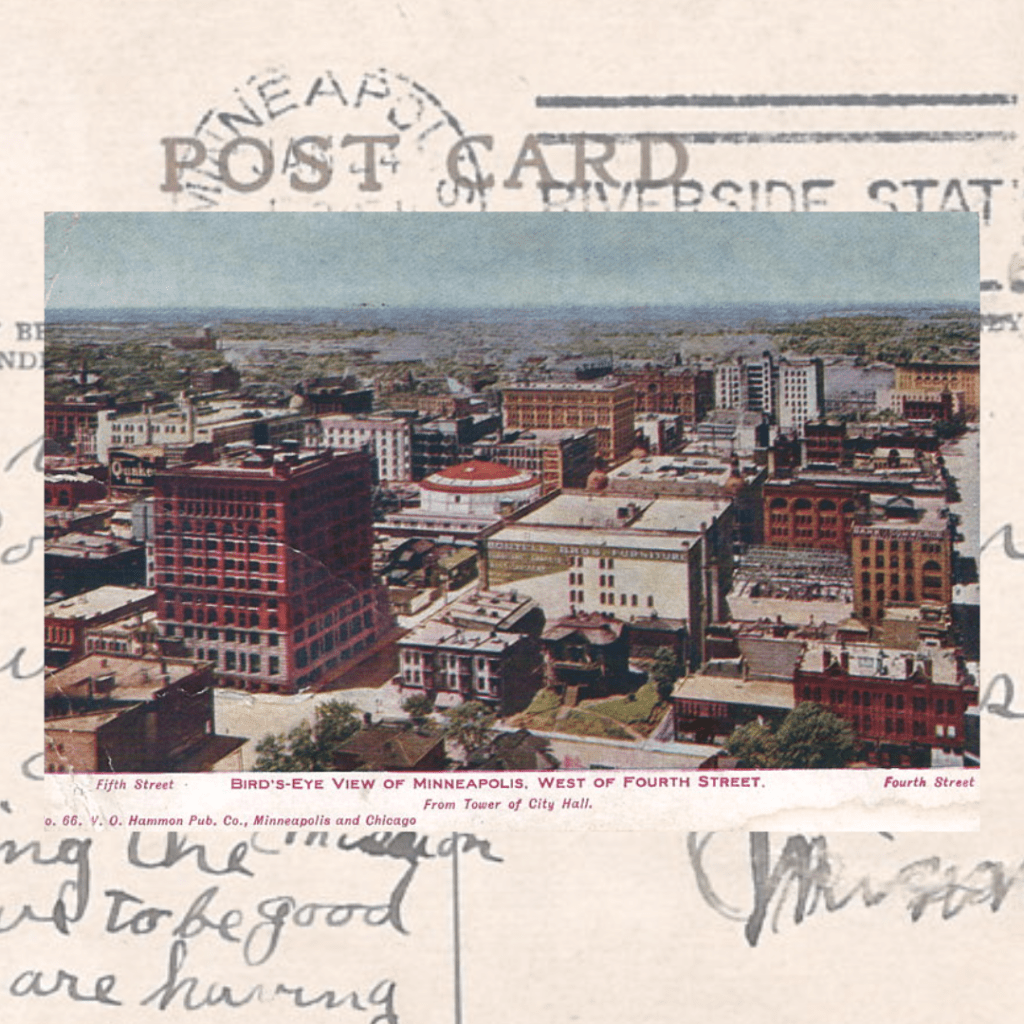
“Bird’s Eye View of Minneapolis, West of Fourth Street”

Categories
Education family History Photographs Poems Postcards Teaching Vintage Work In Progress writing

“Did You Get a Man Yet?”: A 1915 Tease and the Mystery of Single Susie

To: Miss Susie Miller. From: Bill. 1915

Well did you get a man yet, if not if I would know I would bring up a duch-man(sic). Love and kisses.

From,

Bill

In 1915, Woodrow Wilson was president, “Typhoid Mary” infected 25 people and was put in quarantine for life, Babe Ruth hit his first career home run, the film Birth of a Nation was released — a precursor to the second iteration of the Ku Klux Klan (also established in 1915), and the R.M.S Lusitania was sunk on it’s way to Britain by a German U-Boat.

And apparently, Bill was trying to hook Susie up with a “duch-man”.

I first have to say, I really love this card. Like, more than love…I adore this card. It’s playful, flippant, goading — everything I need for a little drama in my life. Written in pencil that’s faded only slightly over the 100 years it’s been in circulation, this card feels familial. Like something a brother might write to a sister. So, when I began to research the card, that’s where I started.

I’ll be honest, there were so many Susie and Susan Miller’s of various ages in 1915, that I can’t be sure I found the right one. I will say, I only found one with a brother named “William”, which can be shortened to “Bill.” Is this confirmation bias? Probably, since that’s what I was looking for. However, the card tells me that this is one of two situations:

First, a family member (brother) is teasing Susie. Second, Bill is actually sweet on Susie and is also teasing her (lol I found someone else for you lol). I lean toward the first scenario, so I’ll describe the people I found. You can make your best guess as well.

Susan G. Miller was born in Pennsylvania on May 26, 1895. She had two other siblings: Edward W Miller (1890) and William B. Miller (1892). It seems Edward died young, in 1918. Based on the date and his grave, I think he was probably killed in World War I, though whether he died from gas, bullets, or Spanish Flu is unclear.

The two remaining children, William and Susan, lived with their mother Maude until at least 1940. That’s where the records for both William and Susan end. I’m unsure when William died, but Susan lived until April of 1986, and passed away at the age of 91. I can’t find a grave for her, nor could I find additional information about her past 1940.

For some reason, it always makes me a little sad when I find a person who seems to have lived a life alone with no spouse and no children. It makes me wonder why. I understand that now, in 2024, it’s often a choice to remain unattached. For man (especially women) this is a form of freedom we’ve never been historically afforded.

But typically, a 20 year old girl in the early 1900’s would have been expected to marry. Though, Susan did live out her formative years under the shadow of World War I, the riotous 1920’s, and the crushing 1930’s. It’s possible that social change combined with the economic struggle of the Great Depression prevented her from finding “the one.”

It’s also possible that she wanted to remain with her mother and brother (perhaps one or both were ill?), or she simply wanted to make her own path. For a woman in the 20’s, 30’s, and 40’s, this would have been difficult — but not impossible. Susan lived through a vast expansion of rights for Americans. She may have seized her opportunity and marched to the beat of her own drum.

And that, my friends, is true freedom.

Until next time!

Mineral Spring Park, Reading, PA

Categories
Education family History parenting Photographs Poetry Postcards Vintage Work In Progress writing

Blue Cotton Skies and the Milky Way: A 1907 Postcard from the Mountain West

To: Miss Elizabeth Jordan. From: Joe 1907

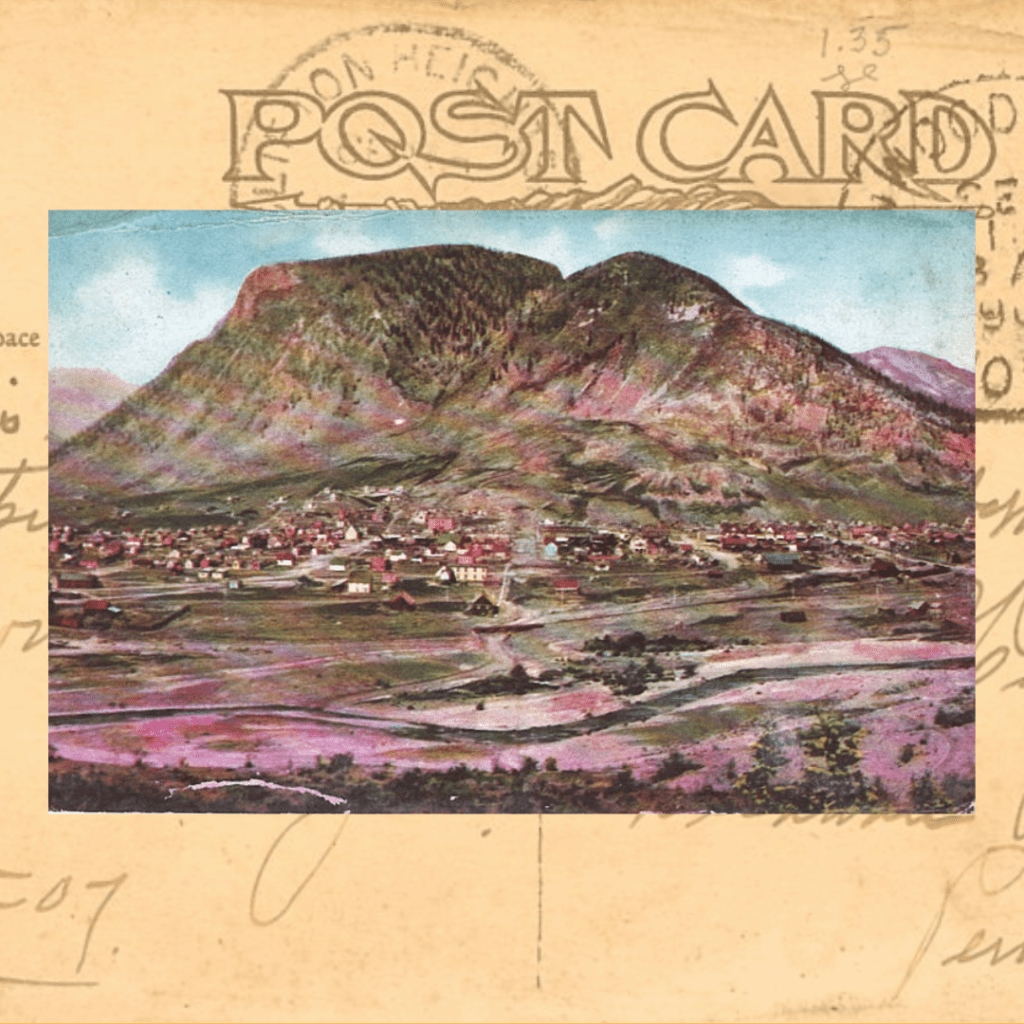
This is a typical Rocky Mountain Town.

Joe

In 1907, Teddy Roosevelt was president, Ellis Island saw the busiest year, with 1.1 million immigrants arriving, a variety of national forests was established (thanks to Roosevelt), and a major financial crisis hit the New York Stock Exchange. The crisis was only stopped with a group of financiers, including J.P. Morgan, funded a pool of $25,000,000 to bail the exchange out. This led to the Federal Reserve.

Officially, the US “closed” the frontier in 1890. However, that doesn’t mean that the wide expanse of western land and sweeping western skies filled with fluffy cumulus clouds didn’t hold an appeal. Even the postcard shows blue skies dotted with clouds and land that trundles off into the distance, unobscured and untouched. Certainly different from a place like Delaware County, Pennsylvania, that had been settled by Europeans since before the founding of our nation.

I’ve featured this postcard before, but as I’ve said in a few previous posts, I’m trying to re-visit some of my favorite cards in an effort to provide more information and perhaps uncover some of the people involved. I did talk somewhat extensively about Silverton, Colorado on my first post — but suffice it to say, it was a mining town that looks very much the same today as it did in 1907.

As for Elizabeth Jordan, I believe I found her. Elizabeth was born on January 24, 1892 to Elizabeth McFarlin and Jacob Jordan. She was the 6th of 8 children, all of whom survived and lived (mostly) long lives. In 1907, she would have been 15 years old. In 1922, she married Bonva Allen. They had one child together.

I’m fairly certain of my identification of Elizabeth, since I can place her in Delaware County, PA (she was the only one). Based on her age, I hoped it would be a straight shot from her to Joe. I thought maybe a brother, but none match the name. That led me to think that it was perhaps a cousin who wrote. But, her parents both have a lot of siblings and still, I couldn’t find a cousin named “Joe”. That doesn’t mean it wasn’t a cousin, it just means the records are a bit fuzzy.

It’s possible, as well, that this is not our Elizabeth. It’s always a little dicey with research, especially since I have access to so few records. I don’t have a subscription to the bigger sites like Ancestry, and I don’t pay for newspapers.com. Maybe one day I’ll splurge, but that day is not today. For now, then, Joe will have to remain a mystery. But I do hope that when Elizabeth received this card, her mind was filled with the thought of crisp, clean mountain air, skies that went on for days, and falling asleep under a painting of milky stars.

Front of Card: Silverton, Colorado.

Categories
Education History parenting Photographs Poems Poetry Postcards Vintage World War II

A 1914 Postcard Mystery: Love, Lost Names, and a Journey Through Time

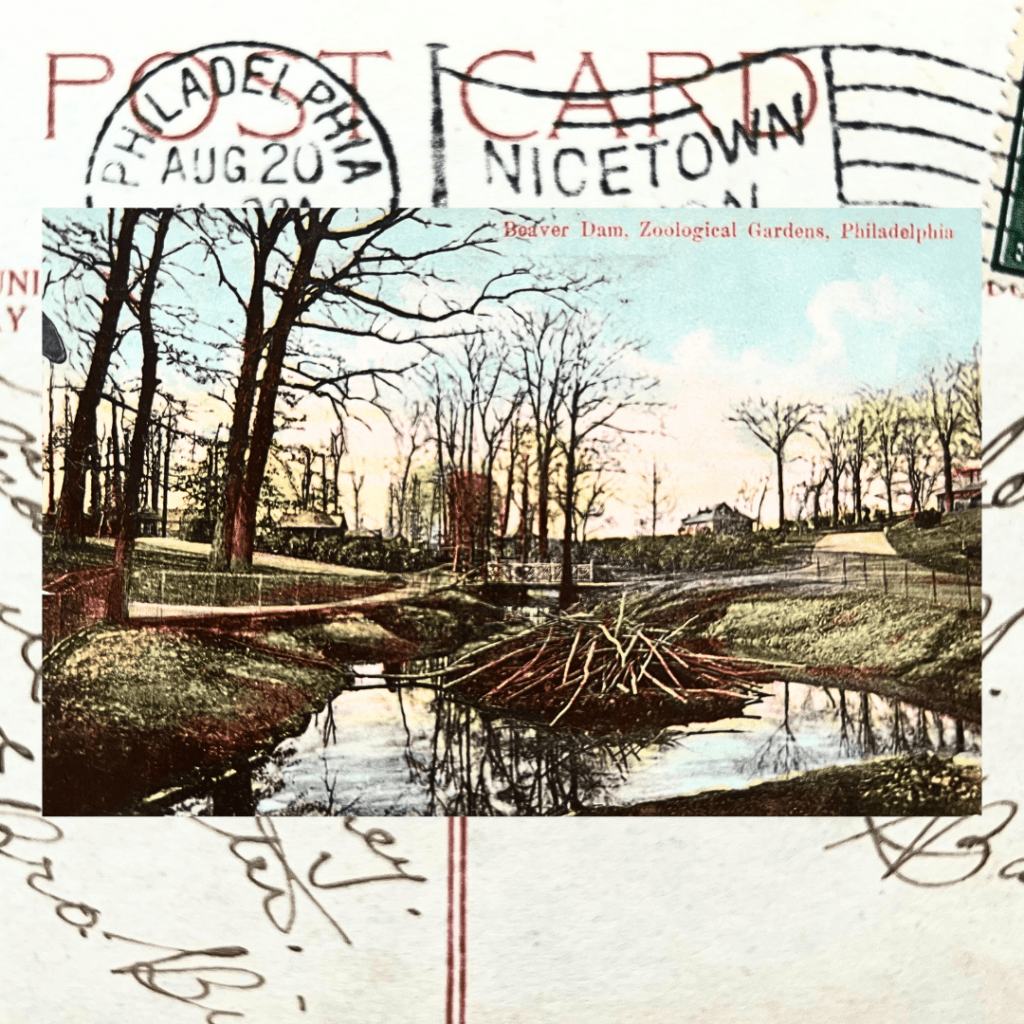
To: Miss Esther Vandevere From: Bro Bill 1914

Arrived O.K. 3 hours late. Had a pleasant journey. Will write later.

With Love,

Bro Bill

(on side): With best regards to “miss Bertha Nelson”

In 1914, Woodrow Wilson was president, 4 people were killed in the “Lexington Avenue Bombing”, which was a failed attempt to assassinate John D. Rockefeller, days later, 5,000 people attended a rally to remember the anarchists killed in the bombing. The last passenger pigeon died, and Henry Ford sold 248,000 cars. The first world war had begun, but America was still a few years away from joining.

This postcard has everything I love: a familial connection and a love story. The sender and the recipient are related, and Bill even asks his sister to give his best regards to Bertha, whom I will assume is his paramour. I know that historians are not supposed to assume…but this is a personal blog, not a peer reviewed article, and I think Bill liked Bertha.

Frustratingly, despite the swath of information on this card, I couldn’t find a single person listed. I searched for Bill and William (since “Bill” is likely a nickname). I searched for Esther with Vandevere maiden and married names, and I even searched for Bertha. I tried Vandever, Vandevere, and Vandiever. I even tried Dever, with the thought that the “van” was dropped from government records. All this do no avail.

The only sort of hit I got was a first class passenger list from the S.S. Lurline. In 1937 there was a William and a Wilabeth Vandevere that sailed from Los Angeles to Hawaii. I thought the name “Wilabeth” was strange…could it be our William and Bertha? I somehow doubt it, but it was an exciting hit, at first.

As an aside, the SS Lurline is an interesting ship. It made the runs to Hawaii and Australasia during the 1930’s, it even carried Amelia Earhart and her plan to Hawaii before her record breaking solo flight from Hawaii to Oakland. On December 7, 1941, it was enroute to Hawaii when Pearl Harbor was bombed. It arrived, after taking a zig-zagging route, days later. The ship was thereafter commissioned during WWII to carry troops and supplies from California to Hawaii or Australia.

It goes to show that archives are never easy, nor is information a given. I was lucky over the last few days, and so I suppose I needed an off day when it came to finding senders and recipients. That being said, I’d sort of like to believe that Bill returned from Philadelphia, married Bertha, and lived a long and happy life with her. Perhaps they even voyaged to Hawaii.

Until tomorrow, fam. Stay posted.

Front of Postcard: Beaver Dam, Zoological Gardens, Philadelphia

Categories
Education family History parenting Photographs Poems Postcards Vintage Writing Prompt

Secrets in a 1908 Postcard: A Mysterious Message, a Tragic Twist, and a Family’s Forgotten Past

To: Mrs. HM. Maurey From: Roy 1908

Drive safe and in good condition

Roy

In 1908, Teddy Roosevelt was president, the Converse Rubber Shoe Company is formed, and Thomas Selfridge is the first person to pass away from an airplane crash. For those who follow my blog, you’ll know that 1908 is one of my favorite years to collect from. You’ll also know I love the Progressive Era and all the changes that were taking place at the start of the 20th Century. I think it was my late 90’s obsession with the musical Ragtime.

Although this card doesn’t give us too much, a simple “drive safe and in good condition,” implicitly it says a lot about the changing laws and norms that surrounded postcards. In 1907, it became legal to place a message on the back of postcards. This is known as the “divided back” period. Prior to 1907, postcards had to be addressed on the back, and any message was squished onto the front. This often caused problems, as the front of the postcard could smear, or there was very little room to write anything.

What’s unique about this card is that it looks like it’s from the “undivided back period” (historians aren’t great at making fancy names for eras). During this period, the address would take up the entirety of the back of the card, and any message had to be squished in to what little blank space was on the front. In fact, if you look at this particular card, you can see that there’s a tiny bit of space on the left. Certainly not enough to write more than a passing phrase.

However, our friend Roy divided his own back. It was legal, after all, to write the message on the back of the card along with the address, so Roy went ahead and took advantage of that fact. Maybe he had an old postcard lying around, or a set of them. Or perhaps stores still sold the undivided back sets. Whatever the case, Roy drew a stark line down the card and wrote his message.

Except he didn’t really say much. “Drive safe and in good condition” would have easily fit on the front of the card, and there were no laws saying you couldn’t write on the front after 1907. It seems to me that the collective habit of writing out a short note on a postcard took longer to fade from the zeitgeist. Roy divided his back, but kept the message clipped. He said all he needed to say.

As for the Maurey’s…I’m not 100% sure I found them. Honestly, I’m only about 70% sure I have the right family, but I’ll explain what I found and let you make your best guess.

As you know, it’s incredibly difficult to find anyone with just initials. If you add to the fact that this card is written to a woman…now you have her obscured by both her husband’s name AND his initials. Which can be doubly frustrating. Nonetheless, I searched up the name and plugged in a few dates.

The first promising hit was a Roy Maurey. Thinking maybe this is the writer, I decided to check out Roy’s family tree. Turns out, he had a father named…drumroll please…Henry M. Maurey. That takes care of the HM. But these are all men’s names. Who is the woman behind them? Henry was married to Emma Fritz. Could she be our HM Maurey? I think it’s possible. Let me break the family down.

Henry M. Maurey was born on May 7, 1856 in Lebanon Pennsylvania. Unfortunately, the record doesn’t show when he married Emma Fritz, but the two of them had three children together. Henry died the day before his birthday, May 6 of 1932 at the age of 76. And, I can’t stress this enough, he would have been roughly 4 years old at the beginning of the American Civil War. His wife, Emma, was born in November of 1859. Unfortunately, I don’t have a death date for her, and I couldn’t find grave information for either of them.

Their son, Roy, was born on December 26 of 1888. At some point, he married Florence Edna Wilbur (can’t find out when). I have to imagine that the card, then was sent to his mother, Mrs. HM Maurey, because they were coming out to visit. Roy would have been 20 by this time and perhaps working in Maryland. Though, and this is the kicker, I can’t place him there in the records.

Here’s where the story takes a bit of a sad turn. Roy died on March 6, 1913 at the age of 25. He had one son with Florence. Roy Jr. was born 7 months later, on October 6, 1913. Which, is honestly tragic. Even worse, Florence passed away on October 13, 1916, when Roy Jr. was only 3 years old. By the census of 1920, Roy Jr. was living with our very own Henry M Maurey in Sunbury, PA. He lived a long life, passing away at the age of 80 in Illinois.

Because of this postcard, I was able to attach a variety of documents to his family tree, and I found his gravesite. Perhaps…perhaps these are not the original people involved in our postcard. But, I have to believe that the story was asking to be told and that led me to this family.

I hope you enjoyed reading this twisted tale. What do you think? Did I find the right people?

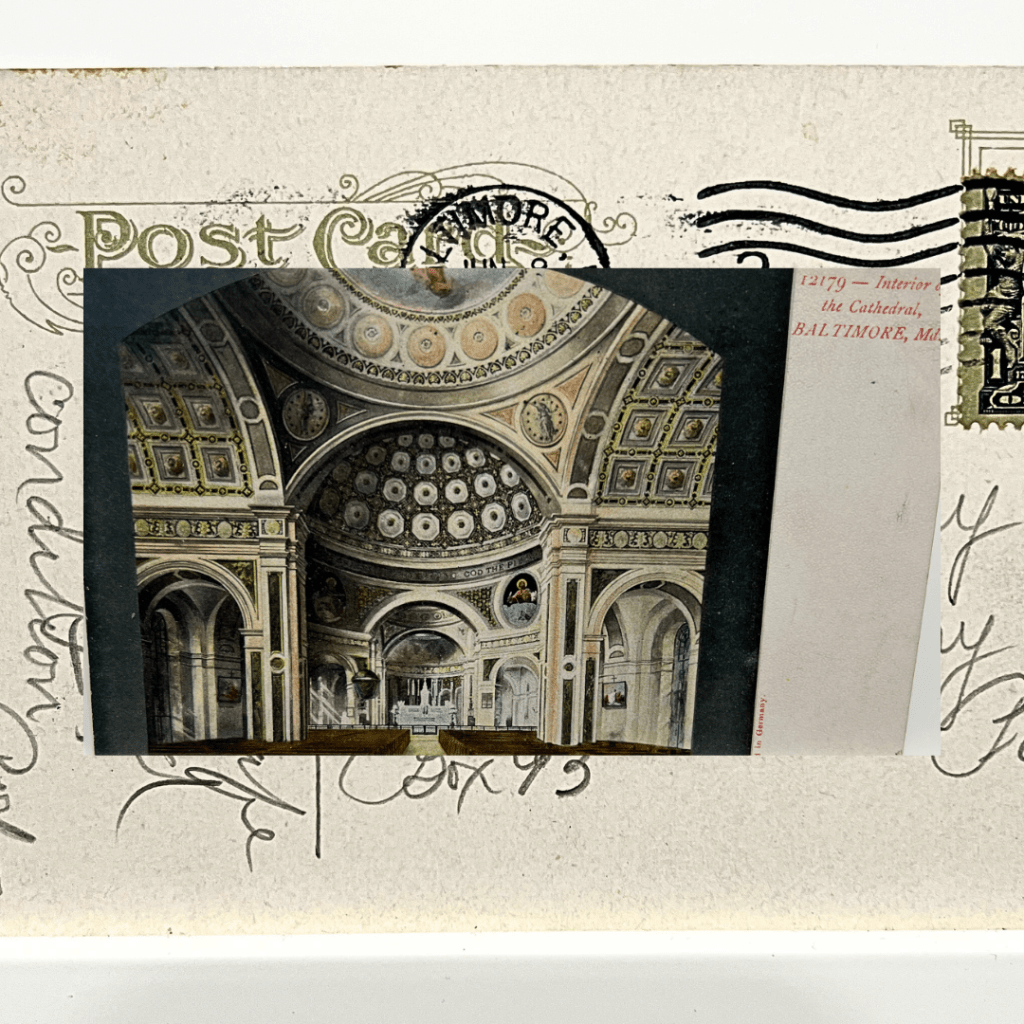
Front of Postcard, Interior of Cathedral, Baltimore, MD

Categories
Education History Photographs Postcards Vintage writing Writing Prompt

Secrets, Slices, and Scandals from Seattle Day 1909: A Postcard’s Peek into the Alaska-Yukon-Pacific Exposition

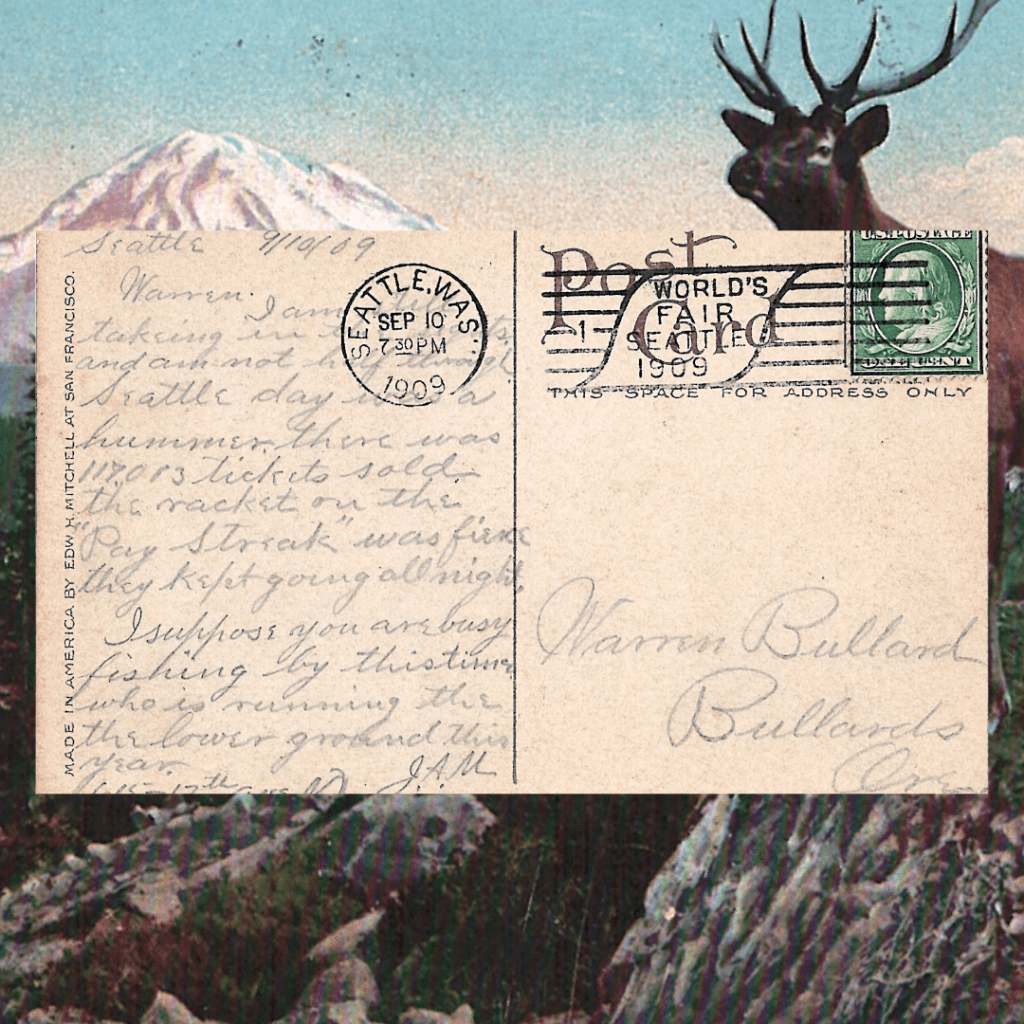
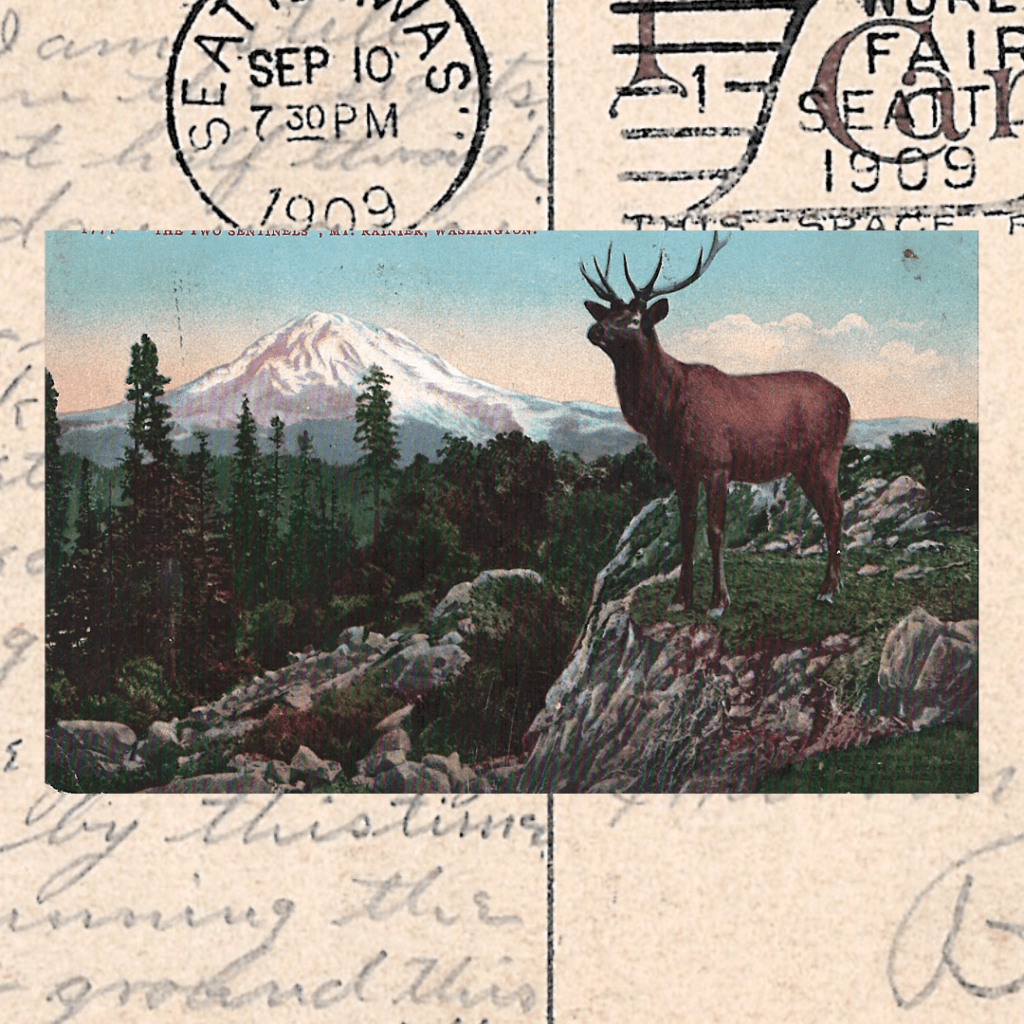
From: J.A.M To: Warren Bullard 1909

Seattle 9/10/09

Warren,

I am still taking in the sights and am not half through. Seattle day was a hummer. There was 117,013 tickets sold the racket on the “Pay Streak” was fiene(sic), they kept going all night.

I suppose you are busy fishing by this time. Who is running the the lower ground this year.

(615-12th ave N.)

J.A.M

In 1909, William Howard Taft was president, the NAACP was founded, Alice Huyler Ramsey became the first woman to drive across the United States, and the Alaska-Yukon-Pacific Exposition opened on June 1 — running until October 16.

And J.A.M was there.

This is one of my favorite postcards, partially because it provides so much information on such a small canvas. I’ve posted this card before, but I didn’t feel like I did it justice, so I wanted to re-post now that I’m a little better at this blog thing.

First, I want to talk about the Seattle World’s Fair — or the Alaska-Yukon-Pacific-Exposition. The exposition was huge, and on opening day attracted 80,000 people. However, “Seattle Day” brought in a crowd of 117,013. I’m amazed that this piece of information is immortalized in JAMs letter. I’m also thrilled about it. As a historian, it’s amazing when you can get real data from a source. And this source provides a ton of information.

The “Pay Streak” was sort of the fair’s answer to a midway. There were a variety of things that one could do on the “pay streak”. There were babies in incubators, machines that could slice a salmon in half, and even an orphaned baby that was “auctioned” off. Yes. That was a thing that happened. However, the winner never collected their prize. Apparently, historians are still trying to figure out what happened to the child. Suffice it to say, just because technology was progressing, doesn’t mean humans were.

And what of Warren Bullard and JAM? Well, I found Warren almost immediately. Warren Bullard was born January 20, 1884, which made him 25 at the time the postcard was written. A year later, in 1910, he married a woman with the best name possible, Leafy May Kendall. They had three children, and remained together until Warren’s early death in 1940. Warren registered for WWI, but I can’t find records that he fought. Leafy lived another 38 years after his death. She taught school and lived to be 90. She’s buried next to her husband.

And as for JAM? As you know, without a full name it’s almost impossible to find the person, unless they happen to be a relative of the recipient of the postcard. Unfortunately, I couldn’t find JAM. He’s not a cousin or brother that I can see — which must make him a friend or school mate. Alas, thems the breaks sometimes.

This postcard is more than just a connection, it’s a true primary source that chronicles the Seattle World’s Fair. It’s an exceptional find and I’m thrilled to at least have found Warren. I hope he took as much pleasure in reading the card as I have taken in talking about it.

Front of Postcard, Mt. Rainier, Washington