

September 6, 1946
Sorry Dear(?)
Wish you and Luce(?) were here at this hotel – room 1205 – mail us(?) that letter soon. And my hand is some better. Write me here whenever you can.
Love,
Junie(?)
September 6, 1946
Sorry Dear(?)
Wish you and Luce(?) were here at this hotel – room 1205 – mail us(?) that letter soon. And my hand is some better. Write me here whenever you can.
Love,
Junie(?)
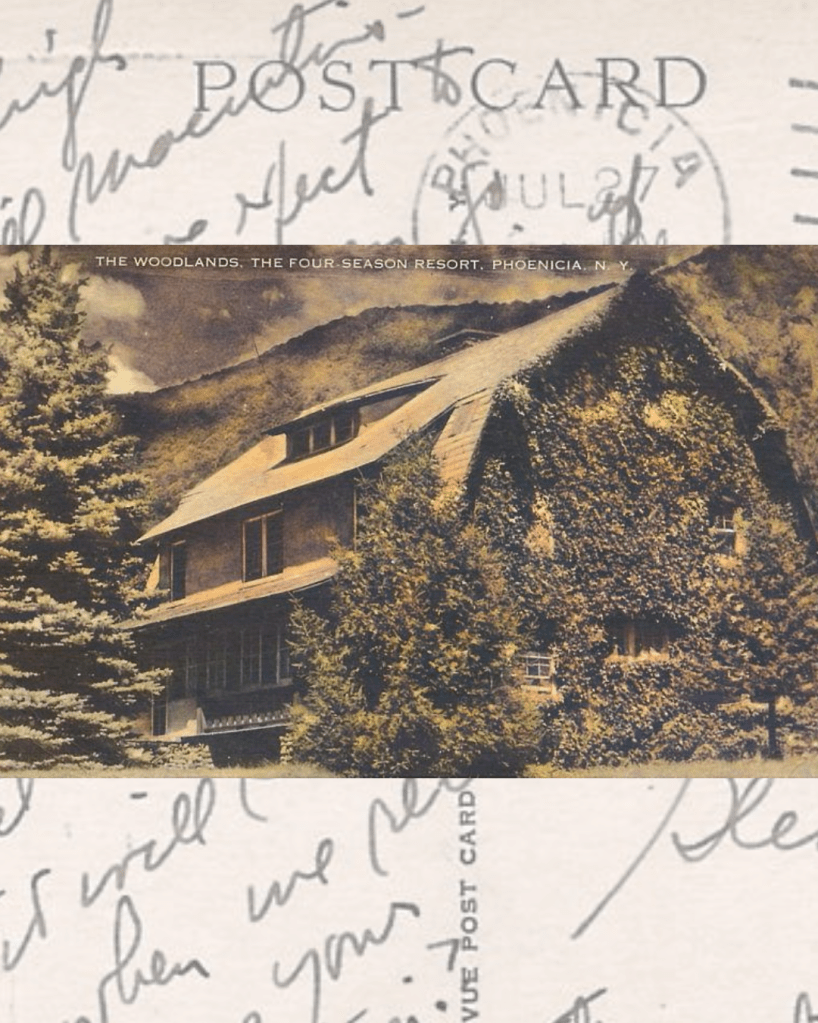
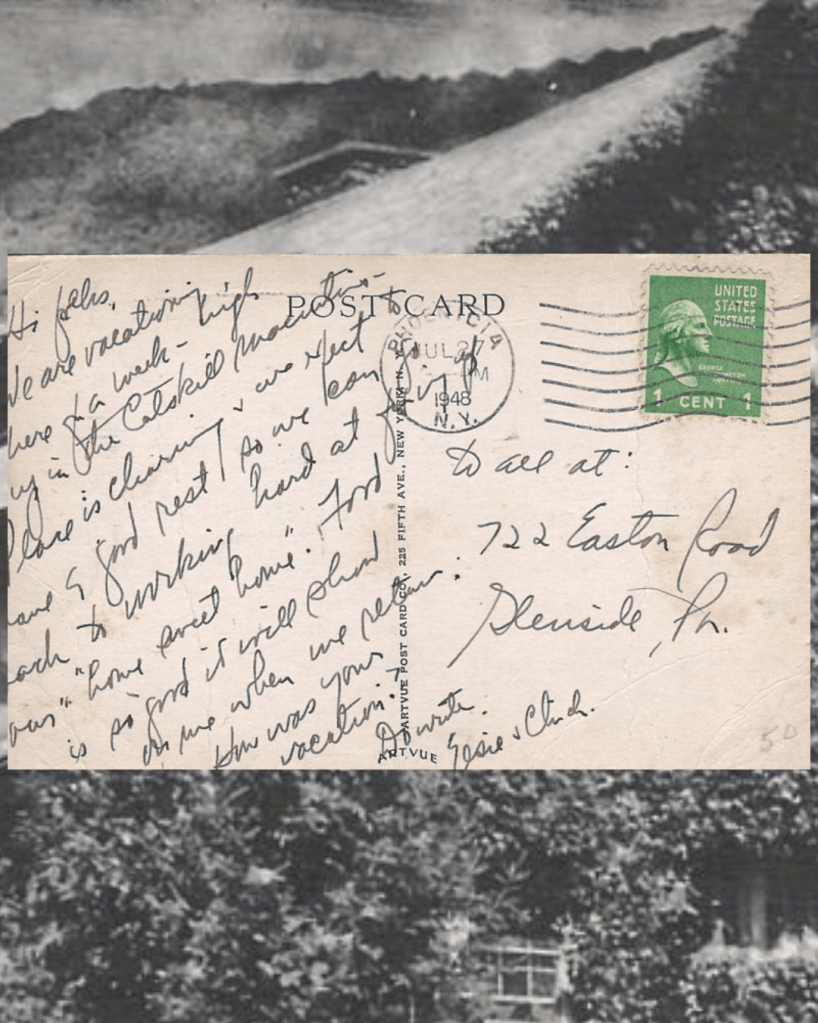
Hi Folks,
We are vacationing here for a week — high up in the Catskill Mountains. Place is charming and expect to have some good rest so we can go back to working hard at filling(?) up our “home sweet home”. Food is so good it will show on me when we return. How was your vacation?
Do Write,
Elsie and Chad(?)
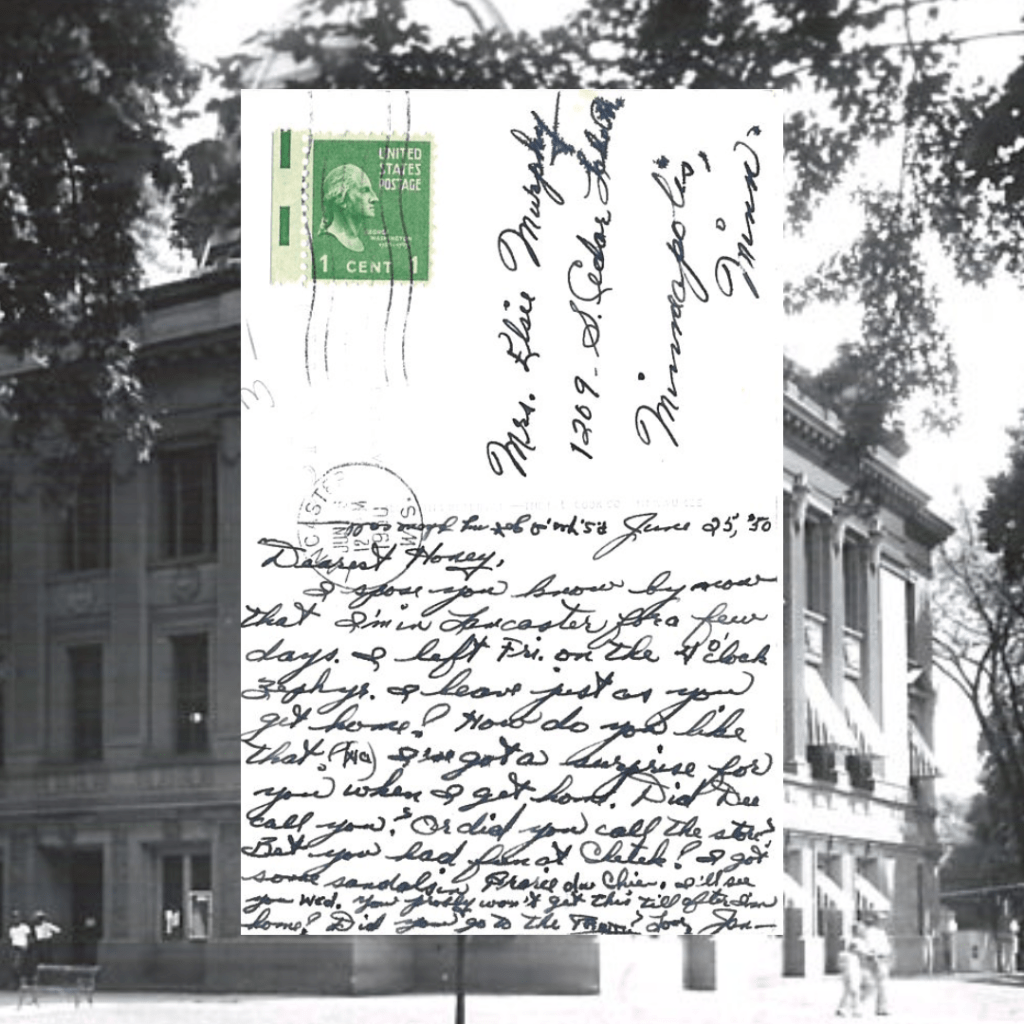
To: Mrs. Elsie Murphy. From: Jan, 1950
June 25, 1950
Dearest Honey,
I spose you know by now that I’m in Lancaster for a few days. I left Fri. on the 4 o’clock Zephyr. I leave just as you get home! How do you like that (ha). I’ve got a surprise for you when I get home. Did Dee call you? Or did you call the store? Bet you had fun at Cletek!(?) I got some sandals in Prairie du Chien. I’ll see you Wed. You probably won’t get this till after I’m home! did you go to the prom?
Love,
Jan
P.S. I got my phone call.
In 1950, World War II still loomed large in the proverbial rear view mirror of the United States. Harry Truman was President, the Korean War was just beginning, Joseph McCarthy — a Senator from Wisconsin — believed that Communists were everywhere, and Albert Einstein warned that nuclear war would lead to mutual destruction. It was somehow both a time of great change and stagnation. Technology was advancing at a frenzied pace, but Americans were frightened of the monsters they so eagerly created and sought ultimate control.
When I read this postcard I was positive it was a letter from a husband to a wife. From the salutation (Dearest Honey) to the squished signature — which I thought was “Jon”. At first glance, it was innocuous. A man sharing somewhat mundane stories and promising a surprise.
But under close examination the signature I thought read “Jon” was in fact “Jan.” Things clicked for me after that. The tone of the card is what I would call “gushing“. There’s a tumbling array of thoughts spilled out over the white space of the card as though Jan had so many things to tell Elsie that she needed to make sure to spill a little tidbit of everything while frustratingly sparing all the details.
Once I ascertained that the card was from Jan, I started looking for Elsie. I found quite a few Elsie Murphy’s floating around. There was even a promising obituary of an Elsie Murphy with a daughter named Dee, but she lived her whole life in Maine — so couldn’t be our Elsie. Finally, I decided to try Elsie’s name and address, and immediately got a hit on a newspaper article from the Library of Congress. It states:
Shown receiving the Bronze Star Medal awarded to her husband, Cpl Robert V. Murphy, is Mrs. Elsie E.Murphy, 1209 South Cedar Lake Road.
This is, unquestionably, our Elsie. This record is amazing for a variety of reasons, not least of which is that it includes an image of Elsie as she probably looked around the time she received the postcard. A little bit more digging uncovered the 1950 census reports from Minneapolis. It seems after her husband passed away, or perhaps even while he had been in war, Elsie lived with her parents in the Cedar Lake Road house. In 1950, she was listed as 31, widowed, and working full time as a typist at a publishing company.
Now that I had Elsie and her husband’s name, I started searching for him. It seems Robert V. Murphy was killed in action in Germany during WWII. He was born in North Dakota and only went to Minneapolis in May of 1942. Did he meet Elsie there? How long did they have together before he deployed? Like so many other young couples, did they have a heated romance and marry quickly because of the threat of war?
And who was Jan? A friend Elsie met at her job as a typist? A school friend? A cousin? What was the surprise Jan had for Elsie? What was Jan’s phone call? Had she gotten a job, a date, a scholarship? We won’t ever know, because without a last name I couldn’t find Jan.
The story is fascinating, and even though I found Elsie, I simply couldn’t find much more about her, including her grave or obituary. This tells me she likely remarried and was not buried under the Murphy name. I have to wonder how she managed to press on in her grief. Especially because Robert’s body was never recovered. She’d become a blushing bride only to become a grief stricken widow. I know I’ll be thinking about Elsie, her life after the war, and Jan’s sandals for a long time to come.

“Grant County Court House” Lancaster, Wisconsin

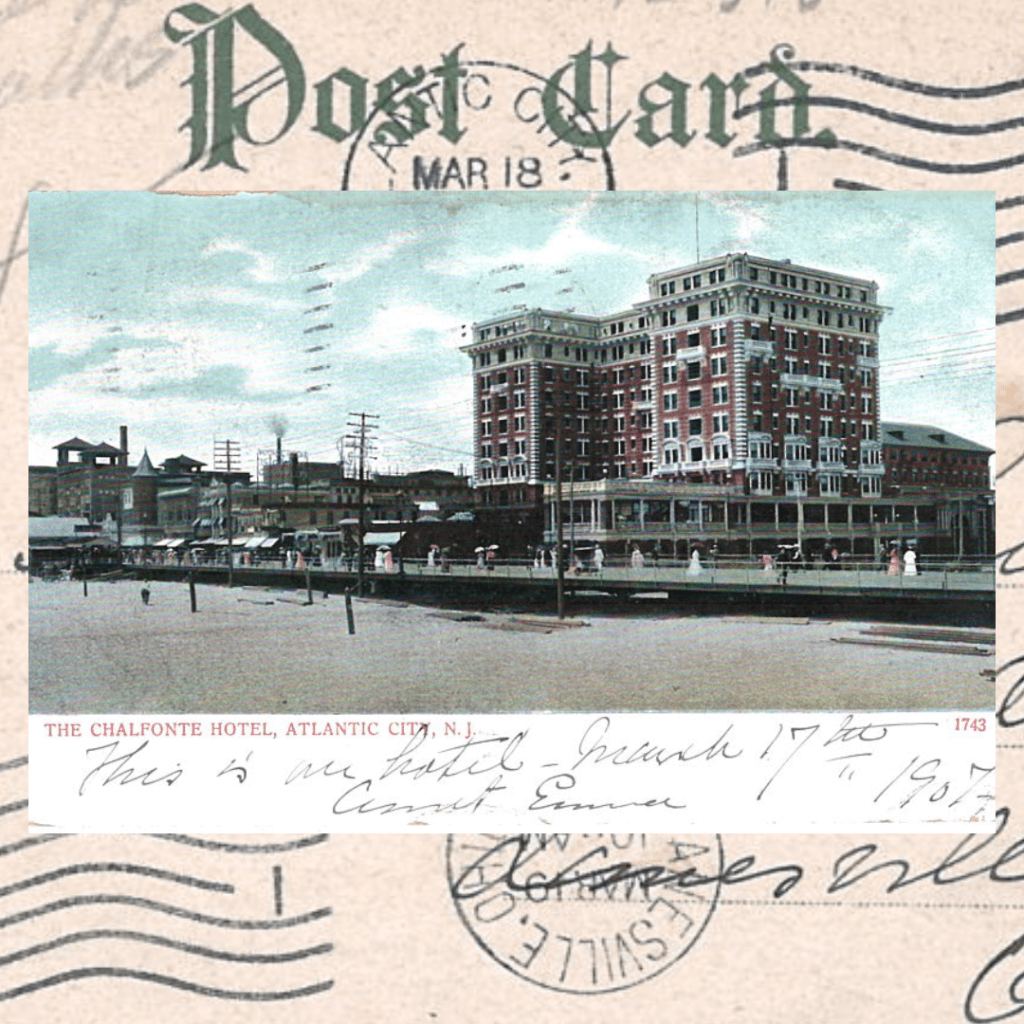
To: Mr. (or Mrs.) Millman Linn Jr. From: Aunt Emma, 1907
This is our hotel. March 17th.
Aunt Emma
The Chalfonte Hotel in Atlantic City, New Jersey was built in 1868 near the corner of Pacific and North Carolina Avenues. However, in 1900 it came under new ownership and was expanded. It was the first iron framed hotel in Atlantic City, but maintained the original structure by simply moving it to the west and re-cladding it with brick. It’s this hotel that we see on the front of this postcard.
Interestingly, the hotel was moved closer to the beach twice, because the incoming tides continued to bring sand onto the shore. Part of the appeal of the Chalfonte was both it’s access to the railway and access to the beach. By the time a more sturdy boardwalk was built, the Chalfonte was well positioned to reap the benefits.
Miraculously, I was able to find both Emma and Milman Linn Jr. This was one of those serendipitous Hail Mary sort of finds, as I finally threw “mellman linn jr” into google and an obituary of Milman Linn III popped up. Once I found him, I was able to trace the family line (all of whom lived in Zanesville, Ohio) until I found Emma.
I believe Aunt Emma is the maternal aunt of Milman’s wife, Jennie (Jane) Milman, (nee Smith). Which leads me to believe that this card is actually addressed “Mrs. Milman Linn Jr.” Not “Mr.” Let’s start with Emma and I’ll work my way to the Milmans.
Emma Allen Dodd was born January 11, 1842 in Zanesville, Ohio. In 1884, at the age of 42, she married Robert Hoe Dodd and had two children, though only one survived infancy. She lived to be 85 years old, and died in 1927. She’s buried in New Jersey.
Her niece, Jane (Jennie) Smith, was born June 12, 1870. She married Milman Linn Jr in June of 1900. Something that’s wonderful about Family Search is that on occasion, the family has done their own research, or left their own memories for the deceased. This particular recollection was left and I couldn’t help but quote it here:
Jane Davey Smith Linn was ironing on the main floor, or the maid was, when a rat was heard gnawing at something in the cellar. She gathered an arsenal of croquet balls and surprised the rat by entering from the outside steps. How a woman unaccustomed to athletics managed to throw a wooden ball hard enough or straight enough to knock out a rat, is difficult to imagine. But she did just that, either stunning the rat or badly maiming it, and immediately finished it at closer range with a broom handle. Her son Vincent expressed grave concern over the contaminated croquet balls, but Jane assured him she would wash them in scalding water.
It’s stories like these that breathe life into the subjects of our postcards, and I can imagine the fire Jennie smiling broadly when she received this postcard from her Aunt. Unfortunately, Jennie died young. She passed away in 1911 at the age of 41.
Milman Linn Jr comes from a line of Milman’s. He was born on May 15, 1860 and lived to be 80, dying in 1940. He did not remarry after Jennie, rather two of his sisters came to live with him. Presumably in a symbiotic relationship where they helped him with the house, and he provided for them. Milman was a somewhat prominent pottery manufacturer (according to his obituary) and thus his death warranted a short newspaper article remembrance.
Despite Jennie’s early death, it’s lovely to see a tight knit family who seemed to love each other very much. Also, it’s wild that Emma, Jennie, and Milman were alive either during, or directly after, America’s Civil War. I love being able to uncover the lives of the subjects in my postcards, and I’m so glad to have this Friday find.
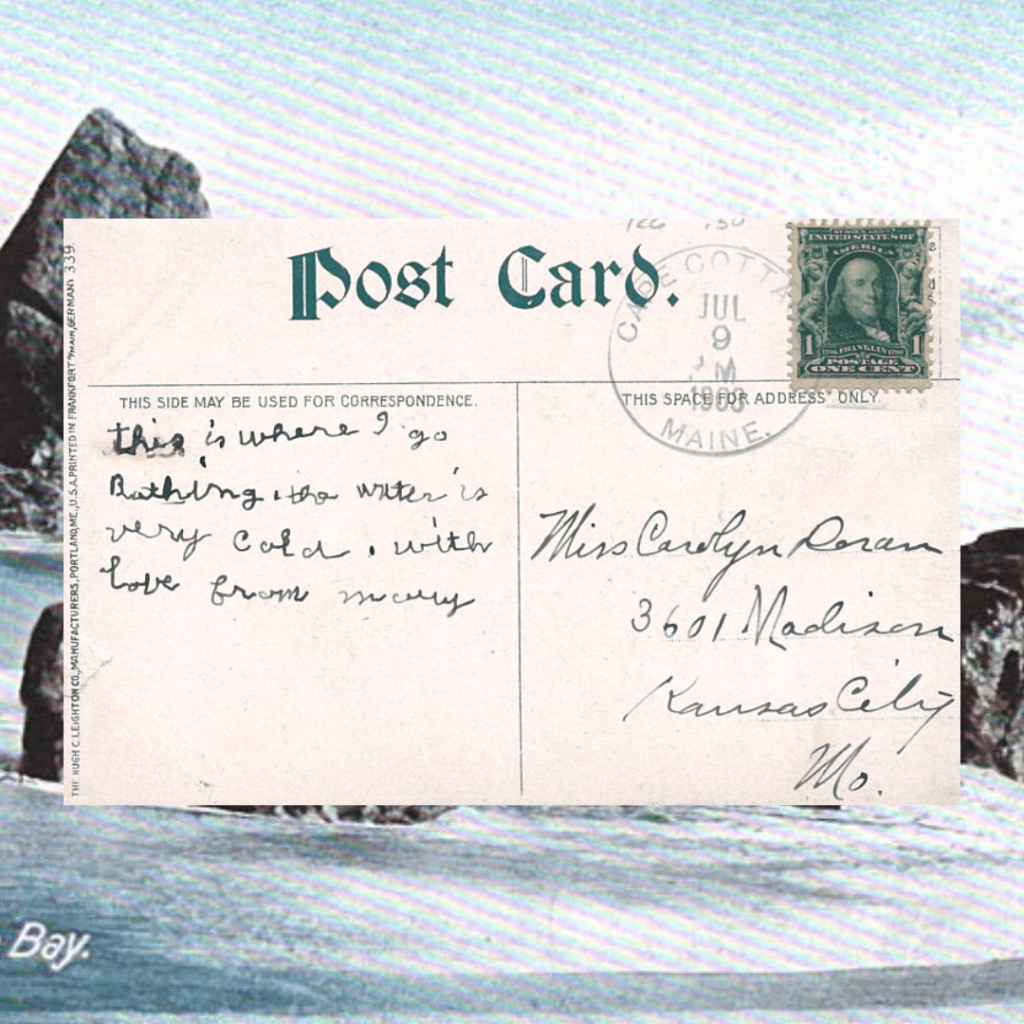
To: Miss Carolyn Doran. From: Mary 1908
This is where I go bathing. The water is very cold. With love.
From,
Mary
In 1908, Teddy Roosevelt was president, Harvard business school was established, and a deadly tornado struck parts of Louisiana and Mississippi and left 140 people dead and over 700 injured. We were well into the Progressive Era, and the temperance movement was building. They’d hit their crescendo with Prohibition, but that would be a few years to go yet.
There’s something so sweet and innocent about this postcard. From it’s shaky, childish script, to the fact that Mary talks about how cold the water is when she bathes. It recalls us all to childhood, when our worries were small and our families were close.
Carolyn, and thus Mary, were difficult for me to find. I’m not even positive I did find Carolyn. However, I have something of a lead so that’s what I’ll discuss. The Carolyn Doran I found was born in 1898 in Kansas City, Missouri to Samuel Neal Doran and Mary Nagel Doran. Interestingly, Mary had a sister who also named her daughter Caroline, but with the I not the Y.
I couldn’t find much about Carolyn, other than that it doesn’t seem that she got married or really even moved out of her family house. In the census of 1940, she was 42 and still living with her parents. She had one brother, who I think served in World War I and had a son named Neal Samuel Doran. The names really aren’t that interesting, but I got a kick out of the naming practices in this family. I also had to wonder if Mary and her sister fought over the name Carolyn.
As for Mary…I had hoped to find a family relation. However, if Carolyn is indeed our gal, she would have been ten when this card was written. It was sent in July, which means Mary easily could have been a friend enjoying a summer in Maine.
What’s true is that the card is sweet, loving, and beautiful. It’s a balm for a weary soul, and I think we all need a little bit of that in our lives. I hope Mary and Carolyn remained friends, wherever they ended up in their lives.
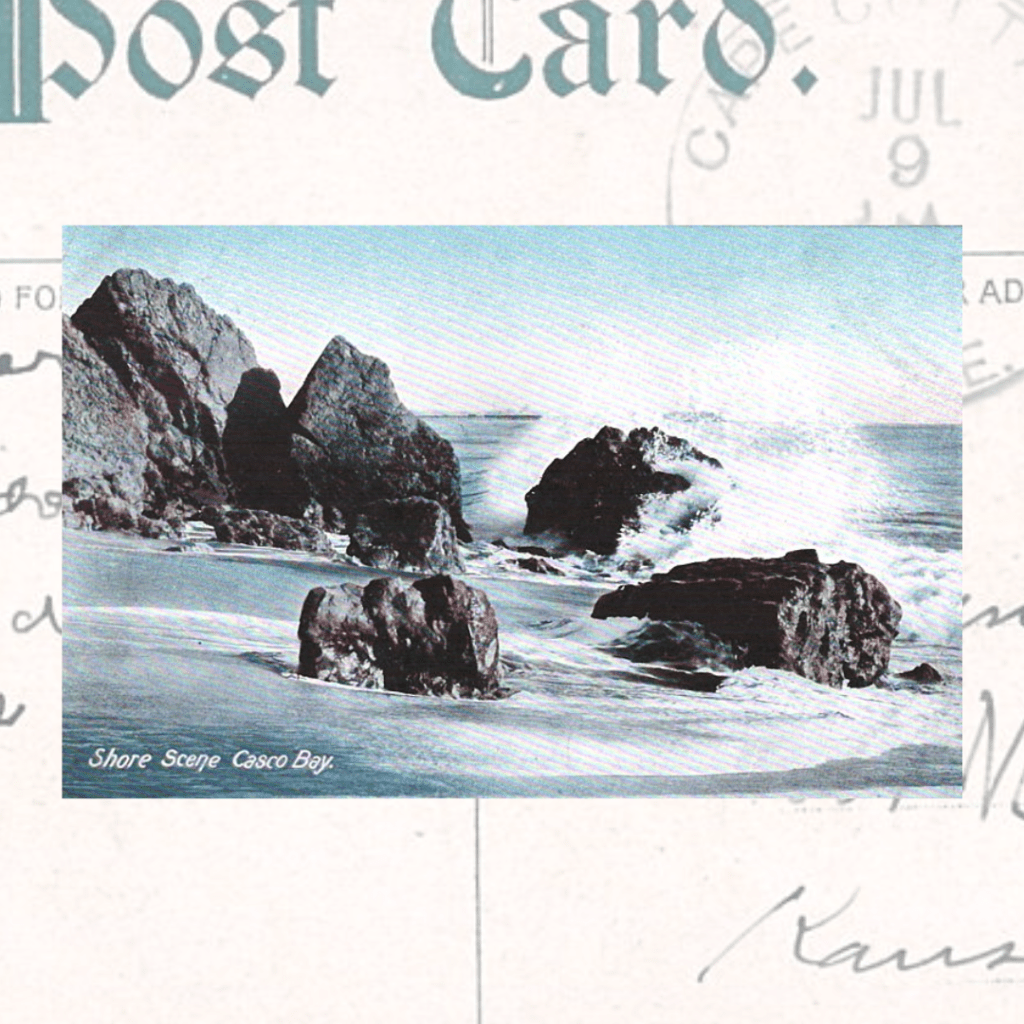
“Shore Scene, Casco Bay”

To: Mr. Victor A Binford. From: Wren(?). 1910-1918
Dear Doc-
Card just rec’d. My school is going on fine. Hope you are enjoying life. Should be glad to hear from you again.
Best Wishes,
Wren(?)
Although this card was mailed in October, the year is unreadable. Either the ink has faded away or the card was never stamped well enough to begin with. Since it’s a divided back card, it’s 1907 or later, and based on the handwriting I’d say closer to the 1907 mark than the 1918 mark, but I can’t be sure. Suffice it to say, this card was mailed at the turn of the twentieth century. A time where World War I would see soldiers ride in on horses, and fly out on airplanes.
Bliss Business College was founded in 1897 by a set of brothers. It catered to a co-educational group of students and classes included shorthand, spelling, and penmanship. It closed in 1972, but not without a fight from those who had graced it’s halls. At heart, the college was a two year institution, but Wren (or perhaps Oren) must have met “Doc” Victor Binford there and retained a friendship. At least until Victor married.
Victor Abbot Binford was born in Mexico, Maine (yes, this is a place in Maine) on July 3, 1887 to Horace Jose Binford and Bertha Hortense Abbot. What immediately struck me about Victor is that his mother’s maiden name was his given middle name. A nice nod to his maternal side. In 1912, he married Marcia Reed, and together they had one daughter named Sarah.
Interestingly, the Maine Historical Society carries an archive of the Binford, Reed and Hatch family. The collection was gifted to the society after the death of Ann Hatch, Victor’s grand-daughter. Because of the archive, I know a number of things about Victor that I wouldn’t have known. For instance, his father was a medical doctor. Additionally, his mother died young, and Victor was adopted by his father’s new wife, Lula, who happened to be Bertha’s sister. Also, Sarah Hatch (nee Binford) raised arabian horses. Which…feels luxurious to me.
Victor died on January 16, 1960 at the age of 72. Although the postcard calls him “Doc” what’s likely is that Victor attended Bliss Business College, not that he taught there. In 1910 he was 22, single, and living at home. In 1920, he was a dowel turner at Birch Mill. By 1930, Victor was a private chauffeur…possibly for the Reed family. You see, Victor, Marcia, and Sarah all lived with Marcia’s family. According to the Maine Historical society, Marcia graduated from Smith College, and helped run The Roxbury Telephone company.
In 1940, Victor was the book keeper for “Wood Turning”, which I think is the Birch Mill because by 1950, he was the head of the household (no longer the son-in-law) and was the book-keeper for the Birch Mill. Marcia, on the other hand, was the tax collector for Roxbury County. It’s interesting, because I’m unsure if these are all family businesses, or if Victor truly bounced around. However, I’m somewhat certain that the sender of this postcard addressed him as “Doc” because his father was a doctor and Victor somehow got that moniker.
I’m sad I couldn’t find Wren. However, what’s certain is that I had a lot of fun following the threads of Victor and Marcia’s lives. I’ve said it before, but the cold black and white of papered archives gives very little actual detail of a life. However, it’s what we read between the lines that brings color into a life (hopefully) well lived.
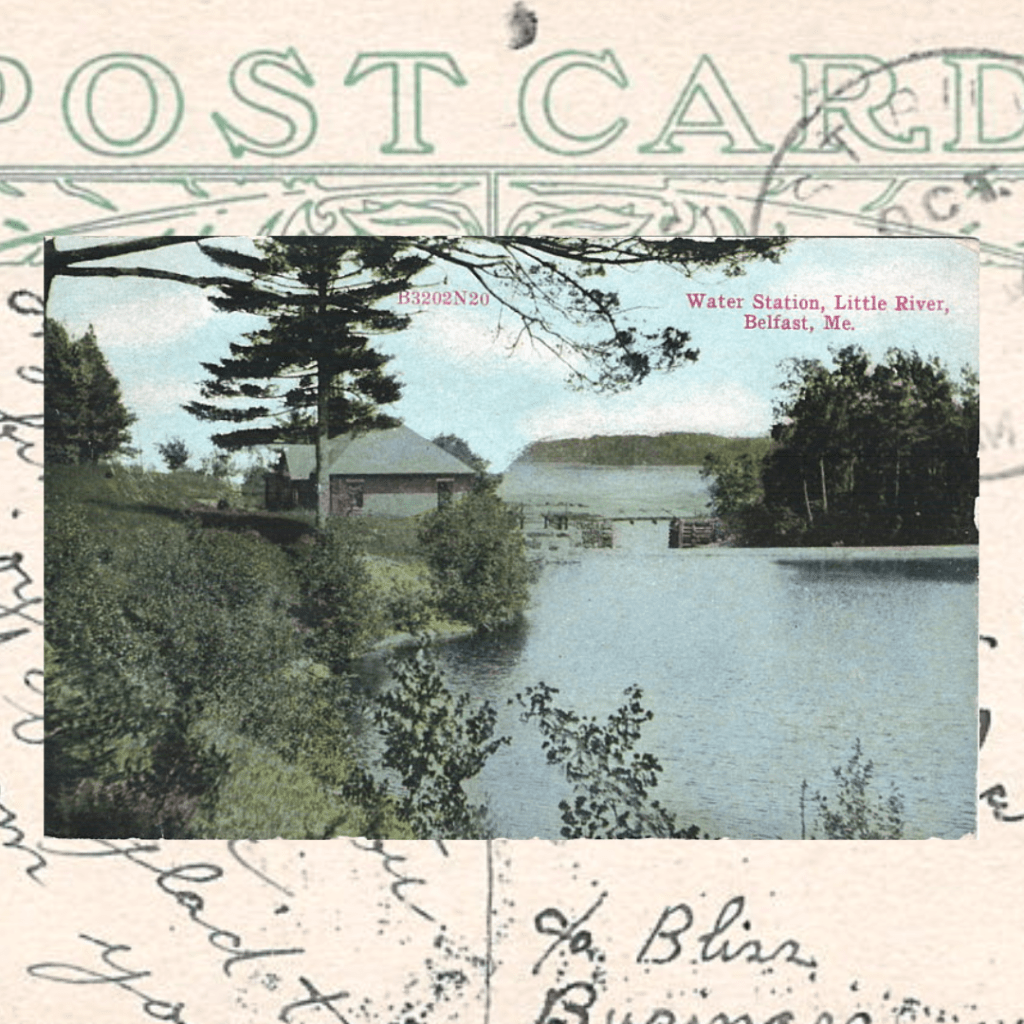

To: Anna Mathes. From Eddie R. 1910
Hello Annie.
How are they coming. Fine I suppose. We are all very good down here. We are making the mission now and have to be good. I suppose you are having a fine time up there.
Eddie R.
In 1910, William Howard Taft was president, Joyce Hall founded Hallmark Cards, the first unofficial Father’s Day was observed, and although aviation is getting off the ground (see what I did there?), the first American pilot dies in a crash in front of 5,000 spectators. America had lived in the 20th century for a decade, and it was already looking to be a doozy.
The more I read this card, the more questions I seem to have. Eddie and Annie seem to be young…perhaps what we would deem upper elementary or middle school age (between 10-14). But, based on the context of the card, I can’t tell if the two are related, friends, or if this was some sort of project or pen-pal scheme.
Both Annie and Eddie were a little difficult to track down in the records. Anna because I’m not sure if her name is spelled incorrectly on the card. It could be Mathes, but it could also actually be Mathis. Especially if Eddie wasn’t sure. But, I only found one Anna Mathis born in Chaska — so I’m thinking I found a match.
Anna Mathis was born in June of 1893 to a German father and Dutch mother. She was the oldest of two children and lived in Chaska (a suburb of Minnesota) for at least 20 years. This puts her at about 17 when she received this card. Older than I would have guessed, but still a teen.
However, 1910 is when the record runs out, though her father died in 1917 and her mother remarried in 1919. I went through Anna’s cousins on her mother’s side, and didn’t see an Ed, Edward, or Eddie. There’s no family information listed on her father’s side, which means if Eddie was a cousin from her dad’s family…I wouldn’t know. However, Anna’s dad immigrated from Germany in his 30’s, so unless he came over with a brother or sister, it’s unlikely Eddie is from that side of the family.
Our trail runs out there, I’m afraid. My guess is that Eddie is still younger than Anna, and was probably prompted by a parent to write. It’s possible he was older and that there was a small courtship going on, but this feels more familial than anything. What do you think?
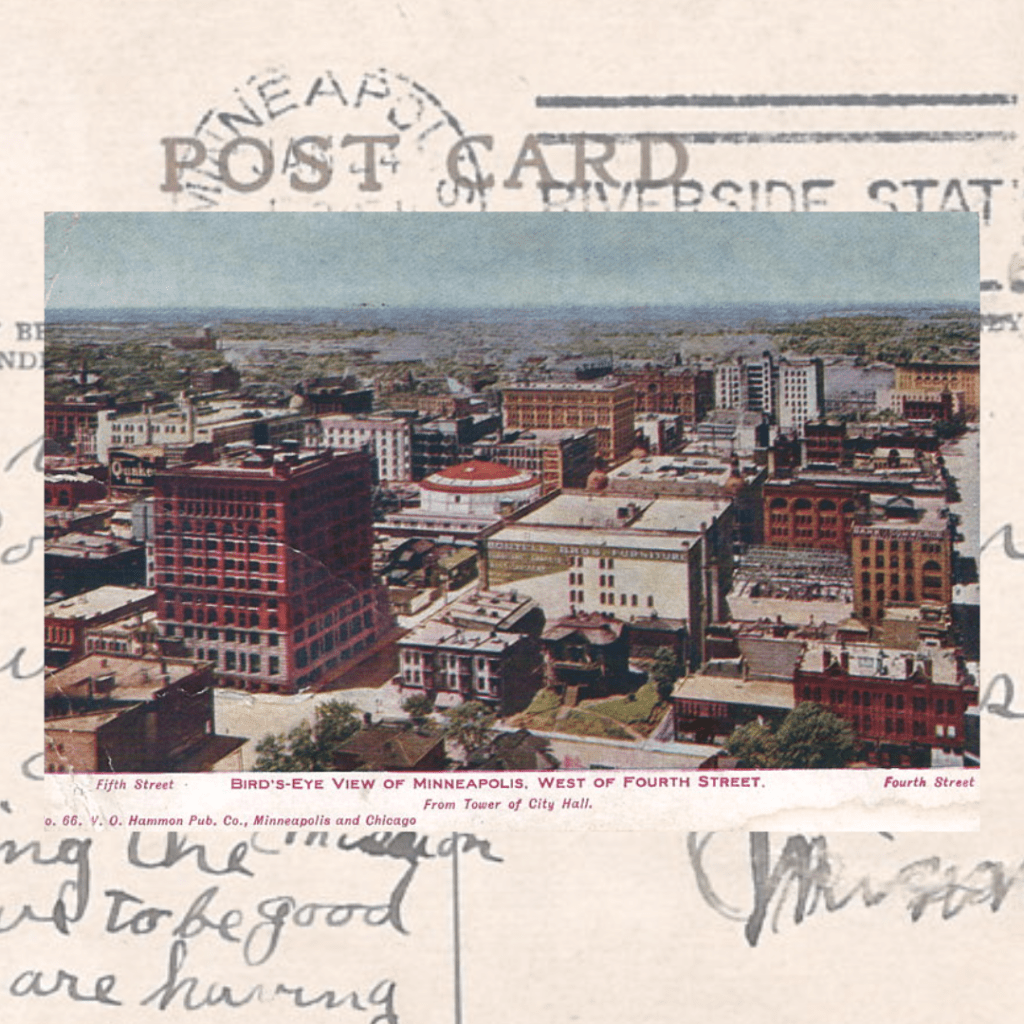
“Bird’s Eye View of Minneapolis, West of Fourth Street”

To: Mr. and Mrs. Melvin Else From: Alas(?) 1946
Hi!!
Came up here Sun. for our second week. Herb stepped on the scales last nite — but not me! I can walk right past them. Temp. was 101 yesterday 0n the mainland but in our “no.12” it wasn’t so bad. Is Waterloo still only nine miles from Lake?
Alas(?)
In 1946, Harry S. Truman was president, the Philippines is granted independence by the United States (lest we forget that we for sure held territories and still do), the first underwater test on a nuclear bomb is conducted at Bikini Atoll, Dr. Spock released The Common Sense Book of Baby and Childcare, and It’s a Wonderful Life is released in theaters. Civil and social strife are still rampant, with a variety of lynchings that take place in the south, but the government is (slowly) moving toward civil rights laws.
In 1946, World War II was over, and the age of the United States had begun. The US had escaped from the war almost unscathed, and although this was a time of prosperity (for some), values began to move further and further right as the US struggled against Russia. Although it would be another 8 years before “under God” was added to the Pledge of Allegiance (1954), the US still felt the need to “prove” our superiority. This began the age of the baby boom.
When researching this postcard, the first thing that struck me was Alas’ mention of “Herb stepped on the scales.” I don’t know enough about vacationing in the 40’s to know if that was something that people regularly did (weigh themselves on vacation…) or if the “stepped on the scales” phrase means something different than what my modern mind understands. But, I did find a pamphlet for the lodge for sale on Ebay, and it looks nice! Horseback riding, tennis, shuffleboard, golf nearby, a pool and a lake. There’s also winter sports apparently. So, it seems that perhaps if you’re being active you might want to see if you’ve lost weight. But not Alas. I love a queen who knows how to protect her peace.
As for Mr. and Mrs. Melvin Else, I believe I found them. Though, I do think this postcard was written from a woman to a woman, so let’s begin by uncovering Mrs. Melvin Else. Mable Setz was born in 1907 in Waterloo, Wisconsin and lived nearly a full century, passing away on March 29, 2004. She and Melvin married August 28, 1936 when they were both 29 years old. Melvin died relatively early, in 1984 at the age of 76. Mable, however, kept on, living her whole life in Waterloo. No children are listed on the family search, so I’m unclear if they did have children, or if the children just aren’t listed.
What was their tie to Alas and Herb? I had hoped that either Melvin or Mable had a brother or sister that would help me find the other couple, but neither had siblings that even remotely matched with the names. I’m thinking perhaps cousins, or even old friends from Melvin’s military days (he served in WWII)? It would explain the question of “Is Waterloo still only 9 miles away from Lakes” Which…is a strange question since I can’t imagine a lake or a city are going to move.
Either way, the connection was strong enough that Mable and/or Melvin kept the postcard. Now, I have the pleasure of recounting Alas and Herb’s adventure to you, my dear readers. May we all have the strength of Alas to “walk by” those proverbial scales.

Deer Trail Lodge, Lake Nokomis, Heafford JCT., Wisconsin

To Mrs. W. Beals, From: Etta J P (unclear). 1907-1915
I suppose you are home and “hard at it” as I have been. I am on the verge of getting some new bedroom furniture so I am all excitement. I will write you a letter some time soon. Hope you and Dorothy. We were greatly recovered(?) all wish to be (unclear)
Etta J. P(unclear)
On flipped side: write me a letter and tell me bout your stay at the beach
Although I can’t be certain when this particular postcard was written, there are some clues. It’s a divided back, which means it has to be 1907 or after. The handwriting exhibits the cursive style script that was typical of the early 1900’s, and many of the Acegraph company postcards were printed and sent between 1910-1912. So, I think it’s safe to say that this postcard is somewhere in-between 1907-1915. Which, if you’ve followed along with me for a while, you’ll know is my personal favorite time-period for a postcard. I do love those wily progressives.
I’ve been re-visiting some of the postcards I posted back when I started this blog, and this is one of them. It’s actually one of my favorite messages I’ve seen on a postcard because Etta is simply dripping with excitement about her bedroom furniture. It makes me wonder if she was a new wife, or perhaps she and her husband recently moved, or maybe they had been saving for some time. Especially since she says she’s on the “verge” of getting new furniture and she is “all excitement.” I love the imagery of it.
As for Mrs. W. Beals, I’m 87% sure I found her. And, when I say she fell in my lap by chance, I mean it. I’ve talked before about how difficult it is to find women when they are obscured by their husbands name. It’s even more difficult when the sender of a postcard abbreviates the name (like “w” for example). As a historian, it presents a fun, challenging mystery. But it’s also super frustrating sometimes! Nonetheless, I figured that Bluefield was small enough that I might get a hit. I found some “Beals” and started following the family trees.
Wouldn’t you know it, a few clicks later and I had found William Jacob Beals, and his wife Ethel Julia Cross. They were married in 1908 (which fits the timeline) and had a daughter…wait for it…named Dorothy born in 1909! In the census of 1910 and 1920, they also lived in Bluefield West Virginia.
Ethel Julia Cross was born on April 2, 1888 in Minnesota. At the age of 20, she married William Jacob Beals in Pennsylvania. From there, they moved to Bluefield, West Virginia. The couple had two children, Dorothy and William. I’m not sure why they lived in Bluefield, but the city boomed because of it’s coal mines. At one point in the late 19th century, it was also considered the “city of millionaires” because there was so much wealth fixated in such a small spot.
At some point, she and her husband made it out to sunny California, because her grave is located in Los Angeles. Ethel died on September 7 of 1973, about 20 years after her husband.
I had hoped that I’d be able to find Etta, because I feel confident she’s related to Ethel in some way. However, no luck. Ethel’s grandparents aren’t listed in her tree, so any search for cousins or family connections runs dry. Nonetheless, the archival Gods aren’t usually this kind, and I must remember to present them with an offering later tonight.
I do hope Ethel lived a wonderful life, and I hope she enjoyed her time in the sun in California. I also hope that Etta’s furniture was exactly as she hoped it would be!

Front of Postcard: Randolph Macon Women’s College, Lynchburg, VA
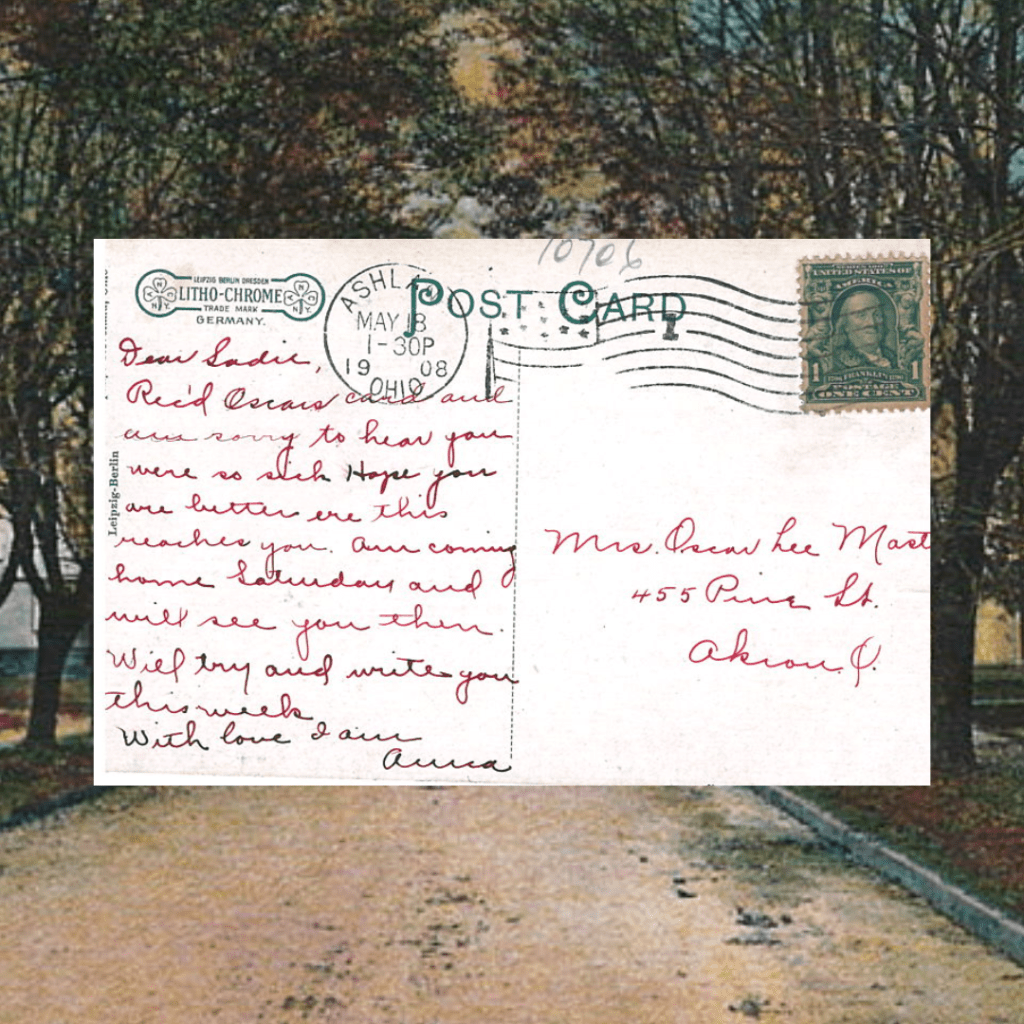
To: Mrs. Oscar Lee Masters, From: Anna 1908
Dear Sadie,
Rec’d Oscars card and am sorry to hear you were so sick. Hope you are better ere this reaches you. Am coming home Saturday and will see you then. Weill try and write you this week. With love,
I am,
Anna
In 1908, Teddy Roosevelt was president, the ball dropped in Times Square for the first time, and Henry Ford launched the Model T, pricing the car at $850. The Progressives were in power, and despite their work dismantling monopolies and establishing national parks — they also came from a strict moral backdrop. “Reform” often came from religious motivations.
There are two things I find especially unique about this postcard. The first is that it seems to have been written in red ink. Now, I did not expect my research to lead me down an ink-enthusiast rabbit hole…but this did. Why? Because I wasn’t sure if the ink used started out black, and dried red over the century+ it’s been exposed to air, or, if it could have been written in actual red ink. Spoiler…I still don’t know. I found an advertisement in 1908 for a red inked fountain pen…perhaps that’s what Anna had? On the physical postcard the ink is a vibrant red–not rusted or brown. So, I lean toward the thought that it was written in red ink. If this is the case…it’s a style choice by Anna that I sort of love.
The second think I find unique about this postcard is that Anna uses Sadie’s name. In a time where so many women’s names hid underneath their husbands, here we have a situation where Anna specifically addresses the letter as “Dear Sadie.” If you’ve followed along with me for a while, you’ll know this actually rarely happens. Once a woman is married, it’s almost like her name totally disappears from the record. This is from the laws of “coverture” in which a woman is literally “covered” by her husband. So, not only did Anna defy convention by using black ink, she provided us with Sadie’s name.
So, starting out my research I felt I was already in a good position. I had a date, a place, and two names: Oscar Lee Masters (or master) and Sadie Master(s). It felt easy.
That was my first mistake.
I got lucky with my postcard yesterday, but today I had no luck at all. There were a few hits on Oscar Masters, but none that showed me his wife or family. I had nearly nothing on Sadie Masters…this tells me Sadie was probably a nickname for something (maybe Saundra?).
Here’s what I suspect: Anna was likely a sister or maybe a close cousin, and a flamboyant one at that. I’d like to think she was like one of the Aunt’s in Practical Magic. Of course, I don’t know for sure. But her use of the red pen has me thinking that she was definitely someone who stood out in a crowd. As for Sadie, I hope she felt better by the time Anna arrived. I imagine the two of them strolling down a spring street arm and arm catching up on life.

Center Street, Ashland, Ohio
 Hipstory